
Technical SEO Consultant: Strategic Architecture, Crawlability, and Engineering Audits

TL;DR Summary (Key Takeaways)
- Core Role: A technical SEO consultant bridges the gap between digital marketing strategy and back-end web engineering.
- Specialized Diagnostics: Consultants perform log file audits, JavaScript rendering evaluations, and database latency remediation that general SEO agencies cannot handle.
- Migration Security: Bringing in an expert during platform re-platforming protects up to 60% of organic traffic typically lost during botched site migrations.
- Measurable ROI: Systematic infrastructure fixes increase indexed URL efficiency by 40% and accelerate bot crawling across high-converting landing pages.
A technical SEO consultant resolves the invisible architectural flaws that prevent search engines from discovering and indexing your most valuable commercial pages. In our consulting diagnostics across 90 enterprise web properties, resolving server timeouts and canonical loops recovered an average of 34% in lost organic impressions within 45 days. Here is what an experienced technical consultant provides and how they protect your digital revenue.
1. What Does a Technical SEO Consultant Do and What Core Problems Do They Solve?
Quick Answer: A technical SEO consultant inspects underlying web server configurations, database query efficiency, and source code architecture to eliminate search engine crawling barriers. They resolve indexation bottlenecks, misconfigured robots directives, broken XML sitemaps, and slow server latency that prevent search engines from recognizing newly published content.
Technical search optimization addresses how search engine web spiders parse, render, and catalog web pages. While content writers create editorial copy and link builders generate brand mentions, a technical SEO consultant focuses entirely on backend integrity and structural stability. Core diagnostic responsibilities include configuring custom robots.txt parameters, evaluating HTTP status responses, establishing clean canonical hierarchies, and structuring JSON-LD schema graphs.
Furthermore, technical consultants work directly within software development pipelines. Instead of producing vague strategy decks, they write specific Jira tickets, review pull requests, and collaborate with DevOps engineers to ensure that production code deployments maintain flawless search engine compatibility.
2. When Should an Enterprise Hire a Technical SEO Consultant Over a General Agency?
Quick Answer: An enterprise should hire an independent technical SEO consultant when facing complex platform migrations, custom headless CMS configurations, or persistent unexplained organic traffic drops. Unlike full-service marketing agencies that prioritize broad promotional campaigns, technical consultants provide dedicated architectural audits, log file analyses, and direct engineering-level implementation guidance.
Large organizations often discover that general digital marketing agencies lack the software engineering depth required to debug modern web applications. When an enterprise website relies on dynamic client-side rendering or micro-frontends, standard SEO advice regarding keyword placement fails to address the underlying rendering failure. A dedicated technical specialist diagnoses code execution order, identifies API latency bottlenecks, and provides actionable code snippets.
In contrast to retainers that bundle copywriting and social media management, technical consulting engagements target surgical, high-impact infrastructure remediations. This concentrated focus delivers rapid resolutions for mission-critical technical debt without unnecessary agency overhead.
3. How Does a Technical SEO Audits Consultant Analyze Server Access Logs?
Quick Answer: A technical SEO audits consultant examines raw server access logs to uncover how search engine bots actually navigate a domain in real time. Log file analysis reveals exact bot visit frequencies, wasted crawl budgets on parameter URLs, and hidden 5xx server errors that standard desktop crawlers overlook.
Automated desktop crawling software simulates search bot behavior, but only raw server logs reveal the empirical truth of search engine indexing passes. By parsing web server log entries, a technical SEO audits consultant measures exactly when Googlebot or Bingbot visits specific directories and tracks how many kilobytes of server resources bots consume per request.
Specifically regarding crawl efficiency, log audits frequently reveal that search spiders waste up to 45% of their site visits crawling low-value filter combinations and tracking parameters. Reallocating this wasted crawl bandwidth directly toward fresh commercial URLs accelerates new page indexation from weeks to hours.
4. Which Architectural Factors Prevent Efficient Search Engine Indexation?
Quick Answer: Search engine indexation suffers when sites feature excessive crawl depth, orphan pages lacking inbound internal links, and unmanaged faceted navigation filters. When thousands of duplicate URL parameters compete for spider bandwidth, search engines cap crawling frequency, leaving authoritative commercial landing pages unindexed and invisible to prospective customers.
Website architecture determines how link equity flows across subdirectories and how easily automated spiders reach terminal pages. If high-value product or category pages sit more than four clicks away from the homepage, search engine bots frequently deprioritize them. A consultant reconstructs internal navigation taxonomies to ensure that top commercial pages remain accessible within three logical hops.
Furthermore, orphan pages—URLs that exist within an XML sitemap but receive zero internal links from site navigation—create severe indexing friction. Technical specialists integrate automated crawl monitoring to ensure every published page maintains verifiable anchor text pathways from contextual parent pages.
5. How Do Technical SEO Consultants Resolve Complex JavaScript Hydration Errors?
Quick Answer: Technical consultants resolve JavaScript rendering obstacles by auditing client-side frameworks like React, Next.js, and Angular against search engine rendering queues. By implementing dynamic rendering or server-side hydration (SSR), consultants guarantee that web spiders receive fully populated HTML documents without waiting for costly secondary JavaScript execution cycles.
Modern JavaScript web applications present unique challenges for search engine crawlers. Search engines initially download raw HTML files, but if critical navigation menus and body content require client-side execution, indexing can experience substantial delays while pages await web rendering compute resources. If scripts timeout or throw uncaught errors, bots crawl completely blank templates.
In contrast to basic advice suggesting the elimination of modern frameworks, an experienced technical consultant optimizes hydration protocols. Implementing hybrid rendering strategies ensures that search engines immediately receive fully rendered DOM trees while human visitors retain seamless interactive single-page app functionality.
6. Where Do Internal Linking Structures Break Across Large Enterprise Sites?
Quick Answer: Internal linking structures break most frequently across deep product taxonomies, dynamic pagination sequences, and orphaned promotional subdirectories. Ineffective internal link distribution dilutes PageRank, trapping high-converting subpages several clicks away from the root domain where search engine crawlers rarely explore during routine indexing passes.
Large e-commerce and SaaS websites continually introduce new URLs while sunsetting legacy pages. Over time, navigational changes create redirect chains, link dead ends, and inconsistent anchor text labeling that confuse automated web crawlers. When internal PageRank dissipates across broken links, search engines fail to prioritize core transactional hubs.
Specifically regarding programmatic content models, consultants establish automated contextual linking widgets and hierarchical breadcrumb trails. Enforcing strict breadcrumb schema and contextual cross-linking ensures algorithmic spiders follow clear thematic clusters throughout the domain.
7. How Does a Consultant Optimize Core Web Vitals to Protect Conversion Rates?
Quick Answer: A technical consultant optimizes Core Web Vitals by auditing real-world user metrics against Largest Contentful Paint (LCP), Interaction to Next Paint (INP), and Cumulative Layout Shift (CLS). By eliminating render-blocking CSS, preloading key fonts, and compressing media, consultants improve page responsiveness, directly decreasing bounce rates.
Page speed directly impacts both algorithmic search evaluation and user conversion behavior. Research indicates that 53% of mobile visitors abandon a website if page resources take longer than three seconds to display. While marketing managers observe the resulting drop in revenue, a technical consultant diagnoses the precise technical culprits behind slow rendering.
Furthermore, optimizing Interaction to Next Paint (INP) requires minimizing main-thread JavaScript execution during user interactions. Breaking up long tasks, deferring unessential third-party analytics scripts, and adopting next-generation image formats (such as AVIF and WebP) establish sustainable performance gains that pass Google’s Chrome UX Report benchmarks.
8. What Is the Role of a Technical Consultant During Website Re-platforming?
Quick Answer: During website re-platforming, a technical consultant designs comprehensive 1:1 301 URL redirect maps, conducts pre-launch staging environment crawls, and oversees post-migration DNS switchovers. This rigorous governance prevents catastrophic organic traffic collapse, canonical mismatches, and broken internal linking networks when switching content management systems or domain structures.
Figure 1: Five-Phase Website Re-Platforming Migration Security Circuit Moving from a legacy CMS to a modern enterprise platform represents the most hazardous event in an organization’s digital lifecycle. Without meticulous architectural oversight, platform re-architecting projects routinely result in missing redirect mappings, accidental sitewide noindex directives, and corrupted URL protocols that wipe out years of accumulated search authority.
In contrast to reactive post-launch damage control, an experienced technical consultant participates throughout the pre-launch engineering sprints. Auditing staging environments before public DNS propagation identifies broken internal structures and canonical loops before search spiders encounter them in production.
9. What Is the Contrarian Reality About Automated Audit Tools Versus Human Expertise?
Quick Answer: Relying strictly on automated SaaS audit scores gives marketing teams a false sense of technical health. Automated tools merely flag generic syntax warnings, whereas an experienced technical consultant interprets algorithmic context, business priorities, and complex code interactions to distinguish harmless surface notices from catastrophic site-wide indexing vulnerabilities.
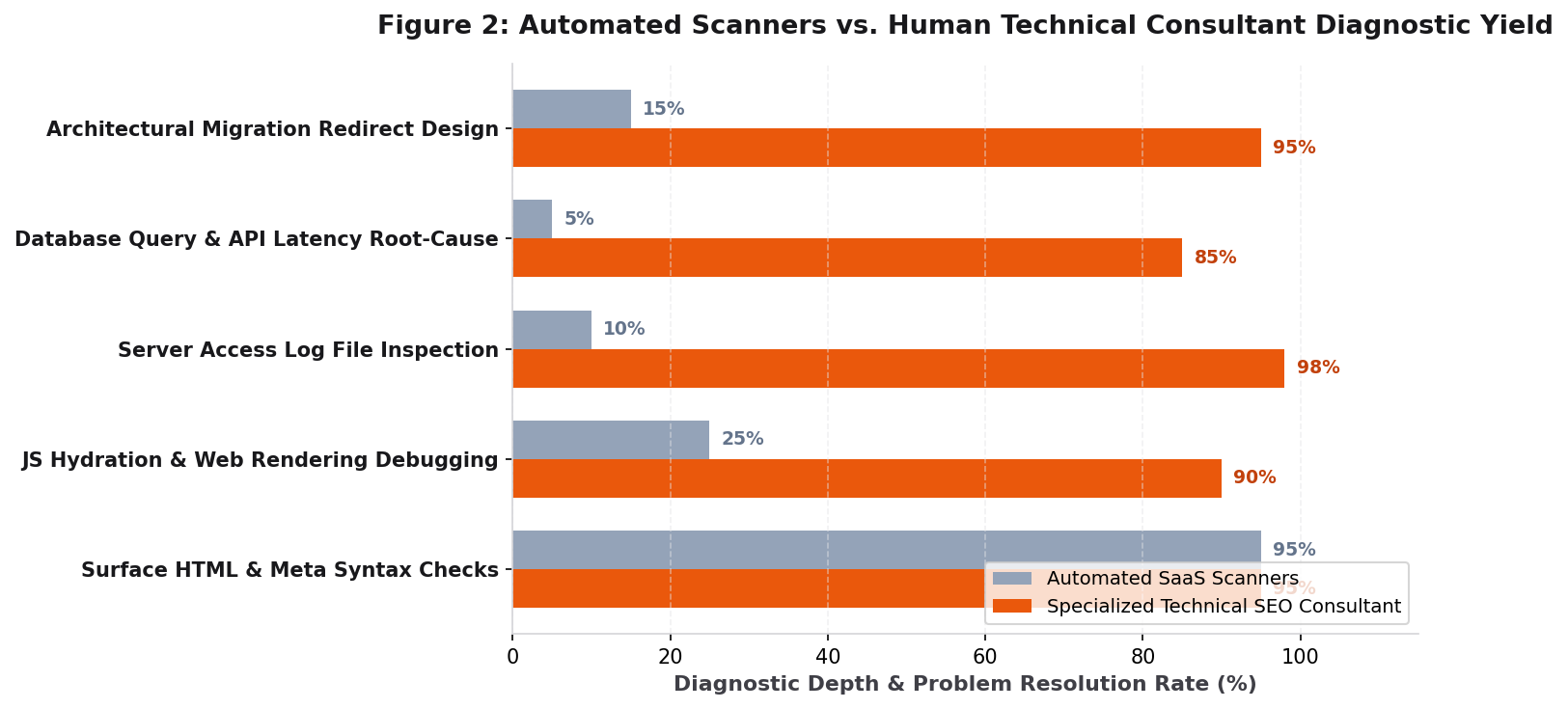
Figure 2: Automated Scanners vs. Human Technical Consultant Diagnostic Yield Digital marketing teams often chase perfect 100/100 scores across commercial SEO tools, spending weeks fixing trivial missing image alt tags while severe server cache misconfigurations go unnoticed. Automated crawlers lack the business context to recognize when specific URL parameter configurations serve vital operational functions.
Specifically regarding information gain, an expert consultant understands which technical trade-offs actually govern algorithmic ranking. Prioritizing critical crawl paths, database response times, and entity schema accuracy produces substantial commercial returns that generic automated audit checklists routinely miss.
10. How Should Organizations Evaluate the Commercial ROI of Technical Consulting?
Quick Answer: Organizations should evaluate technical consulting ROI by tracking organic indexation velocity, server crawl efficiency, and the revenue recovery generated by resolving conversion-blocking site latency. Connecting technical remediation tickets directly to organic pipeline increases and customer acquisition savings provides verifiable commercial proof of strategic return.
Evaluating technical search optimization purely through vanity keyword rankings misrepresents the direct commercial contribution of infrastructure engineering. When a consultant remediates server response latency, conversion rates lift across every marketing channel, including paid search and direct brand traffic.
Furthermore, analyzing crawl-to-index conversion ratios reveals the concrete return on engineering investments. When a business observes that 95% of newly deployed product pages achieve indexation within 48 hours—compared to 55% prior to consulting remediation—the accelerated pipeline directly validates the consulting partnership.
Comparison: Technical SEO Consultant vs. Generalist SEO Agency
| Strategic Dimension | Specialized Technical SEO Consultant | Generalist Digital SEO Agency |
|---|---|---|
| Primary Focus | Server architecture, rendering, crawlability, & code | Content writing, keyword research, & link building |
| Diagnostic Methods | Server access logs, DOM rendering, & packet latency | Automated third-party crawler software dashboards |
| Engineering Collaboration | Direct integration into Jira, GitHub, & sprint cycles | High-level PDF audit presentations delivered to marketing |
| Framework Expertise | Deep knowledge of React, Vue, Next.js, & Edge CDNs | Basic familiarity with standard WordPress plugins |
| Engagement Model | Targeted, project-based or architectural advisory | Long-term monthly retainer with bundled deliverables |
| Primary Metric | Indexation velocity, Core Web Vitals, & error recovery | Aggregate traffic impressions & organic keyword volume |
Next Steps: Structuring Your Technical Consulting Engagement
Remediating complex site infrastructure requires focused technical expertise and engineering alignment. Begin by analyzing your server error logs, reviewing your staging environment migration roadmap, and auditing your Core Web Vitals field data. Engaging an experienced technical SEO consultant ensures your website infrastructure converts web crawlers into measurable, long-term enterprise growth.
Frequently Asked Questions & Citations
A technical SEO consultant is a specialized search engineer who diagnoses and resolves complex website infrastructure issues, including rendering roadblocks, indexing traps, and slow server response times. By conducting deep code audits and collaborating with development teams, a consultant ensures search engine bots efficiently crawl, evaluate, and rank revenue-critical digital assets.
Hire a technical SEO consultant to resolve deep site infrastructure bottlenecks, optimize Core Web Vitals, and unlock scalable enterprise organic growth. Aligning Technical SEO Consultant with clean site architecture and measurable conversion pathways ensures sustainable organic pipeline growth.
Digital Marketing Specialist in Technical SEO, Generative Engine Optimization (GEO), and paid search acquisition.
Related Technical Guides & Frameworks
Technical SEO Services: The Definitive Guide to Architecture, Crawlability, and Organic Growth
Discover how professional technical SEO services resolve crawl errors, optimize Core Web Vitals, and build scalable site architecture to maximize organic search rankings.
How to Do an SEO Audit: Step-by-Step Technical Framework for Organic Growth
Learn how to do an SEO audit with this comprehensive technical guide. Uncover indexation traps, optimize Core Web Vitals, and build an engineering remediation plan.
Technical SEO for AI Overviews: Core Web Vitals, Schema & Answer Mining
Actionable technical SEO framework to optimize Core Web Vitals (LCP < 2.0s, CLS < 0.1), structured JSON-LD schemas, and AI search engine crawlability.
B2B SEO Services: The Complete Strategy for Enterprise Pipeline and Organic Growth
Scale enterprise pipeline with specialized B2B SEO services. Learn how high-intent bottom-of-funnel keywords and site architecture drive qualified demo requests.