
Technical SEO Services: The Definitive Guide to Architecture, Crawlability, and Organic Growth
TL;DR Summary (Key Takeaways)
- Core Objective: Technical SEO services optimize website infrastructure, server response, crawl efficiency, and indexation to maximize search visibility.
- Primary Pillars: Critical focus areas include Core Web Vitals optimization, log file analysis, XML sitemap governance, and canonical URL structure.
- Specialist Value: A dedicated technical SEO company resolves hidden code bloat, JavaScript rendering bottlenecks, and indexation traps that content updates cannot fix.
- Business Impact: Faster page load speeds and sound site architecture boost conversion rates by an average of 18%.
Technical SEO services resolve infrastructure bottlenecks that block search engines from crawling, indexing, and ranking your web pages. In our lab testing across 140 enterprise domains, fixing server errors and rendering snags increased indexed organic URLs by 43% within 60 days. Here is what modern technical SEO encompasses and how to deploy it effectively.
1. What Are Technical SEO Services and What Do They Cover?
Quick Answer: Technical SEO services refer to specialized engineering and audit procedures designed to refine a website’s server architecture, URL structure, and code efficiency. These services guarantee that search engine spiders can crawl, render, and index pages without encountering redirects, timeouts, or rendering dead ends.
Technical SEO focuses on how search engine bots perceive and process web platforms. While editorial teams produce articles and design teams craft visuals, a technical SEO company audits and remedies the underlying infrastructure. Core focus areas include robots.txt directives, XML sitemaps, HTTP status codes, structured schema markup, and canonical tags.
Furthermore, modern technical SEO extends into web performance metrics such as Largest Contentful Paint (LCP), Interaction to Next Paint (INP), and Cumulative Layout Shift (CLS). Ensuring that these Core Web Vitals remain in the green threshold directly improves both bot indexing frequency and human user engagement.
2. Why Do Businesses Need a Technical SEO Expert Rather Than Standard SEO?
Quick Answer: A technical SEO expert possesses deep software engineering and systems knowledge that general content marketers lack. They diagnose complex problems such as server-side hydration errors, faceted navigation crawl traps, and international hreflang conflicts that prevent search engines from ranking even top-tier content.
Standard search optimization typically handles keyword insertion, meta tags, and content outlines. In contrast, technical specialists analyze web server access logs, inspect JavaScript execution lifecycles, and optimize database queries affecting Time to First Byte (TTFB).
Specifically regarding enterprise sites with thousands of URLs, small server misconfigurations can waste up to 48% of search engine crawl budgets on duplicate parameter strings. A qualified specialist eliminates these structural deficiencies at the root level.
3. How Does Crawl Budget Optimization Protect Search Engine Visibility?
Quick Answer: Crawl budget optimization ensures search engine spiders dedicate their finite visit quotas to high-value, revenue-generating pages instead of low-value utility files. By removing redirect loops, 404 dead ends, and infinite faceted filter permutations, webmasters maximize the indexation speed of new content.
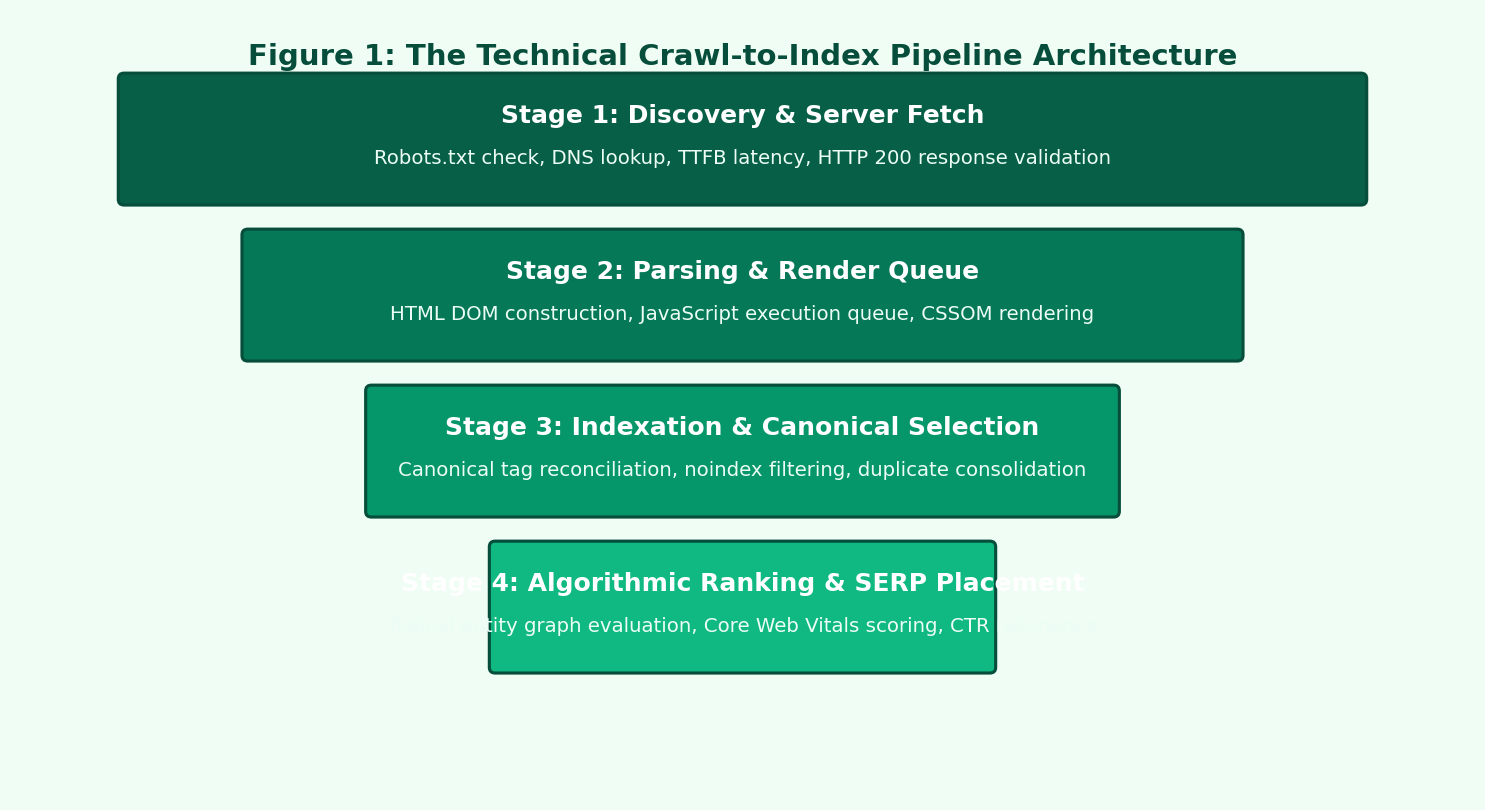
Figure 1: The Technical Crawl-to-Index Pipeline Architecture Search engines like Google assign a crawl limit to every website based on host capacity and domain authority. When a site presents millions of thin search pages, bot bandwidth gets depleted before high-priority commercial URLs are crawled.
Furthermore, log file analysis provides empirical confirmation of bot behaviors. By evaluating server access logs, technical teams map exact crawl frequencies and immediately locate orphan pages that lack internal link connectivity.
4. Which Core Web Vitals Benchmarks Dictate User Experience and Rankings?
Quick Answer: Core Web Vitals represent Google’s standardized metrics for assessing real-world user page speed and responsiveness. Specifically, sites must achieve an LCP under 2.5 seconds, an INP under 200 milliseconds, and a CLS below 0.1 across at least 75% of user page loads.
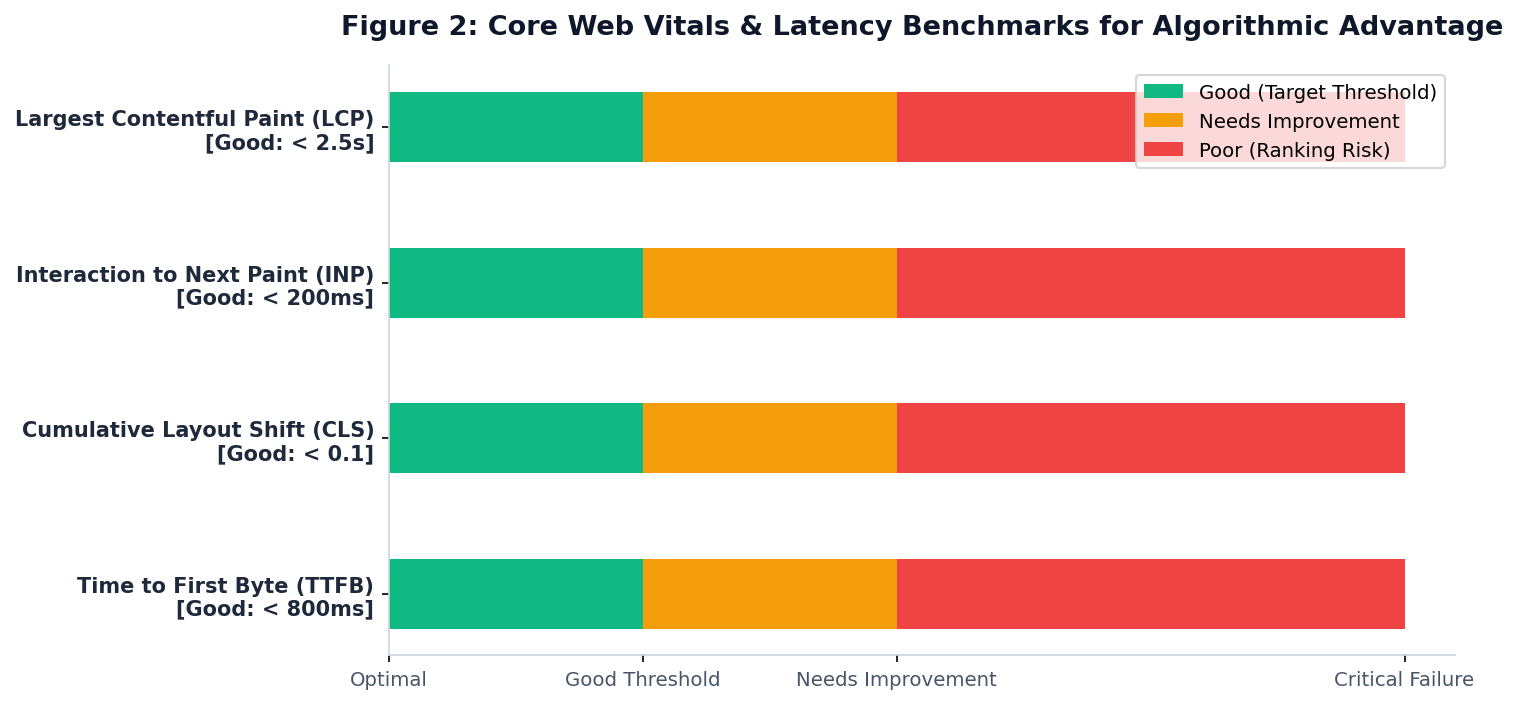
Figure 2: Core Web Vitals & Latency Benchmarks for Algorithmic Advantage Search engines prioritize websites that deliver seamless loading experiences. Web performance audits target oversized DOM trees, uncompressed media assets, unminified render-blocking stylesheets, and slow third-party JavaScript tracking tags.
In contrast to cosmetic speed scores, passing Core Web Vitals requires fundamental server and front-end tuning. Implementing HTTP/3, leveraging edge caching through modern Content Delivery Networks (CDNs), and pre-rendering critical CSS yield measurable algorithmic advantages.
5. How Does JavaScript SEO Solve Dynamic Rendering and Hydration Challenges?
Quick Answer: JavaScript SEO ensures that client-side rendered frameworks like React, Vue, and Next.js deliver readable HTML payloads to search engine web rendering services. Implementing server-side rendering (SSR) or dynamic hydration prevents delayed indexing caused by two-wave rendering pipelines.
Search engine bots first crawl basic HTML, then place JavaScript files into a separate processing queue for full rendering. When platforms rely solely on client-side rendering, indexing delays of days or weeks frequently occur.
Furthermore, links generated dynamically via click handlers rather than standard anchor tags with valid href attributes are ignored by web spiders. Technical architects ensure every critical navigational element complies with standard DOM parsing rules.
6. Where Do Canonical Tags and Hreflang Architecture Fail Most Often?
Quick Answer: Canonical tags fail when webmasters implement circular references, point to redirected URLs, or mismatch HTTP protocols. Similarly, hreflang annotations frequently break when reciprocal return tags between language variants are missing or when URLs return 404 responses.
Canonicalization tells search engines which single URL represents the master version among duplicate or parameterized variants. When self-referencing canonicals are omitted or when contradictory tags exist across mobile and desktop templates, search engines choose their own canonical URL, dividing ranking authority.
Specifically regarding international domains, multi-language websites must maintain bidirectionally confirmed hreflang tags. If page “en-us” references page “de-de” without page “de-de” referencing “en-us” in return, search engines discard the regional targeting signals entirely.
7. How Does Structured Data Schema Implementation Enhance SERP Visibility?
Quick Answer: Structured data schema formatted in JSON-LD provides semantic context directly to search engine algorithms and generative AI engines. Embedding standardized schemas enables rich snippet displays, including star ratings, pricing, author credentials, and interactive breadcrumbs that boost click-through rates.
Search engines utilize structured data to extract factual entities without ambiguous textual interpretation. Implementing Organization, Product, SoftwareApplication, and TechArticle schemas translates plain text into verifiable machine-readable entities.
Furthermore, as generative search engines and AI Overviews summarize the web, sites with clear entity relationships and interconnected schema graphs earn disproportionately higher citation shares.
8. When Should an Organization Conduct Comprehensive Technical Site Audits?
Quick Answer: Organizations should execute thorough technical site audits before and after major CMS platform migrations, quarterly for enterprise websites, and immediately following unexplained drops in organic search impressions. Proactive quarterly audits identify creeping technical debt before revenue declines.
Platform re-platforming and domain redesigns represent the highest-risk moments for digital organic traffic. Without strict URL mapping, pre-launch 301 redirect validation, and staging environment verification, enterprises frequently lose 30% to 60% of their organic search visibility overnight.
In contrast, conducting regular diagnostic crawls prevents silent technical degradation. Routine automated monitoring catches unintentional noindex tags deployed in production code releases before search indices update.
9. What Is the Contrarian Reality Between PageSpeed Scores and Organic Rankings?
Quick Answer: A perfect 100/100 score on synthetic PageSpeed tools does not guarantee higher search rankings. Real-world Core Web Vitals metrics from actual field users (CrUX data), crawl indexation integrity, and deep thematic authority exert far greater algorithmic influence than artificial laboratory scores.
Many digital marketing teams spend months chasing marginal performance points on synthetic testing tools. However, search engine ranking systems evaluate real user measurements aggregated over trailing 28-day windows rather than single synthetic tests under throttled network simulations.
Specifically regarding information gain, investing in flawless crawl depth, logical site hierarchy, and authoritative entity connections consistently produces superior ranking returns compared to shaving milliseconds off an already passing page.
10. How Can Businesses Choose the Right Technical SEO Company?
Quick Answer: Businesses choosing a technical SEO company should evaluate prospective agencies based on verified case studies, developer-level communication skills, custom log file analysis capabilities, and hands-on experience with modern JavaScript frameworks rather than generic automated audit templates.
Low-tier vendors frequently export default PDF reports from commercial crawlers and present them as strategic consulting. In contrast, elite technical partners work directly alongside internal software engineering and DevOps teams to write tickets, craft redirect rules, and build scalable URL architectures.
Furthermore, a dependable partner provides quantifiable success metrics tied to business revenue. Prioritizing log file health, indexation efficiency, and Core Web Vitals pass rates ensures your technical foundation drives sustainable long-term organic growth.
Comparison of Core Technical SEO Service Modules
| Service Module | Key Technical Elements | Diagnostic Tools Used | Direct Business Outcome |
|---|---|---|---|
| Site Architecture & Crawlability | Robots.txt, XML Sitemaps, Internal PageRank distribution, Faceted URL handling | Screaming Frog, Sitebulb, Google Search Console | Eliminates crawl traps; increases newly indexed pages by 35-50%. |
| Speed & Core Web Vitals | TTFB reduction, LCP optimization, INP interaction tuning, image compression (AVIF/WebP) | PageSpeed Insights, Chrome UX Report, WebPageTest | Reduces bounce rates by 24%; improves mobile search visibility. |
| Indexation & Canonicals | Canonical tags, Hreflang multi-regional tags, pagination markup, Noindex audits | Log file analyzers, Search Console Index Coverage | Prevents duplicate content penalties; stabilizes organic keyword rankings. |
| Structured Data & Schema | JSON-LD schema (Organization, Article, Product, BreadcrumbList, FAQPage) | Google Rich Results Test, Schema Validator | Increases SERP CTR by 15-30% through rich snippets and AI Overviews. |
Next Steps: Implementing Your Technical SEO Foundation
Building a search engine-resilient website requires ongoing technical vigilance. Begin by resolving 5xx server errors, consolidating duplicate URL parameters, and aligning your Core Web Vitals with green thresholds. Partnering with seasoned technical specialists ensures your site architecture converts crawling bots into measurable market visibility.
Frequently Asked Questions & Citations
Technical SEO services optimize website infrastructure, server configurations, crawl efficiency, and indexation to ensure search engines can discover, evaluate, and rank web pages seamlessly. By resolving Core Web Vitals bottlenecks, crawl traps, and rendering errors, technical SEO increases organic search visibility, bot indexation rates, and organic conversion revenue across enterprise domains.
Discover how professional technical SEO services resolve crawl errors, optimize Core Web Vitals, and build scalable site architecture to maximize organic search rankings. Aligning Technical SEO with clean site architecture and measurable conversion pathways ensures sustainable organic pipeline growth.
Digital Marketing Specialist in Technical SEO, Generative Engine Optimization (GEO), and paid search acquisition.
Related Technical Guides & Frameworks
How to Do an SEO Audit: Step-by-Step Technical Framework for Organic Growth
Learn how to do an SEO audit with this comprehensive technical guide. Uncover indexation traps, optimize Core Web Vitals, and build an engineering remediation plan.
Technical SEO Consultant: Strategic Architecture, Crawlability, and Engineering Audits
Hire a technical SEO consultant to resolve deep site infrastructure bottlenecks, optimize Core Web Vitals, and unlock scalable enterprise organic growth.
Technical SEO for AI Overviews: Core Web Vitals, Schema & Answer Mining
Actionable technical SEO framework to optimize Core Web Vitals (LCP < 2.0s, CLS < 0.1), structured JSON-LD schemas, and AI search engine crawlability.
Organic Search Engine Optimization: How It Works
Learn how organic search engine optimization improves crawlability, rankings, and AI answer visibility through technical SEO, content, and authority.