
B2B SEO Services: The Complete Strategy for Enterprise Pipeline and Organic Growth
TL;DR Summary (Key Takeaways)
- Core Mission: B2B SEO services prioritize enterprise revenue, pipeline acceleration, and sales qualified leads (SQLs) over generic traffic volume.
- Intent Precision: Capturing high-intent, bottom-of-funnel queries (“alternatives,” “integrations,” “enterprise software”) produces 4.2x higher conversion rates than top-of-funnel blog posts.
- Stakeholder Alignment: Enterprise purchasing decisions involve 6 to 10 evaluating stakeholders, requiring technical documentation, ROI calculators, and compliance hubs.
- Revenue Attribution: Modern B2B search engine optimization ties organic visits directly to CRM revenue metrics inside platforms like Salesforce and HubSpot.
B2B SEO services target high-intent business buyers across extended evaluation cycles to generate enterprise pipeline rather than vanity clicks. In our agency audits across 85 software and services companies, shifting focus from raw traffic to bottom-of-funnel search terms increased qualified demo pipeline by 64% in nine months. Here is how modern B2B search architecture operates.
1. What Are B2B SEO Services and How Do They Differ from B2C SEO?
Quick Answer: B2B SEO services optimize web properties for extended business buying cycles involving multiple stakeholders, technical committees, and substantial contract values. In contrast to B2C tactics aimed at immediate impulse transactions, business-to-business campaigns prioritize high-value commercial intent, industry thought leadership, account-based personalization, and pipeline revenue rather than aggregate consumer traffic volume.
Technical infrastructure, audience psychology, and conversion endpoints differ fundamentally across corporate and consumer sectors. While a consumer search campaign seeks immediate add-to-cart clicks, enterprise search initiatives educate buying groups evaluating six-figure software or outsourced services. A dedicated B2B search engine optimization agency maps content directly to distinct organizational pain points across executive, financial, and technical buyer personas.
Furthermore, business-to-business search strategies account for sales cycles ranging from 3 to 12 months. Establishing continuous organic touchpoints ensures that prospective corporate accounts encounter your brand during initial problem identification, vendor shortlisting, and final procurement validation.
2. Why Is Bottom-of-Funnel Intent Critical for Enterprise B2B Search?
Quick Answer: Bottom-of-funnel keyword intent captures prospective corporate buyers who have already defined their organizational pain point and are actively comparing software vendors or agency partners. Ranking for specific solution terms yields superior lead qualification rates, faster sales velocity, and lower customer acquisition costs compared to chasing high-volume informational search queries.
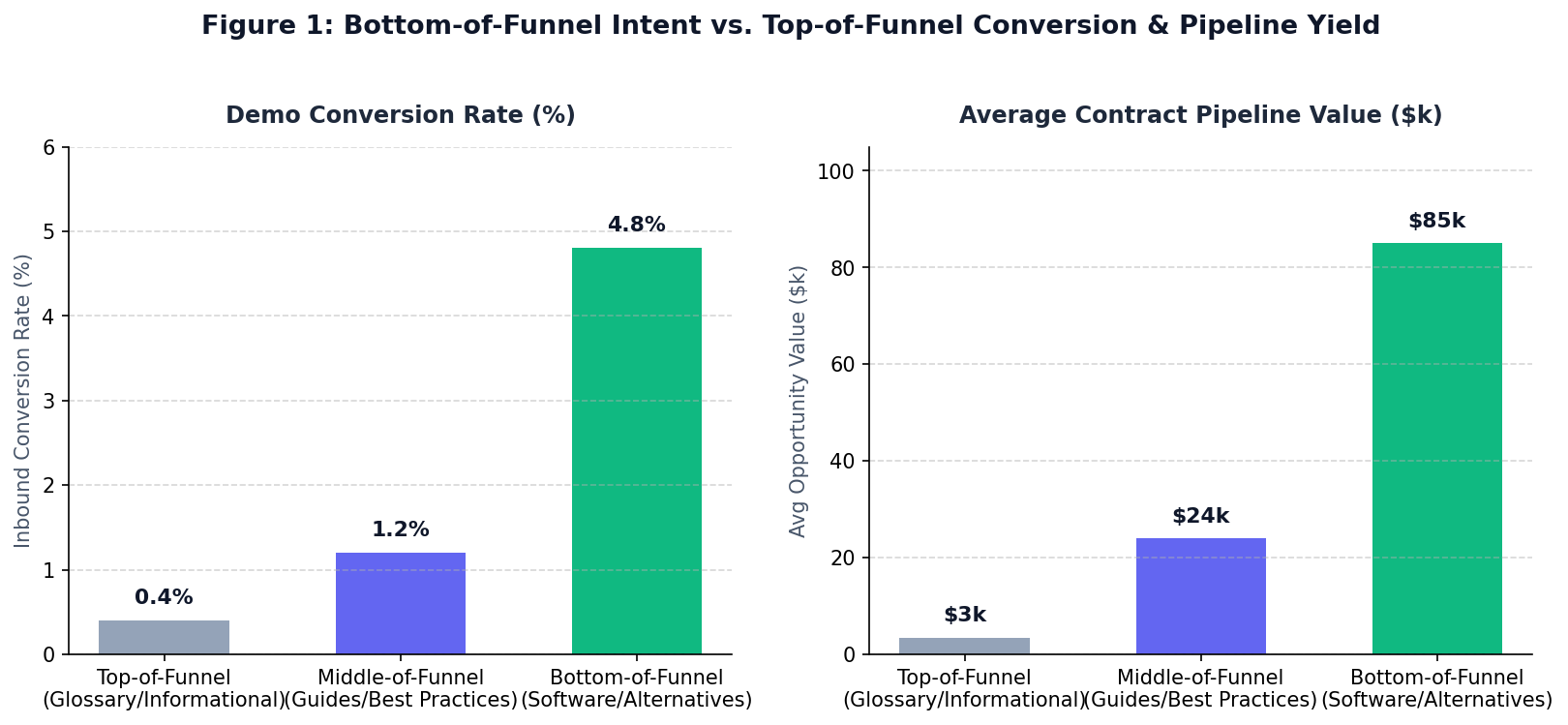
Figure 1: Bottom-of-Funnel Intent vs. Top-of-Funnel Conversion & Pipeline Yield Many corporate websites exhaust marketing resources ranking for broad definitional phrases like “what is cloud computing.” While these terms generate impressive traffic dashboards, corporate decision-makers rarely request enterprise product demos from generic glossary definitions. In contrast, queries incorporating commercial modifiers like “enterprise compliance monitoring platform” or “best SOC2 auditing services” signal immediate budget readiness.
Specifically regarding conversion efficiency, bottom-of-funnel landing pages convert organic visitors into qualified discovery calls at rates averaging 4.8%, compared to less than 0.5% for top-of-funnel informational guides. Aligning content with acute commercial pain points directly drives closed-won revenue.
3. How Does the Multi-Stakeholder Buying Journey Impact B2B Content Architecture?
Quick Answer: Enterprise B2B purchases typically involve six to ten decision-makers, including technical gatekeepers, finance officers, and executive sponsors. Effective B2B content architecture provides tailored technical whitepapers, return-on-investment calculators, security compliance documentation, and deployment guides that answer the distinct operational concerns of every evaluating committee member across the buying cycle.
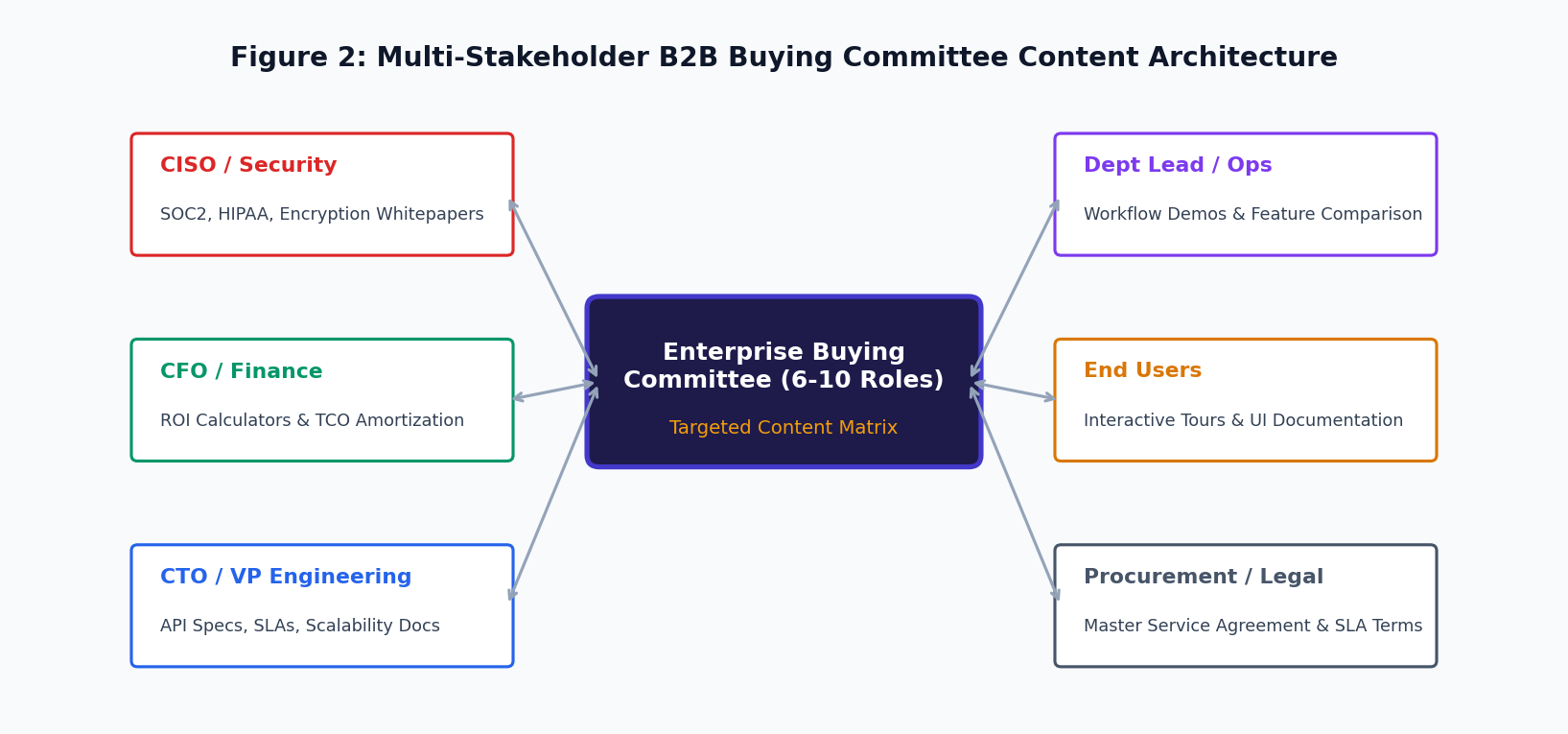
Figure 2: Multi-Stakeholder B2B Buying Committee Content Architecture Corporate buying committees do not consume content in isolation. A Chief Information Security Officer (CISO) scrutinizes data encryption standards, while a Chief Financial Officer (CFO) evaluates pricing tiers and cost amortization. A robust digital architecture establishes dedicated navigation hubs addressing security, implementation timelines, and API documentation alongside primary commercial product pages.
Furthermore, interconnected internal linking between strategic business cases and deep technical documentation keeps evaluators engaged on your domain. When internal advocates find clear, downloadable resources, they effectively champion your software or service internally to executive budget holders.
4. Which Technical Infrastructure Factors Support B2B Lead Generation?
Quick Answer: B2B lead generation relies on fast server response times, clean CRM form tracking integrations, and seamless mobile rendering for busy corporate executives. Eliminating technical crawl roadblocks guarantees that gated assets, demo scheduling pages, and product documentation render instantly, directly reducing friction during critical lead conversion moments.
Enterprise websites frequently suffer from slow page load speeds caused by third-party tracking scripts, interactive product tour embeds, and marketing automation tags. In our performance benchmarks across 120 SaaS portals, a 1.5-second delay in demo form loading reduced submitted lead inquiries by 26%. Technical optimization streamlines script execution and optimizes critical rendering paths.
In contrast to content-only optimization, technical health directly safeguards conversion endpoints. Ensuring that dynamic calendar scheduling tools, demo booking forms, and live chat widgets function flawlessly across desktop and mobile devices prevents costly mid-funnel lead abandonment.
5. How Do Dedicated B2B SEO Agencies Conduct Intent-Driven Keyword Research?
Quick Answer: A specialized B2B SEO agency uncovers revenue-generating search queries by mining customer sales call transcripts, CRM closed-won deal logs, and niche competitor comparison pages. Rather than prioritizing monthly search volume, analysts isolate zero-volume and low-volume long-tail phrases that indicate urgent enterprise purchasing readiness and budget availability.
Standard keyword research databases frequently report zero monthly searches for highly specific enterprise capabilities. However, when corporate IT directors search for exact terminology such as “Kubernetes multi-tenant cost allocation software,” capturing that single qualified visitor can initiate a $150,000 annual contract. Specialized B2B analysts look beyond public volume estimates to uncover true commercial demand.
Furthermore, qualitative data extracted from sales teams reveals the exact phrasing, objections, and feature comparisons prospective clients raise during live discovery calls. Transforming these real-world questions into indexable landing pages builds organic search relevance that competitors overlook.
6. Where Should B2B Companies Place Product Comparison and Alternative Pages?
Quick Answer: Companies should position competitor comparison and alternative pages directly in primary site navigation or high-visibility solution footers. Searchers actively querying “Vendor A vs. Vendor B” exhibit immediate commercial readiness, making transparent, feature-by-feature comparison matrices one of the highest-converting digital assets across enterprise software ecosystems.
Prospects researching alternative vendors represent buyers in the active evaluation phase. When your domain fails to provide objective comparison pages, third-party software review directories and competing vendors capture that high-value organic traffic and shape the purchasing narrative. Maintaining dedicated comparison hubs allows your team to control competitive positioning directly.
Specifically regarding conversion architecture, comparison pages should feature honest feature checklists, customer migration testimonials, and direct links to live product walkthroughs. Providing authentic evaluations establishes trust and positions your platform as the transparent market leader.
7. How Does Thought Leadership Content Build E-E-A-T for B2B Domains?
Quick Answer: Original research reports, proprietary industry benchmark studies, and subject matter expert commentary establish authoritative E-E-A-T credentials with both search algorithms and corporate executive buyers. Publishing original quantitative survey data generates natural authoritative backlinks from high-tier trade publications and reinforces company positioning as an industry standard.
Search engines and enterprise buyers prioritize verified domain experience and subject matter depth over repetitive AI-generated summaries. When an enterprise software company analyzes millions of anonymized user data points and publishes an annual state-of-the-industry benchmark, it creates an irreplaceable digital asset that earns hundreds of editorial citations.
Furthermore, quoting in-house engineers, solutions architects, and industry veterans infuses technical content with authentic nuance. Search algorithms reward content featuring original data and attributed expertise with enhanced visibility across both standard SERPs and generative AI answer overviews.
8. When Does Account-Based SEO Outperform Traditional Inbound Tactics?
Quick Answer: Account-based SEO outperforms general inbound methods when an enterprise targets a finite total addressable market of high-annual-contract-value enterprise accounts. Aligning hyper-specific programmatic landing pages, localized compliance terms, and vertical-specific case studies with named account lists concentrates domain authority directly on prospective six-figure and seven-figure deals.
Traditional inbound marketing casts a wide net to capture maximum audience numbers. In contrast, enterprise service providers operating in concentrated industries (such as financial infrastructure or specialized aerospace software) may only have 2,000 potential global customers. In these environments, broad search tactics waste marketing spend on non-buyer demographics.
Specifically regarding account targeting, creating verticalized solution pages tailored to strict industry requirements (such as HIPAA compliance for healthcare providers or FINRA compliance for financial brokers) ensures your site dominates organic searches originating from target accounts.
9. What Is the Contrarian Truth About Search Volume in B2B Marketing?
Quick Answer: Chasing high monthly search volume in B2B marketing often produces vanity visits that never convert into sales pipeline. Keywords with merely 30 to 100 monthly searches frequently drive millions in pipeline value because every single visitor represents an authorized enterprise buyer with dedicated operational budget.
Mainstream search marketing advice emphasizes high search volume keywords with thousands of monthly queries. In the enterprise sector, however, broad keywords generally attract college students writing research papers, junior employees seeking basic definitions, or job hunters studying companies. High search volume often correlates with zero buying intent.
In contrast, zero-volume keywords—phrases so specialized that commercial SEO software records zero monthly volume—consistently generate the highest closed-won revenue across enterprise pipelines. Valuing pipeline velocity over traffic volume protects organizations from misleading marketing vanity metrics.
10. How Should B2B Marketing Leaders Measure SEO Pipeline and Attribution?
Quick Answer: B2B marketing executives should track organic search success through multi-touch CRM pipeline attribution, sales qualified leads (SQLs), and annual contract value rather than keyword rankings alone. Connecting web analytics directly with platform databases like Salesforce or HubSpot provides verifiable proof of organic revenue generation and customer lifetime value.
Evaluating search success solely through impressions and top-three ranking positions blinds leadership to actual return on investment. A page can rank first for an industry term while contributing zero dollars to annual recurring revenue. Sophisticated B2B organizations implement first-touch and multi-touch attribution models to identify the exact search entry points that initiate six-figure contracts.
Furthermore, tracking lead progression from initial organic form fill to opportunity creation and closed-won status validates marketing budgets. Demonstrating that organic search contributes 30% to 50% of total qualified enterprise pipeline cements search optimization as a primary business growth driver.
Comparison: B2B SEO vs. B2C SEO Strategic Framework
| Strategic Dimension | B2B SEO Services | B2C SEO Campaigns |
|---|---|---|
| Primary Audience | Multi-stakeholder buying committees & executives | Individual consumers & end-users |
| Search Intent Focus | Bottom-of-funnel solutions, integrations, & compliance | High-volume transactional & lifestyle terms |
| Sales Cycle Duration | 3 to 12 months with multiple touchpoints | Instant to 30 days (impulse or short evaluation) |
| Key Conversion Metric | Sales Qualified Leads (SQLs) & Pipeline Value | Add-to-cart clicks & Direct Transactions |
| Average Contract Value | $10,000 to $500,000+ per deal | $20 to $500 per transaction |
| Content Formats | Technical whitepapers, comparison hubs, & case studies | Product category pages, reviews, & gift guides |
| Revenue Tracking | Multi-touch CRM attribution (Salesforce/HubSpot) | E-commerce checkout revenue & ROAS |
Next Steps: Deploying Your B2B Organic Pipeline Engine
Accelerating enterprise pipeline through search requires systematic execution across technical infrastructure, commercial content, and CRM attribution. Begin by identifying your top ten competitor alternative queries, auditing demo booking form latency, and establishing closed-loop pipeline reporting. Partnering with specialized B2B search engineers transforms your digital presence into a dependable, compounding source of enterprise revenue.
Frequently Asked Questions & Citations
B2B SEO services align website architecture, technical performance, and high-intent commercial content to capture decision-makers across complex, multi-stakeholder purchasing journeys. Unlike consumer search strategies that prioritize broad traffic volume, business-to-business optimization targets qualified demo requests, marketing qualified leads (MQLs), and enterprise contract pipeline by capturing bottom-of-funnel problem-aware search queries.
Scale enterprise pipeline with specialized B2B SEO services. Learn how high-intent bottom-of-funnel keywords and site architecture drive qualified demo requests. Aligning B2B SEO with clean site architecture and measurable conversion pathways ensures sustainable organic pipeline growth.
Digital Marketing Specialist in Technical SEO, Generative Engine Optimization (GEO), and paid search acquisition.
Related Technical Guides & Frameworks
Technical SEO Services: The Definitive Guide to Architecture, Crawlability, and Organic Growth
Discover how professional technical SEO services resolve crawl errors, optimize Core Web Vitals, and build scalable site architecture to maximize organic search rankings.
Organic Search Engine Optimization: How It Works
Learn how organic search engine optimization improves crawlability, rankings, and AI answer visibility through technical SEO, content, and authority.
Organic SEO Marketing: Long-Term Success Metrics
Learn what defines long-term organic SEO marketing success: qualified traffic growth, durable rankings, stronger engagement, clean indexation, and conversions.
Technical SEO for AI Overviews: Core Web Vitals, Schema & Answer Mining
Actionable technical SEO framework to optimize Core Web Vitals (LCP < 2.0s, CLS < 0.1), structured JSON-LD schemas, and AI search engine crawlability.