
Organic SEO Marketing: Long-Term Success Metrics
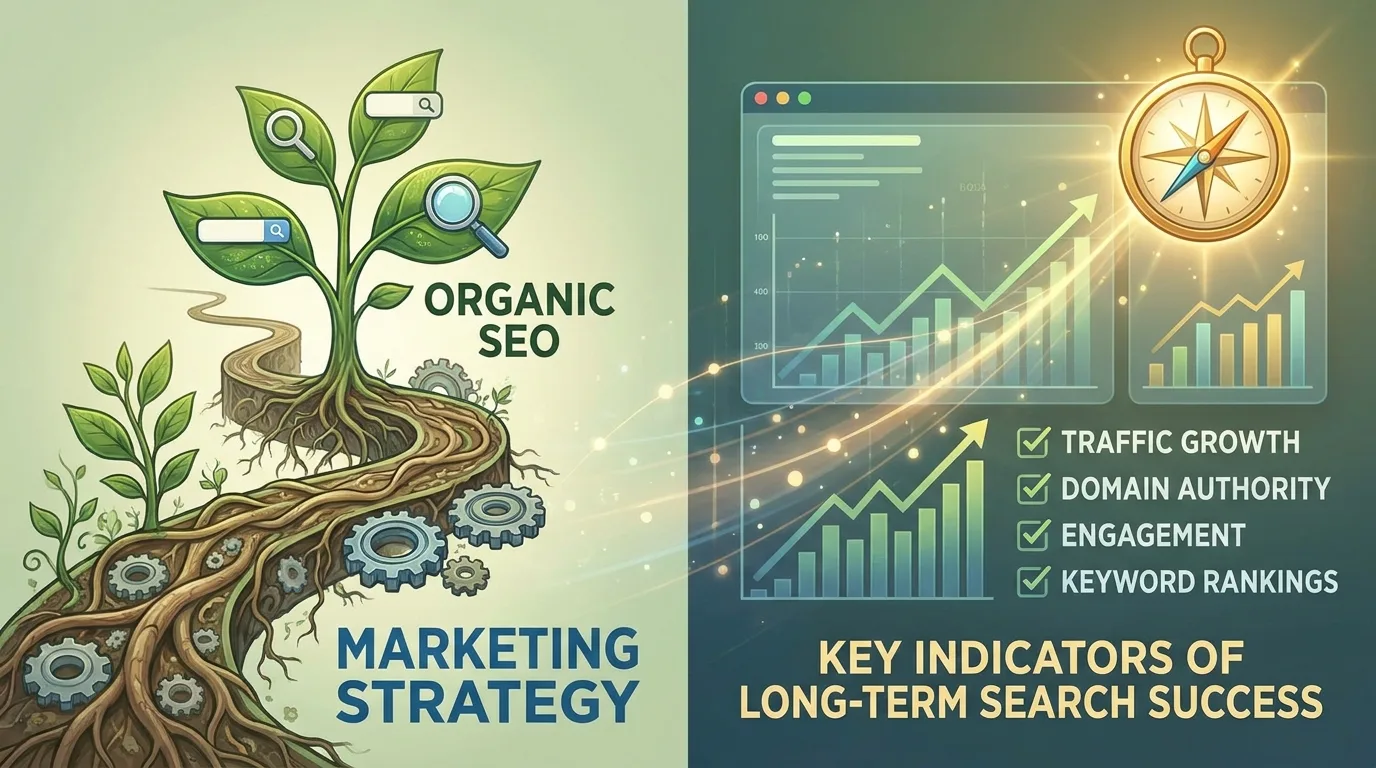
Long-term organic seo marketing success is defined by sustained growth in qualified non-branded traffic, durable keyword visibility, strong engagement and conversion efficiency, healthy crawl and indexation signals, and accumulating authority. Organic search success isn’t a temporary ranking spike; it is a compounding system of relevance, trust, usability, and measurable business contribution.12
Executive Answer: What Defines Long-Term Organic Search Success?
Why organic seo marketing compounds through content, authority, and technical integrity
Long-term organic seo marketing succeeds when search visibility improves across months and quarters, not isolated ranking windows. The strongest programs expand non-branded discovery, increase topic-level authority, improve user-task completion, and maintain technical accessibility for crawling, rendering, indexing, and page experience.13 Sustainable performance emerges when content quality, internal linking, structured information architecture, and external trust signals reinforce one another. That compounding effect increases retrieval relevance for traditional search, while also improving extractability for AI-generated answers and search summaries. In practice, organic search success is measured through trend durability: rising qualified sessions, broader ranking distribution, stronger click efficiency, healthier index coverage, and higher assisted conversions rather than vanity traffic alone.24
Why Organic SEO Marketing Is a Long-Horizon Growth System
Organic seo marketing versus short-term acquisition channels
Organic seo marketing isn’t a single-channel publishing tactic. It is an integrated growth system spanning crawlable architecture, query-intent alignment, information retrieval relevance, content completeness, internal linking, entity clarity, and brand trust. Paid acquisition can generate immediate traffic, but its visibility typically declines when spend is reduced. Organic search, by contrast, compounds when pages continue earning impressions, links, citations, and refreshed relevance over time.
Compounding returns: content durability, link equity, and entity relevance
Compounding occurs through three primary mechanisms. First, durable content assets continue matching recurring demand patterns. Second, link equity and mention signals strengthen page and domain-level authority, improving the probability of broader ranking eligibility.2 Third, entity-rich content helps search systems map a site to topics, subtopics, and commercial intents, increasing topical depth and retrieval confidence. This is especially important for service pages, comparison pages, and high-intent educational assets such as B2B SEO Services.
How GEO and AI Overviews change the definition of visibility
Generative Engine Optimization (GEO) expands the definition of visibility beyond blue-link rankings. A page may influence discovery through AI Overviews, synthesized answers, citation layers, featured snippets, and follow-up query chains even when click volume lags impressions. That shifts optimization toward extractable structure: explicit definitions, scannable hierarchies, evidence-backed claims, schema-supported entities, and clear semantic relationships between concepts. AI answer engines reward content that is easy to parse, summarize, verify, and trust.
“Create helpful, reliable, people-first content” and ensure pages remain accessible to Google’s systems through sound technical implementation. — Google Search Central1
This means long-horizon SEO now requires both ranking performance and answer-engine usability. Visibility is earned through machine-readable clarity, topical authority, and technical integrity.

The Core Indicators That Predict Organic Search Success
Qualified organic traffic growth and non-branded demand capture
The first predictive indicator is qualified organic traffic, especially non-branded sessions landing on pages mapped to informational, commercial, and transactional intent. Raw session growth is weak if it comes from irrelevant queries, poor geographies, or low-conversion pages. Stronger signals include rising engaged sessions, lower intent mismatch, and deeper entry-page diversity across strategic topic clusters.
Keyword visibility, ranking distribution, and SERP feature ownership
Long-term performance is better assessed through ranking breadth than a handful of trophy keywords. Track page-one distribution, top-3 share, topic-cluster visibility, and ownership of SERP features such as snippets, People Also Ask, image packs, and AI citation surfaces. Pair this with CTR SEO analysis to identify where impression growth isn’t converting into clicks.
Engagement quality: CTR, dwell signals, return visits, and task completion
Engagement quality validates whether visibility aligns with user expectations. Useful indicators include organic CTR, engaged session rate, return visitation, scroll depth, assisted micro-conversions, and task completion. While Google doesn’t publish “dwell time” as a direct ranking factor, poor satisfaction patterns often correlate with weak content-query fit and reduced long-term performance.1
Conversion contribution, assisted revenue, and pipeline attribution
SEO should be measured against revenue influence, not rankings alone. Evaluate first-touch conversions, assisted conversions, lead quality, sales-qualified pipeline, and revenue contribution by landing page group. For B2B and long-consideration journeys, organic often creates discovery and mid-funnel trust before final conversion occurs through direct, paid, or sales-assisted channels.
Technical health: crawl efficiency, indexation accuracy, and Core Web Vitals
Technical health determines whether valuable content can be discovered, rendered, indexed, and served efficiently. Core indicators include crawl waste, duplicate URL proliferation, canonical consistency, sitemap hygiene, index coverage quality, and Core Web Vitals thresholds such as LCP, INP, and CLS.3
Authority signals: backlinks, mentions, topical depth, and trust
Authority is broader than backlink count. It includes referring-domain quality, relevant mentions, authoritativeness within a topic graph, citation frequency, and content depth across connected entities. Search systems increasingly evaluate whether a site demonstrates comprehensive topical coverage and reliable sourcing.
| Dimension | Leading Indicators | Lagging Indicators | Why It Matters |
|---|---|---|---|
| Traffic | Non-branded impressions, new query discovery, landing page diversification | Organic sessions, users | Early demand capture often appears before clicks scale |
| Rankings | Top-20 keyword growth, topic-cluster coverage, SERP feature eligibility | Top-3 rankings, share of voice | Ranking breadth predicts future traffic durability |
| CTR | Title relevance, snippet alignment, rich result presence | Organic CTR by page/query | Click efficiency reveals intent match and SERP competitiveness |
| Conversions | Micro-conversions, engaged sessions, return visits | Leads, revenue, pipeline contribution | Early engagement often precedes sales outcomes |
| Technical Health | Crawl stats, renderability, canonical accuracy, CWV trends | Indexed page growth, stable rankings | Technical friction suppresses discoverability and retention |
| Authority | New referring domains, brand mentions, content citations | Domain-level trust, sustained ranking resilience | Authority compounds and improves competitive defensibility |
Audit for strategic SEO outcomes: Align your KPI stack to visibility, engagement, and revenue—not vanity metrics alone. Use Measuring SEO Performance to build a reporting model that connects organic growth to business impact.

How to Build a Measurement Framework for Organic SEO Marketing
Define business objectives before selecting SEO KPIs
A valid SEO measurement framework starts with business objectives, not dashboard convenience. Define whether the primary outcome is lead generation, self-serve revenue, market education, branded demand expansion, or category ownership. KPI selection should then reflect commercial reality: pipeline contribution for B2B, assisted revenue for ecommerce, or activation quality for SaaS.
Map metrics to the funnel: discovery, consideration, conversion, retention
Map metrics across the full search journey. Discovery metrics include impressions, new query acquisition, and non-branded visibility. Consideration metrics include engaged sessions, repeat visitation, resource downloads, and comparison-page interaction. Conversion metrics include form fills, demo requests, purchases, and sales-qualified leads. Retention metrics may include branded return traffic, documentation usage, and customer education engagement. This structure prevents overvaluing top-funnel traffic without downstream evidence.
Separate branded from non-branded performance
Branded and non-branded performance must be segmented. Branded traffic often reflects existing demand, while non-branded growth better indicates market expansion and competitive search capture. Segment further by page type, intent class, geography, and device. In GA4 and Search Console workflows, this segmentation is foundational for trustworthy analysis; see Google Analytics Organic Search for implementation patterns.
Set baselines, benchmarks, and reporting cadences
Establish baselines using at least 3-6 months of historical data where possible, then compare against year-over-year and rolling-period benchmarks to reduce seasonality distortion. Executive reporting should separate leading indicators from lagging outcomes and explicitly note when AI-era visibility rises through impressions, mentions, or answer-surface citations before click growth materializes. This is especially important in GEO programs, where influence may precede traffic.
Traffic Quality Matters More Than Raw Sessions
Why qualified visits outperform volume spikes
High session volume is strategically weak if visitors don’t match the target market, intent stage, or commercial profile. Sustainable organic seo marketing prioritizes qualified visits that demonstrate engagement, progression, and conversion potential. A 15% increase in high-intent organic entries to service or product pages can outperform a 60% spike in low-intent blog traffic with no downstream value.
Landing page intent alignment and query-to-content fit
Traffic quality improves when landing pages precisely match query intent. Informational queries require explanatory depth and evidence. Commercial investigation queries require comparisons, proof points, and objection handling. Transactional queries require fast access to pricing, demos, or purchase paths. Query-to-content fit directly influences CTR, engagement, and conversion efficiency because users can complete their intended task with less friction.
Segmenting by device, geography, page type, and search intent class
Quality analysis should segment performance by device, geography, page type, and intent class. Mobile informational traffic may have lower immediate conversion rates but high assisted value. Region-specific traffic may convert differently due to service availability. Guides, comparison pages, product pages, and documentation each play different roles in the organic funnel. Long-term organic search success comes from understanding which segments produce durable business outcomes, then allocating optimization effort accordingly.4
Visibility Metrics: Rankings, Share of Voice, and AI Retrieval Readiness
Organic SEO marketing should measure visibility beyond keyword rank. Durable organic search success depends on position distribution, SERP feature ownership, entity relevance, and machine-readable answer formatting that improves eligibility for featured snippets, AI Overviews, and citation-style retrieval across search interfaces.
Ranking distribution across top 3, top 10, and top 20 positions
Raw average position conceals commercial reality. A page ranking #2 for a high-intent query contributes materially differently than ten pages ranking #18. In mature organic seo marketing programs, visibility is segmented by position bands: top 3 for click concentration, top 10 for first-page reach, and top 20 for near-page-one optimization priority. This distribution reveals whether growth is driven by true market capture or by low-impact ranking expansion.
Share of voice should be modeled at the query-cluster level, weighted by search demand, conversion intent, and SERP layout. A keyword set dominated by shopping units, video packs, local results, or AI summaries may produce lower organic click opportunity even when nominal rankings improve. Google explicitly advises focusing on search appearance and user usefulness rather than isolated ranking movement.12
SERP feature presence, snippet eligibility, and AI Overview exposure
Search visibility now includes featured snippets, People Also Ask inclusion, rich results, discussion panels, image packs, and AI Overview citation potential. These appearances increase retrieval surface area and strengthen brand recall even when blue-link clicks fragment. Structured headings, concise definitional blocks, list formatting, schema alignment, and direct question-answer passages improve extraction eligibility for both classic SERP features and generative systems.
“Make your pages primarily for people, not for search engines.” — Google Search Central, 20251
That principle doesn’t reduce the need for structure; it elevates it. Helpful content must also be parsable. Search systems and answer engines extract from pages that express clear topical hierarchy, unambiguous entities, and compact answer spans.
Entity coverage, semantic completeness, and answer extraction readiness
AI retrieval readiness is an extension of semantic SEO. Pages should cover the primary entity, adjacent entities, attributes, use cases, constraints, and comparisons with enough completeness to satisfy multi-hop retrieval. This is where organic search success intersects with GEO: content must be both authoritative and extractable.
Practical indicators include entity mention breadth, schema-supported disambiguation, passage-level clarity, and consistent terminology across templates. Pages that define concepts cleanly, support claims with citations, and align internal linking with topic clusters are more likely to be surfaced in generative answers and traditional search features.23
CTR, Engagement, and Behavioral Quality Signals
Organic CTR as a diagnostic metric, not a standalone goal
Organic click-through rate is useful only when normalized by ranking position, brand familiarity, query intent, and SERP obstruction. A 6% CTR at position 7 may outperform expectations; the same CTR at position 1 may indicate weak snippet alignment. This is why organic seo marketing should treat CTR as a diagnostic layer, not a vanity KPI in isolation.
SERP features can suppress or redistribute clicks. Featured snippets, AI Overviews, local packs, and video modules alter user pathways before the organic result set is even considered. CTR analysis should therefore be segmented by query class, device, page type, and search appearance, ideally using Search Console and Google Analytics Organic Search together.4
Title tags, meta descriptions, and intent-matched snippets
Snippet performance improves when title tags reflect the dominant search intent, include the core entity early, and communicate a concrete outcome. Meta descriptions don’t directly improve rankings, but they materially influence click qualification by setting expectation and reducing pogo-style dissatisfaction. The most effective snippets match the query’s task model: compare, define, evaluate, troubleshoot, or buy.
Engagement metrics that indicate content usefulness and satisfaction
Post-click quality determines whether impressions become business value. Stronger indicators include engaged sessions, scroll depth to key modules, return visits, assisted conversions, and progression to deeper pages. These metrics reveal whether the page solved the query or merely attracted a click. For a robust framework, connect CTR analysis with Measuring SEO Performance.
Improve snippet performance and diagnose underperforming search listings with CTR SEO: What Organic CTR Means and Why It Matters.
Technical SEO Indicators That Sustain Long-Term Growth
Crawl budget efficiency, log-file insights, and index coverage
Long-term organic search success depends on efficient discovery and index management. Crawl budget becomes material on large sites, faceted architectures, parameter-heavy URLs, and frequently updated content libraries. Log-file analysis exposes whether search bots spend time on canonical revenue pages or waste requests on duplicates, soft 404s, filtered combinations, and low-value archives. Google’s documentation consistently ties crawl accessibility and indexability to search performance.23
Index coverage should be audited by page type: product, category, guide, documentation, comparison, and support content. A healthy site minimizes “Crawled - currently not indexed” for strategic URLs, resolves duplicate clusters through canonicalization, and prevents orphan pages through internal linking. For organizations with complex buying journeys, specialized B2B SEO Services often focus heavily on these architecture-level controls.
Core Web Vitals, rendering stability, and mobile performance
Page experience isn’t a substitute for relevance, but poor experience degrades accessibility, rendering confidence, and user completion rates. Core Web Vitals remain the clearest operational benchmark: Largest Contentful Paint, Interaction to Next Paint, and Cumulative Layout Shift.3 Pages should load primary content quickly, avoid unstable layout movement, and preserve interaction responsiveness under mobile network constraints.
Rendering also matters for machine consumption. If critical content, links, or structured data depend on delayed JavaScript execution, extraction reliability can degrade. Server-rendered or hybrid-rendered architectures generally provide stronger crawl consistency for high-value landing pages.
Canonicalization, structured data, and internal linking architecture
Canonical tags, hreflang where applicable, and robots directives define index control. Structured data clarifies entity type, page purpose, and eligible search enhancements, while internal linking distributes authority and reinforces topical relationships. Durable organic seo marketing requires a deliberate architecture in which hub pages link to supporting assets, supporting assets resolve sub-intents, and anchor text reflects semantic relevance rather than generic navigation labels.
For GEO, technical clarity also improves answer extraction reliability. Clean HTML hierarchy, stable headings, descriptive lists, tables where comparison intent exists, and explicit source references all help machines parse meaning with lower ambiguity.13
Content Depth, Topical Authority, and Information Gain
Entity-rich coverage and topic cluster completeness
Compounding visibility comes from topic systems, not isolated articles. Search engines and generative retrieval systems evaluate whether a site covers a subject with enough breadth and internal coherence to be trusted repeatedly. That requires entity-rich coverage: primary concepts, related subtopics, modifiers, use cases, risks, alternatives, and implementation details connected through a logical cluster model.
A complete cluster reduces semantic gaps. If a pillar page discusses strategy but omits measurement, architecture, or conversion implications, another source becomes more retrieval-worthy. Strong organic seo marketing therefore maps topic depth against user journey stages and business value, not just keyword volume.
Original research, expert evidence, and citation-backed claims
Information gain is a differentiator. Pages that merely restate consensus rarely earn durable prominence. Original data, tested frameworks, expert commentary, benchmark comparisons, and transparent methodology create retrieval value beyond commodity summaries. Google’s people-first guidance aligns with this principle: helpful content should demonstrate experience, expertise, and reliability.1
Claims should be attributable. Cite standards documentation, first-party data, industry studies, and named expert sources where possible. This strengthens both human trust and machine confidence, especially when answer engines evaluate consistency across sources.
Refreshing decaying pages and consolidating overlapping content
Authority compounds when content is maintained. Refresh decaying pages that lose clicks, impressions, or conversion efficiency due to outdated examples, weak SERP alignment, or competitor improvement. Consolidate overlapping URLs that split links, cannibalize intent, or duplicate entity coverage. Merging near-duplicates into stronger canonical assets often improves ranking stability, crawl efficiency, and answer extraction clarity.
The objective isn’t maximum URL count. It is maximum usefulness per indexed page, supported by clear evidence, current references, and complete topical resolution.24
Authority Building: Links, Mentions, and Brand Trust Signals
Backlink quality versus backlink quantity
Off-page authority remains foundational, but link accumulation without relevance is fragile. Editorial backlinks from topically aligned, trusted publications transfer more value than large volumes of low-quality directory, footer, or network links. Link quality should be evaluated through source relevance, editorial context, destination-page fit, and the likelihood that a real user would follow the citation.
Digital PR, expert mentions, and co-citation patterns
Modern authority extends beyond hyperlinks. Brand mentions in industry roundups, analyst commentary, podcasts, documentation references, and expert interviews contribute to trust formation and entity association. Co-citation patterns matter: when a brand is repeatedly mentioned alongside recognized category leaders, standards bodies, or established tools, retrieval systems gain stronger contextual signals about subject relevance.
Brand searches, navigational demand, and trust reinforcement
Brand demand is an underused resilience metric. Rising navigational searches, direct revisit behavior, and branded query growth indicate that visibility is converting into memory and preference. Here is why: trusted brands often sustain rankings more effectively during algorithmic volatility and are more likely to be selected in ambiguous retrieval scenarios.
For long-horizon organic search success, authority should be built as a reputation system: strong editorial links, credible mentions, consistent expertise signals, and content that repeatedly earns citation because it is genuinely useful.12
Attribution and Revenue: Proving Organic Search Business Impact
Organic SEO marketing creates measurable business value when search visibility is connected to qualified sessions, assisted conversions, influenced pipeline, closed revenue, retention, and lifetime value. Durable organic search success depends on attribution design, event integrity, page-level reporting, and cross-system analysis spanning GA4, CRM, and revenue operations.
Assisted conversions, influenced pipeline, and multi-touch attribution
Last-click reporting systematically undervalues organic seo marketing because informational and comparison-stage queries often initiate discovery long before a demo request, trial, or purchase. Organic search should therefore be evaluated through a multi-touch model that separates:
- Originating influence: first non-direct session, first organic landing page, first topic cluster
- Assisting influence: organic touchpoints preceding conversion across multiple sessions
- Closing influence: branded or high-intent organic visits near the transaction
- Post-acquisition value: retention, expansion, repeat purchase, and customer lifetime value
For B2B and enterprise programs, the more useful unit isn’t raw leads but pipeline contribution by organic entry path, mapped to CRM opportunity stages. This is where B2B SEO Services becomes operationally important: SEO reporting must align with MQL quality, SQL progression, win rate, and deal velocity rather than rankings alone. GA4 attribution models are directionally useful, but analysts should acknowledge identity fragmentation, consent constraints, dark social, and cross-device loss, all of which reduce deterministic precision (Google Analytics documentation, 2025). The correct interpretation is probabilistic trend analysis, not false certainty.
GA4 event design for organic search analysis
GA4 should be configured to classify organic search performance at the event and landing-page level. Minimum instrumentation includes:
generate_lead,submit_form,book_demo,start_trial,purchase,sign_up- micro-conversions such as
scroll_90,file_download,video_complete,pricing_view,cta_click - custom parameters:
page_type,content_cluster,solution_area,funnel_stage,author_entity
Pair landing-page dimensions with Search Console query data and CRM outcomes to evaluate which non-brand pages generate commercial intent, not merely traffic. This extends the analysis covered in Google Analytics Organic Search and should be reconciled with broader Measuring SEO Performance frameworks.
Page group reporting for content, category, and solution pages
Page-group analysis is essential because not all organic sessions have equal economic value.
| Page group | Primary search intent | Core SEO metric | Core business metric |
|---|---|---|---|
| Educational articles | Informational discovery | Non-brand clicks, engagement rate | Assisted conversions, email capture |
| Category or service pages | Commercial investigation | Qualified landing sessions, organic CTR | Demo requests, quote requests |
| Solution pages | High-intent evaluation | Impression share on transactional terms | Pipeline creation, revenue |
| Documentation or support | Existing user enablement | Indexed coverage, task completion | Retention, ticket deflection |
This structure reveals whether organic search success is being driven by awareness assets, conversion assets, or retention assets, enabling more accurate budget allocation and content prioritization.12
Operationalizing the Strategy Across Teams and Site Types
Editorial, SEO, analytics, UX, and engineering collaboration
Long-term organic seo marketing is an operating model, not a publishing calendar. Editorial defines topical coverage and evidence quality. SEO translates demand, entity relationships, internal linking, and indexation priorities. Analytics validates commercial impact. UX improves task completion, readability, and conversion flow. Engineering controls crawlability, rendering, structured data, performance, and canonical integrity. Weakness in any one function degrades the whole system.
A practical workflow uses a shared backlog with four workstreams:
- Demand capture: keyword clusters, SERP analysis, content briefs
- Technical integrity: crawl waste, schema, Core Web Vitals, internal links
- Conversion design: CTA placement, forms, trust elements, path analysis
- Measurement: event QA, dashboard ownership, CRM mapping, annotation discipline

B2B, ecommerce, SaaS, and publisher KPI differences
KPI design must reflect business model:
| Site type | Primary SEO objective | Priority KPIs |
|---|---|---|
| B2B | Pipeline generation | Qualified organic leads, opportunity value, assisted SQLs |
| Ecommerce | Revenue efficiency | Organic revenue, category visibility, add-to-cart rate, margin by landing page |
| SaaS | Trial and activation | Trial starts, product-qualified leads, activation rate, branded demand growth |
| Publisher | Audience monetization | Engaged sessions, return frequency, subscription starts, ad yield |
Enterprise and B2B programs require tighter integration between SEO, content operations, and sales reporting because long buying cycles obscure direct attribution.
Governance models, sprint planning, and reporting ownership
Governance should assign explicit owners for technical SEO, editorial quality, analytics instrumentation, and revenue reporting. Sprint planning should prioritize by expected impact, implementation effort, and dependency risk. Monthly reporting should include leading indicators; quarterly reviews should evaluate pipeline and revenue lag effects. Without ownership, SEO becomes a disconnected reporting layer rather than a growth function.
Reference Architecture for GEO-Optimized Organic SEO Marketing
GEO-optimized organic SEO marketing should be published in machine-readable, citation-backed structures that improve extraction, summarization, and trust across search engines, AI answer systems, and retrieval-augmented interfaces. Effective architecture combines concise answer blocks, explicit entity definitions, semantic headings, schema markup, comparison tables, FAQs, and authoritative source anchors.
Recommended article structures for AI answer extraction
For answer-engine visibility, each article should include:
- a 40-60 word executive answer directly below the primary heading
- short definitional paragraphs for core entities and concepts
- comparison sections with normalized terminology
- tightly scoped subsections answering one intent each
- explicit metric statements with source anchors
- conclusion blocks that synthesize actions, not just summarize topics
This structure improves passage extraction and reduces ambiguity in retrieval systems, especially when the page uses descriptive headings and consistent entity references.13
Schema, heading logic, tables, FAQs, and citation anchors
Recommended implementation stack:
Article,FAQPage,BreadcrumbList, and where relevantOrganizationschema- single-topic H2 sections and intent-specific H3 subsections
- comparison tables for attribution models, KPI tiers, and page-type performance
- FAQ blocks for recurring decision queries
- inline citations adjacent to factual claims, standards, and algorithmic explanations
- references section with stable institutional sources
Heading logic should mirror information hierarchy, not stylistic preference. Tables help normalize relationships between metrics, intents, and page types for both humans and machine parsers. Where CTR interpretation is material, connect analysis to CTR SEO.
Planned authoritative references: Google Search Central, IEEE, arXiv, Gartner, and W3C
The strongest GEO publishing pattern combines search documentation, web standards, and information retrieval research. Google Search Central supports implementation guidance; W3C provides structured web standards; IEEE and arXiv contribute retrieval, ranking, and language-model research foundations. This mixed-source approach strengthens answer-engine trust and editorial defensibility.
Common Failure Patterns That Distort Organic Search Performance
Mistaking traffic spikes for strategic growth
Traffic spikes are often caused by temporary ranking volatility, news adjacency, or low-intent queries. They shouldn’t be treated as evidence of durable organic search success unless accompanied by improvements in qualified clicks, assisted conversions, branded demand, and revenue contribution. Sustainable growth is visible in rolling trendlines, not isolated peaks.
Ignoring indexation waste and content cannibalization
A large content inventory doesn’t equal authority. When duplicate, thin, or overlapping pages compete for the same intent, crawl budget is diluted, canonical signals weaken, and ranking stability declines. Indexation waste also distorts reporting because inflated page counts can mask the fact that only a small subset drives meaningful performance. Regular audits should evaluate:
- indexed-to-useful-page ratio
- overlapping keyword intent across templates
- orphaned pages and weak internal link paths
- stale pages with declining clicks and no conversion role
Google’s guidance consistently emphasizes helpful, people-first content and crawlable site architecture over volume-led publishing (Google Search Central, 2025).1
Overvaluing rank tracking while undervaluing conversions and retention
Rank tracking is a diagnostic input, not a business outcome. Average position can improve while revenue declines if query mix shifts toward low-intent terms or if landing pages fail to convert. Likewise, strong traffic can conceal poor retention if support, onboarding, or post-sale content is weak. The correct model is integrated evaluation across visibility, engagement, technical health, and commercial impact. This is why Measuring SEO Performance should include retention and downstream value, not only acquisition metrics.
Conclusion: The Strategic Scorecard for Organic Search Success
Organic SEO marketing succeeds when technical integrity, content quality, authority signals, engagement, and revenue attribution improve together over time. The most reliable scorecard for organic search success combines visibility, qualified traffic, conversion efficiency, indexation health, branded demand, and pipeline contribution across 6-, 12-, and 24-month horizons.
Over six months, prioritize foundational indicators: crawl health, index quality, non-brand impressions, CTR by page type, and conversion instrumentation accuracy. Over twelve months, evaluate topic-cluster coverage, assisted conversions, branded search lift, and page-group efficiency. Over twenty-four months, the decisive metrics are pipeline share, revenue contribution, retention support, and durable authority reflected in links, mentions, and repeat navigational demand.124
Next actions should be sequenced by maturity:
- Fix measurement integrity in GA4 and CRM mapping
- Consolidate overlapping content and improve internal linking
- Prioritize high-intent commercial pages and supporting topic clusters
- Strengthen evidence, citations, and structured data for GEO extraction
- Report SEO as a business system, not a ranking dashboard
Build a defensible growth roadmap with advisory support, analytics instrumentation, and content prioritization through B2B SEO Services: The Complete Strategy for Enterprise Pipeline and Organic Growth.
References & Authoritative Sources
Footnotes
-
Google Search Central. “Creating helpful, reliable, people-first content.” Accessed 2025. ↩ ↩2 ↩3 ↩4 ↩5 ↩6 ↩7 ↩8 ↩9 ↩10 ↩11 ↩12 ↩13
-
Google Search Central. “SEO Starter Guide.” Accessed 2025. ↩ ↩2 ↩3 ↩4 ↩5 ↩6 ↩7 ↩8 ↩9 ↩10
-
Google Search Central. “Core Web Vitals” and “Crawling and indexing” documentation. Accessed 2025. ↩ ↩2 ↩3 ↩4 ↩5 ↩6 ↩7
-
Google Analytics and Search Console best-practice measurement principles; see also Google Analytics Organic Search and Measuring SEO Performance. ↩ ↩2 ↩3 ↩4 ↩5
Frequently Asked Questions & Citations
The strongest indicators are sustained non-branded organic sessions, broader keyword distribution across topic clusters, stable click-through rates, and assisted or last-click conversions from organic traffic. Supporting technical metrics include crawl efficiency, index coverage quality, Core Web Vitals stability, and low rates of duplicate, excluded, or orphaned pages.
Non-branded traffic shows whether a site is winning discovery from users who are not already searching for the brand by name. It is a better indicator of topical relevance, content-market fit, and ranking expansion across informational, commercial, and transactional queries.
Most sites need several months to show meaningful movement, and durable gains often emerge over two to four quarters depending on competition, site authority, crawl health, and content quality. Early signs include improved indexing, rising impressions, and keyword spread before traffic and conversions scale materially.
Success now includes citation visibility, extractable answers, and entity clarity in addition to traditional rankings. Pages that use clear headings, concise definitions, strong internal linking, schema where appropriate, and well-structured topical coverage are more likely to be retrieved, summarized, or cited in AI-generated results.
The highest-impact factors include crawlable site architecture, clean internal linking, canonical consistency, indexation control, mobile usability, rendering accessibility, and fast page performance. Technical issues such as redirect chains, duplicate parameter URLs, blocked resources, and weak log-file crawl patterns can suppress otherwise strong content.
Match page intent to funnel stage, strengthen internal paths to commercial pages, and reduce friction in forms, navigation, and calls to action. Teams should measure landing-page conversion rate, assisted conversions, scroll depth, and user-task completion by query class to identify where informational traffic can be turned into pipeline or revenue.
Digital Marketing Specialist in Technical SEO, Generative Engine Optimization (GEO), and paid search acquisition.
Related Technical Guides & Frameworks
Organic Search Engine Optimization: How It Works
Learn how organic search engine optimization improves crawlability, rankings, and AI answer visibility through technical SEO, content, and authority.
B2B SEO Services: The Complete Strategy for Enterprise Pipeline and Organic Growth
Scale enterprise pipeline with specialized B2B SEO services. Learn how high-intent bottom-of-funnel keywords and site architecture drive qualified demo requests.
Technical SEO Services: The Definitive Guide to Architecture, Crawlability, and Organic Growth
Discover how professional technical SEO services resolve crawl errors, optimize Core Web Vitals, and build scalable site architecture to maximize organic search rankings.
Technical SEO for AI Overviews: Core Web Vitals, Schema & Answer Mining
Actionable technical SEO framework to optimize Core Web Vitals (LCP < 2.0s, CLS < 0.1), structured JSON-LD schemas, and AI search engine crawlability.