
CTR SEO: What Organic CTR Means and Why It Matters

Organic CTR in SEO is the percentage of impressions that become clicks, calculated as clicks ÷ impressions × 100. It reflects how efficiently rankings convert visibility into traffic. Higher positions usually earn higher CTR, but intent, SERP features, brand demand, and snippet quality materially change actual click share.12
What organic CTR means in SEO and why it matters
Executive answer: organic CTR, ranking position, and click demand
In ctr seo, organic CTR measures the share of search impressions that generate an organic click. The formula is straightforward: clicks / impressions × 100.1 If a page appears 10,000 times in Google Search and receives 1,200 clicks, its organic click through rate is 12%.
CTR sits between visibility and traffic acquisition. Rankings create the opportunity to be seen; CTR determines how much of that opportunity converts into visits. A page in position 2 with weak title targeting can underperform a lower-volume page in position 4 with stronger intent alignment, cleaner snippet construction, and better brand recognition. That is why organic ctr and seo must be evaluated together rather than as isolated metrics.
CTR as a visibility-to-click efficiency metric
Google Search Console reports clicks, impressions, average position, and CTR as core organic performance signals.1 In practice, ctr organic search is a visibility-efficiency metric: it shows whether your listing captures demand once it is surfaced. This makes CTR especially relevant for GEO, where pages must compete not only in classic blue-link results but also against AI Overviews, featured snippets, local packs, image blocks, and other SERP features that compress or redirect attention.23
A strong google organic ctr usually indicates that three layers are aligned:
- Ranking eligibility: the page appears for relevant queries.
- Snippet competitiveness: title, URL path, and description communicate value clearly.
- Intent match: the result satisfies the user’s expected task, not just the keyword string.
Why CTR affects traffic forecasting, prioritization, and content ROI
CTR directly influences traffic forecasts and content economics. If two pages have identical impression volume but one converts impressions into clicks at 2× the rate, it produces 2× the organic sessions without any ranking gain. That makes improve organic ctr work one of the fastest ways to unlock incremental traffic from existing visibility.
For forecasting, the relationship is simple:
Impressions × CTR = Clicks
This is why organic ctr by position matters operationally. Ranking improvements increase exposure, but snippet optimization can raise click yield from current positions. Teams that only chase rankings often miss high-impression pages already sitting on page one with suppressed click efficiency.
Audit your current click efficiency before optimizing rankings alone. Review formulas, interpretation, and optimization levers in Organic CTR in SEO.
For broader measurement frameworks, CTR should be evaluated alongside conversions, engagement, and revenue contribution, not as a vanity metric in isolation. See also Metrics SEO for KPI design and Panorama Lens Trip for a performance case context.
How organic CTR changes by search position
Why position 1 captures disproportionate click share
The strongest predictor of organic click through rate by search position is ranking itself. Position 1 captures disproportionate click share because it sits highest in the primary attention path, occupies the earliest visible pixel depth, and often benefits from trust heuristics associated with top placement.4 In most benchmark studies, CTR decays sharply from position 1 to positions 2 and 3, then continues falling through positions 4–10.45
However, organic ctr by position isn’t a law of nature. It is a behavioral average shaped by interface design, query intent, and SERP competition. Position 1 for a navigational brand query may absorb the majority of clicks, while position 1 for an informational query with an AI Overview or featured snippet may receive far less than historical norms.
“Influential title links and snippets in Search are determined automatically from content on the page and references to it that appear on the web. The goal of the title link is to best represent and describe each result and explain how it relates to the user query.” — Google Search Central2
That guidance matters because how to increase ctr in seo is rarely about gimmicks. It is about descriptive, intent-aligned titles and snippets that win the click honestly.
Expected CTR decay from positions 1 through 10
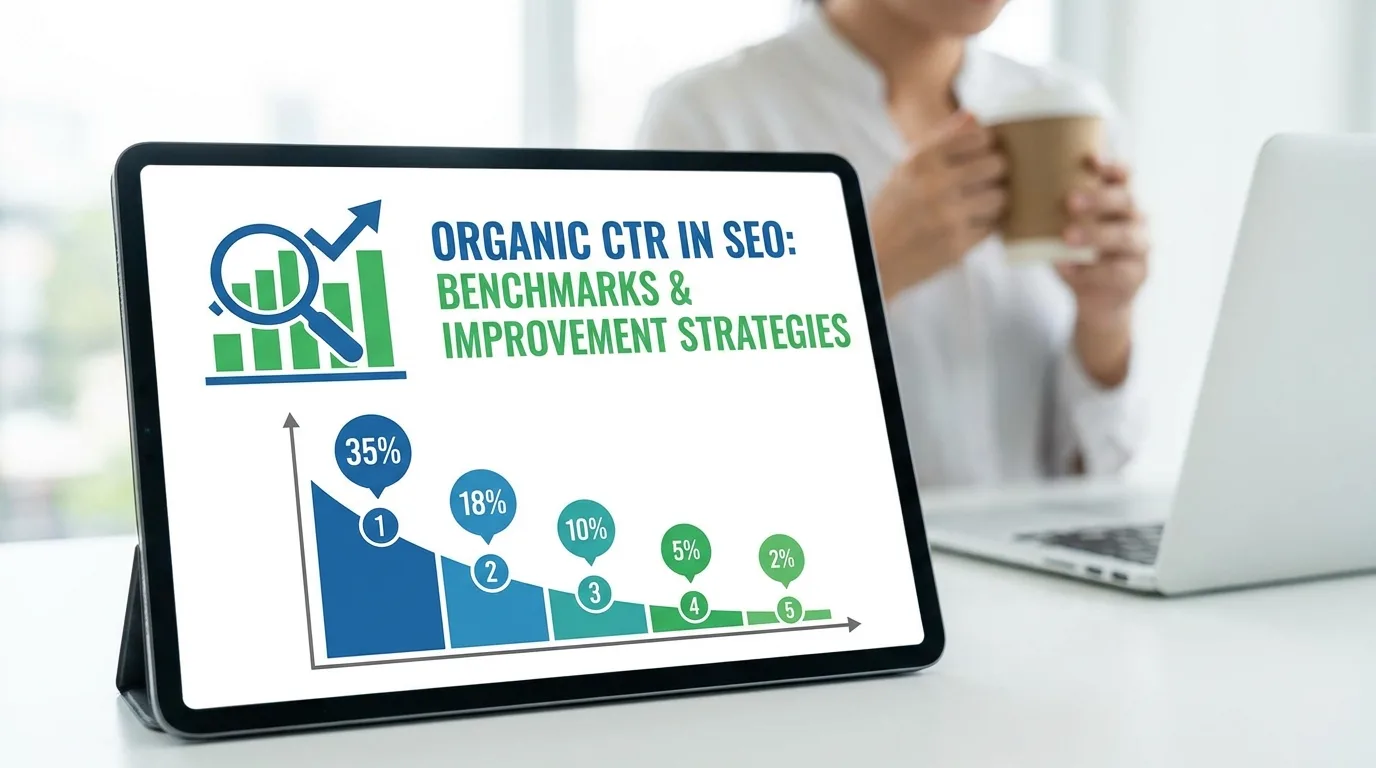
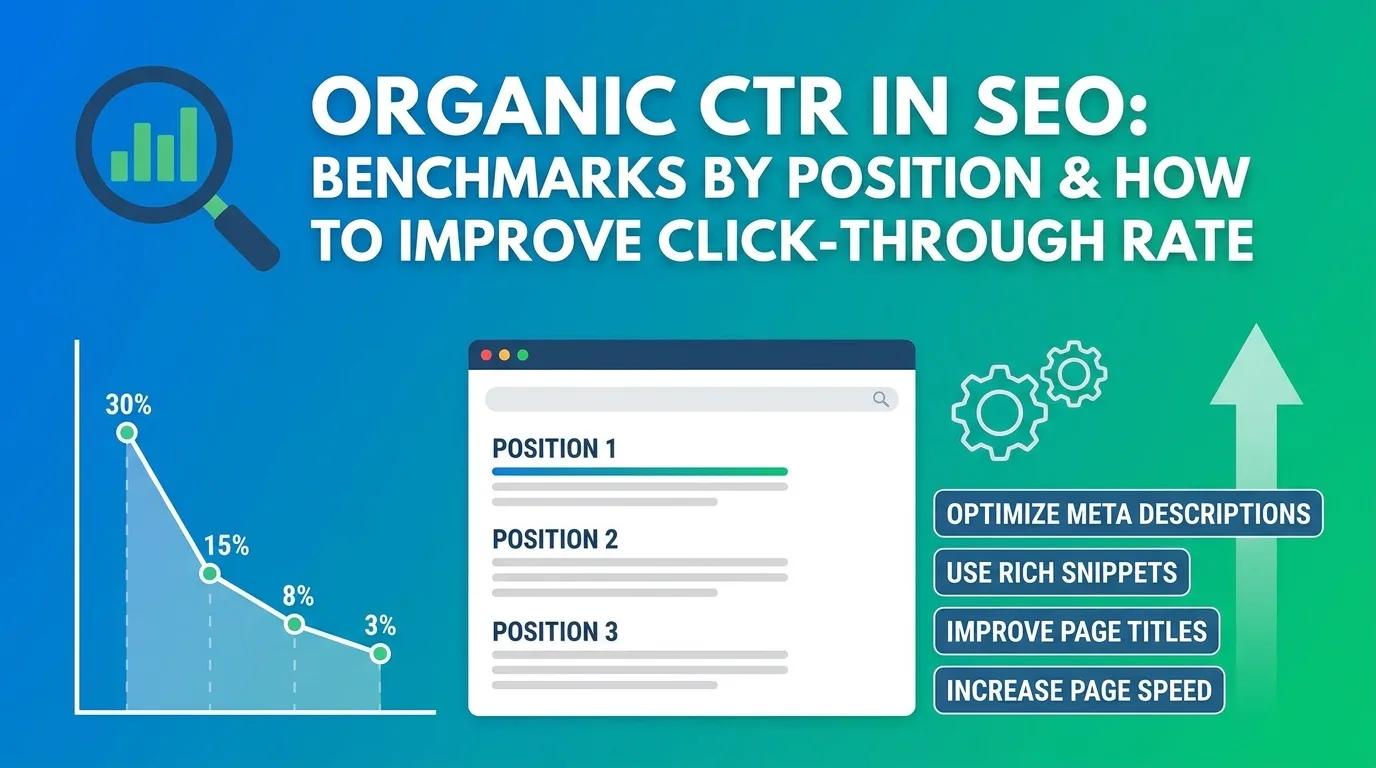
The table below shows directional benchmark logic, not universal truth. Actual google organic ctr varies by industry, device, brand strength, and SERP composition.
| Search Position | Desktop Non-Branded CTR Benchmark | Mobile Non-Branded CTR Benchmark | Desktop Branded CTR Tendency | Mobile Branded CTR Tendency |
|---|---|---|---|---|
| 1 | 28–35% | 24–32% | 45–70% | 40–65% |
| 2 | 15–20% | 13–18% | 12–22% | 10–20% |
| 3 | 10–14% | 8–12% | 6–12% | 5–10% |
| 4 | 7–10% | 6–9% | 4–8% | 3–7% |
| 5 | 5–8% | 4–7% | 3–6% | 2–5% |
| 6 | 4–6% | 3–5% | 2–5% | 2–4% |
| 7 | 3–5% | 2–4% | 2–4% | 1–3% |
| 8 | 2–4% | 2–3% | 1–3% | 1–2% |
| 9 | 2–3% | 1–3% | 1–2% | 1–2% |
| 10 | 1–3% | 1–2% | 1–2% | 1–2% |
These ranges are best used as diagnostic reference bands. If a non-branded page ranks around position 3 with substantial impressions but CTR materially below the expected range, the page may have a snippet, intent, or SERP-layout problem rather than a pure ranking problem.
How intent, device, brand bias, and SERP features distort averages
Average CTR masks major differences across query classes:
- Navigational queries: highest click concentration, often dominated by one brand result.
- Informational queries: more fragmented clicks, especially when summaries answer the question directly.
- Transactional queries: CTR depends heavily on trust signals, product relevance, and competing commercial SERP features.
- Branded queries: unusually high CTR for the recognized entity, especially when the query includes only the company name or a close variant; this is where “seo ctr only company name” patterns often emerge.
Device also matters. Mobile SERPs compress visible space, making top results more dominant but also more vulnerable to displacement by rich features. As a result, blogs about organic click through rate that present one universal benchmark without segmenting device and intent are operationally weak.
Why benchmark data can mislead without SERP context
Featured snippets, AI Overviews, local packs, and zero-click behavior
Static organic ctr benchmarks become unreliable when the SERP itself changes. AI Overviews, featured snippets, People Also Ask, local packs, shopping modules, video carousels, and image blocks all alter click distribution by shifting organic results lower on the page or satisfying intent without a click.36 This is why organic ctr and seo analysis must include SERP context, not only rank position.
A page ranking first below an AI Overview may behave like a traditional position 2 or 3 in terms of actual attention. Likewise, a local-intent query can route clicks into map results rather than standard organic listings. In these cases, organic click through rate by search position is being mediated by interface competition.
When a lower-ranked result outperforms a higher-ranked result
Lower-ranked pages can outperform higher-ranked pages when they better match task intent, offer stronger title semantics, or carry higher brand trust. A position 4 result with a precise commercial modifier may earn more clicks than a vague position 2 result. This is common when searchers scan for specificity—pricing, comparison, location, compatibility, or freshness.
“Clicks are not determined by relevance alone; they are mediated by presentation bias, rank bias, and the user’s examination of the results page.” — Joachims et al., click model research7
That principle explains why how to increase ctr in seo often starts with SERP engineering: stronger titles, more specific metadata, schema eligibility, and better alignment to the dominant intent class.
Query rewriting, title rewrites, and snippet truncation effects
Google may rewrite title links or generate snippets dynamically based on the query and on-page content.2 That means your authored title tag isn’t always the displayed title. Rewrites can improve clarity, but they can also weaken differentiation, remove conversion language, or truncate key modifiers. Similarly, long titles may be cut off by pixel width, especially on mobile.
As a result, benchmark interpretation should account for:
- displayed title, not only source title tag
- snippet truncation risk
- rich result eligibility
- search appearance type
- pixel depth above the fold
- zero-click query behavior
Finding your own CTR baseline in Google Search Console
How to segment by page, query, device, country, and search appearance
The most reliable method for finding your own ctr is Google Search Console Performance data segmented by comparable contexts.1 Start with these dimensions:
- Page
- Query
- Device
- Country
- Search appearance
- Date range
Do not evaluate ctr seo on sitewide averages alone. Sitewide CTR blends branded and non-branded demand, mixes positions 1 and 9, and combines different intent classes into one distorted number. Instead, isolate page groups and query clusters with similar ranking and SERP conditions.
A practical workflow:
- Export pages with meaningful impression volume.
- Segment branded vs non-branded queries.
- Split desktop and mobile.
- Filter by country if market behavior differs.
- Compare web search separately from image, video, or other appearances.
- Review pages within narrow average-position bands, such as 1.0–1.9, 2.0–2.9, and 3.0–3.9.
How to compare page CTR against average position correctly
Average position is a blended metric, so it shouldn’t be treated as an exact rank for every impression.1 A page with average position 3.2 may have appeared in positions 1 through 8 across many queries. To compare organic ctr by position correctly, normalize by:
- similar query intent
- similar device mix
- similar branded status
- similar SERP feature environment
- sufficient impression count
This avoids false conclusions such as declaring a page “underperforming” when its low CTR is actually caused by AI Overview displacement or a heavy informational query mix.
How to detect underperforming pages with high impressions
The highest-value CTR opportunities are pages with:
- high impressions
- page-one average positions
- below-expected CTR for their segment
- strong business relevance
These pages already have visibility. They don’t need discovery; they need better click capture. Typical fixes include title rewrites, intent sharpening, schema enhancement, fresher timestamps where editorially valid, and improved alignment between query wording and snippet promise.
Build a CTR opportunity list from high-impression, below-benchmark pages. Use a structured measurement framework in Measuring SEO Performance.
For KPI integration, connect CTR analysis to conversion and revenue reporting through Metrics SEO. This is the difference between reading blogs about organic click through rate and operating a real organic growth system.
A technical framework for diagnosing low organic CTR
Organic CTR must be diagnosed as a four-layer system: rank, snippet, SERP environment, and intent fit. A page can rank well yet underperform because its title fails to qualify clicks, the results page is crowded by ads and rich features, or the query intent is mismatched to the landing asset. 137
Low ctr seo performance is rarely a single-variable problem. The correct diagnostic sequence is:
- Confirm ranking reality: compare clicks, impressions, CTR, and average position in Google Search Console before rewriting snippets.1
- Segment by query and page: branded, non-branded, informational, commercial, and navigational queries produce very different organic click through rate by search position patterns.45
- Inspect the live SERP: measure ad load, Shopping units, AI summaries, featured snippets, video blocks, local packs, and dominant brands that compress available organic click share.36
- Test message-to-intent fit: determine whether the ranking URL actually matches what the searcher expects to click.
A practical model for finding your own ctr is to compare each query-page pair against expected organic ctr by position ranges, then classify the gap.
Snippet relevance: title tags, meta descriptions, and visible URL cues
Snippet-level failure appears when rankings are acceptable but CTR is weak relative to position benchmarks. Common causes include:
- vague title tags with no primary entity or modifier
- duplicated titles across templates
- meta descriptions that summarize rather than persuade
- weak visible URL paths that don’t reinforce topic specificity
- missing freshness, numbers, comparison terms, or use-case qualifiers
Google may rewrite title links and snippets when supplied elements are weak or misaligned, making CTR loss both a content and rendering issue (Google Search Central, 2025).2
SERP competition: ads, rich results, and brand dominance
Sometimes the snippet isn’t the main problem. Google organic ctr declines when the page competes against:
- multiple paid ads above organic results
- featured snippets or AI-generated answer layers
- strong brand domains with high trust recognition
- image, video, shopping, or local result modules
- query classes with high zero-click behavior6
In these cases, a lower-than-average ctr organic search profile may be structurally normal, not a copywriting failure.
Intent mismatch: when ranking exists but click appeal fails
A page may rank because of topical relevance but still miss click demand. Examples:
- a blog article ranking for a transactional query
- a service page ranking for a definition query
- a broad category page ranking for a comparison-intent search
This is where organic ctr and seo intersect most directly: ranking indicates eligibility, but click behavior validates fit. If the query wants “best,” “pricing,” “examples,” “vs,” or “template,” the snippet and landing page must expose that value immediately. For a stronger baseline model, align this diagnosis with Measuring SEO Performance, Metrics SEO, and the methodology explained in Organic CTR in SEO.
How to increase CTR in SEO with snippet engineering
The highest-leverage way to improve organic CTR is snippet engineering: build title tags that qualify intent, write meta descriptions that reduce uncertainty, and reinforce entities through schema and on-page consistency so both users and search systems can identify the result as the best fit. 23
Writing title tags for specificity, relevance, and click qualification
For how to increase ctr in seo, title architecture matters more than superficial “catchiness.” Strong titles usually combine:
- primary entity/topic
- intent modifier
- specificity signal
- brand only when it adds trust
A reliable framework:
Primary Topic + Intent/Benefit + Specific Qualifier | Brand
Examples:
Organic CTR by Position: Benchmarks, Variance, and AnalysisHow to Improve Organic CTR Without Changing RankingsCTR SEO Benchmarks for Blogs, Service Pages, and Branded Queries
High-performing title characteristics often include:
- exact topical alignment with the query
- numbers or ranges where useful
- comparison or framework language
- freshness cues when recency matters
- removal of generic branding overload in non-branded search
This is especially important in the seo ctr only company name scenario. If titles lead with brand on non-branded queries, they often waste high-value pixel space that should establish relevance first.
Meta descriptions that improve selection without clickbait
Meta descriptions don’t directly determine rank, but they strongly affect selection behavior when used as the displayed snippet.2 Effective descriptions should:
- restate the query theme naturally
- clarify scope, format, and outcome
- reduce ambiguity about what the page contains
- avoid exaggerated clickbait that increases pogo-sticking risk
A practical formula:
What the page covers + who it helps + why it is different
Example:
Analyze organic CTR by search position, benchmark your own query classes, and identify whether low click-through comes from weak snippets, SERP crowding, or intent mismatch.
This approach supports improve organic ctr efforts because it pre-qualifies the click rather than merely attracting it.
Schema markup, rich results, and entity reinforcement for GEO
Schema doesn’t guarantee rich results, but it improves machine-readable clarity and can support eligibility for enhanced SERP presentation.3 For GEO-oriented publishing, schema also helps reinforce entities and relationships that AI systems use for answer extraction.
Prioritize:
ArticleBreadcrumbListOrganizationWebPage- relevant product, review, FAQ, or local business types where valid
Entity reinforcement should be consistent across:
- title tag
- H1
- intro summary
- breadcrumb path
- schema fields
- internal anchor text
This increases semantic coherence for both search engines and generative systems. A useful real-world application pattern can be seen in Panorama Lens Trip, where search presentation and conversion alignment matter together.
Advanced CTR optimization by page type and query intent
CTR optimization must be page-type specific. Blog articles, commercial landing pages, category pages, and branded homepages compete under different intent conditions, so the snippet that wins informational clicks isn’t the same snippet that wins transactional or navigational clicks. 45
Blog articles vs commercial landing pages vs category pages
| Page type | Primary CTR driver | Best snippet treatment | Common failure mode |
|---|---|---|---|
| Blog article | informational specificity | frameworks, numbers, definitions, comparisons | title too broad or academic |
| Commercial landing page | solution clarity and trust | service outcome, proof, location, qualifier | vague marketing language |
| Category page | breadth and selection | product class, use case, inventory scope | generic template title |
For blogs about organic click through rate, users often respond to titles that promise analysis, benchmarks, formulas, or diagnosis. Commercial pages need stronger trust and action framing.
Branded queries, non-branded queries, and the ‘seo ctr only company name’ scenario
Branded CTR is usually much higher because user intent is navigational and brand recognition reduces decision friction.5 Non-branded CTR is more competitive and relevance-dependent.
The seo ctr only company name problem appears when a site performs well only on brand-led searches. That usually indicates one or more of the following:
- weak non-branded title targeting
- poor topical authority in competitive SERPs
- low differentiation against established publishers
- snippets that don’t surface category, benefit, or use case
Local, informational, and comparison-intent CTR patterns
Local queries often lose organic clicks to map packs. Informational queries may be suppressed by featured snippets or AI answer layers. Comparison-intent queries reward titles with explicit modifiers such as best, vs, pricing, alternatives, or review, assuming the page genuinely fulfills that promise.36
The operational takeaway: benchmark organic click through rate by query class, not sitewide average alone. That is the only reliable way to judge whether google organic ctr underperformance is caused by ranking position, snippet construction, or the search-result environment itself.
Testing, measurement, and statistical validation
Reliable ctr seo improvement requires controlled measurement, not anecdotal uplift. Validate changes with query-level pre/post windows, sufficient impressions, stable average position bands, and seasonality controls. Attribute gains to snippet edits only when ranking, SERP features, and demand conditions remain materially comparable across the test period.
How to run title and meta tests responsibly
Title and meta description tests in organic search are observational, not true split tests, because Google may rewrite snippets and because only one version is typically live at a time (Google Search Central, 2025). That makes disciplined test design essential.
Use a pre/post framework with matched conditions:
- compare the same URL set before and after the change
- segment by query intent, device, country, and brand vs non-brand
- isolate keywords within narrow average-position ranges, such as 2.1-3.0 or 5.1-6.0
- exclude periods with site migrations, core updates, major PR spikes, or indexing instability
- document whether Google rendered your supplied title or rewrote it1
For pages with broad query portfolios, evaluate organic ctr by position at the query level rather than page-level averages. A page can show higher aggregate organic click through rate simply because it gained more impressions from easier branded queries, not because the snippet improved. This is why finding your own ctr baseline matters more than importing generic benchmarks from blogs about organic click through rate. Pair Search Console data with the KPI framework described in Measuring SEO Performance.
What counts as meaningful CTR change
Meaningful change depends on impression volume and baseline CTR variance. As a practical rule:
| Test condition | Minimum standard for interpretation |
|---|---|
| Query/page sample size | Prefer 1,000+ impressions per variant window |
| Position stability | Average position movement within a tight band, ideally <0.3-0.5 |
| Test duration | 14-28 days minimum, longer for low-volume pages |
| Confidence threshold | Use 90-95% confidence before declaring a durable lift |
| CTR effect size | Prioritize relative lifts that exceed normal weekly variance |
A 0.2-point CTR change on 200 impressions is noise. A 12-20% relative lift on 20,000 impressions with stable ranking is actionable. For google organic ctr, significance should be evaluated within each query class because local, informational, and comparison SERPs have structurally different click ceilings.23
How to separate CTR lifts from ranking shifts and seasonality
Do not attribute gains to snippet edits if average position improved materially. Since organic click through rate by search position rises nonlinearly near the top of the SERP, even a small ranking gain can explain a large click increase.4 Control for this by:
- binning queries by position before comparison
- using year-over-year windows where seasonality is strong
- excluding dates with major SERP layout changes
- checking impression growth separately from CTR growth
- comparing edited pages against a holdout group of similar unedited pages
This is the operational bridge between organic ctr and seo measurement and decision-quality reporting. For a repeatable KPI model, turn CTR testing into a governed workflow with Metrics SEO.
CTA — Build a repeatable CTR testing system
Turn snippet experiments into a measurable SEO KPI workflow with clear thresholds, segmentation logic, and reporting standards. Start with Metrics SEO.
CTR, rankings, and conversion quality: what actually drives business value
Higher CTR isn’t inherently better. If a title over-promises and the landing page under-delivers, the page may gain clicks while losing engagement quality, assisted conversions, and lead efficiency. Operationally, the best ctr organic search outcomes come from expectation matching: the SERP promise, page introduction, information architecture, and conversion path must align.
Why higher CTR is not always better if click quality drops
A sensational title can increase organic click, but it can also degrade downstream metrics:
- shorter dwell time
- higher pogo-sticking risk
- lower form completion rate
- weaker assisted pipeline contribution
- poorer trust signals for repeat search exposure
This is especially relevant for seo ctr only company name queries, where branded demand naturally inflates CTR but may not reflect incremental acquisition value. Non-brand CTR gains usually matter more for market expansion, while branded CTR often reflects existing awareness rather than new demand capture.5
Balancing click appeal with expectation matching
The objective isn’t maximum curiosity; it is qualified intent capture. Effective snippet construction for how to increase ctr in seo typically combines:
- explicit query-match terminology
- concrete outcome language
- category or use-case clarity
- trust modifiers such as pricing, comparison, methodology, or evidence
- alignment with the page’s actual content blocks
This is where Organic CTR in SEO becomes a performance discipline rather than a copywriting exercise. See Organic CTR in SEO for the formula and impact model.
Using case evidence to connect CTR gains to leads and revenue
The right evaluation sequence is:
- confirm a statistically credible CTR lift
- verify stable or improved engagement quality
- measure lead-rate and revenue-rate impact by landing page segment
- scale only the patterns that improve commercial outcomes
A useful benchmark isn’t “did CTR rise?” but “did qualified sessions and conversion efficiency improve?” The commercial framing shown in Panorama Lens Trip is the correct model: connect SERP improvements to business outcomes, not vanity uplift. That is the real intersection of organic ctr and seo.
References, implementation checklist, and strategic takeaways
Planned citations: Google Search Central, W3C, IEEE, arXiv, Gartner
Strategically, ctr seo now sits at the intersection of ranking, SERP rendering, and AI-mediated answer discovery. In conventional search, stronger snippets improve click capture. In AI-influenced SERPs, stronger semantic clarity, source credibility, and answer-structure improve both citation eligibility and residual click demand.16
Implementation checklist for the next 30 days
- export 90 days of Search Console query, page, device, and country data
- segment branded vs non-branded queries
- benchmark organic ctr by position in narrow rank bands
- identify pages with high impressions, below-expected CTR, and stable rankings
- rewrite titles and descriptions based on intent class, not generic formulas
- annotate deployment dates and monitor 14-, 21-, and 28-day windows
- validate significance with impression thresholds and holdout comparisons
- review engagement and conversion quality after CTR movement
- prioritize pages where CTR uplift can compound into revenue, not just traffic
- document learnings as a reusable testing standard inside your Metrics SEO framework
Key takeaways for GEO, AI Overviews, and sustainable CTR growth
Three conclusions matter:
- Organic click through rate by search position is the baseline, not the full diagnosis. SERP features, intent class, and snippet differentiation determine whether a page underperforms its rank.
- Sustainable improve organic ctr work requires statistical discipline. Without position controls, most claimed wins are measurement errors.
- The best google organic ctr gains come from expectation-matched snippets that support both human clicks and machine-readable answer extraction.
CTA — Request a CTR and SERP opportunity review
Identify the pages with the highest click-growth potential, the weakest snippet differentiation, and the clearest path from impressions to qualified conversions. Request a CTR and SERP opportunity review through your SEO consultation workflow or service contact endpoint.
References & Authoritative Sources
- Google Search Central. Search Essentials and Search Console Help documentation.
- W3C. HTML, metadata, and structured web standards documentation.
- IEEE Xplore. Research literature on click models, rank bias, and search interaction.
- arXiv. Research literature on SERP behavior, answer systems, and information retrieval evaluation.
- Gartner. Digital marketing and measurement frameworks for performance governance.
Footnotes
-
Google Search Console Help. Performance report definitions for clicks, impressions, CTR, and average position. ↩ ↩2 ↩3 ↩4 ↩5 ↩6 ↩7 ↩8 ↩9
-
Google Search Central, title links and snippets guidance, 2025. ↩ ↩2 ↩3 ↩4 ↩5 ↩6 ↩7 ↩8
-
Google Search Central documentation on search features and evolving SERP presentation, 2025. ↩ ↩2 ↩3 ↩4 ↩5 ↩6 ↩7 ↩8
-
Advanced Web Ranking CTR studies and industry benchmark analyses on organic click distribution by rank. ↩ ↩2 ↩3 ↩4 ↩5
-
Backlinko and comparable industry CTR research summarizing position-based click decay patterns. ↩ ↩2 ↩3 ↩4 ↩5
-
SparkToro and industry zero-click search research on changing click behavior in Google Search. ↩ ↩2 ↩3 ↩4 ↩5
-
Joachims, T. et al. Research on click models, rank bias, and user interaction with search results. ↩ ↩2
Frequently Asked Questions & Citations
Organic CTR is the percentage of unpaid search impressions that result in a click. The formula is clicks divided by impressions multiplied by 100, and it is commonly measured in Google Search Console at the query, page, device, and country level.
Higher rankings usually earn higher CTR because they capture more attention above the fold. However, actual click share varies by query intent, device type, brand familiarity, and SERP features such as AI Overviews, featured snippets, local packs, and image blocks.
Use Google Search Console Performance reports and compare clicks, impressions, CTR, and average position by page and query. For cleaner analysis, segment branded versus non-branded terms, split mobile and desktop data, and group keywords into position ranges such as 1-3, 4-6, and 7-10.
Improve title tags, meta descriptions, and URL readability so the snippet better matches search intent and communicates a clearer value proposition. Pages with high impressions but below-average CTR are usually the fastest opportunities because stronger snippet relevance can lift clicks without requiring a ranking gain.
Low CTR at strong positions often signals weak intent alignment, uncompetitive titles, poor brand trust, or SERP layouts that reduce attention on standard blue links. A page can rank in the top three and still underperform if the query is dominated by answer boxes, shopping modules, or navigational brand demand.
There is no universal benchmark because CTR changes significantly by industry, query type, device, and SERP composition. Position-based benchmarks are useful for directional forecasting, but the most reliable target is your own historical CTR by query class and ranking band.
Digital Marketing Specialist in Technical SEO, Generative Engine Optimization (GEO), and paid search acquisition.
Related Technical Guides & Frameworks
Organic CTR in SEO: Meaning, Formula, and Impact
Learn what organic CTR in SEO means, how to calculate it, and how rankings, snippets, and intent affect clicks and traffic growth.
Organic Traffic Meaning: SEO Definition and Metrics
Learn organic traffic meaning, how it differs from paid, direct, and referral traffic, and how to measure SEO clicks, conversions, and revenue accurately.
Organic Search Visibility: Meaning, Metrics & SEO
Learn what organic search visibility means, how it differs from rankings and traffic, and how to improve SERP presence in modern SEO.
Organic Positions: Meaning, SEO Impact & Tracking
Learn what organic positions mean in SEO, how rankings affect CTR, traffic, and visibility, and how to track them against SERP features and intent.