
Metrics SEO: The Definitive Framework for Tracking KPIs and Organic ROI
1. What Are the Core Metrics for SEO and How Do They Differ by Business Objective?
Quick Answer: Core metrics for SEO span three distinct operational layers: technical health, search visibility, and commercial conversion. Technical metrics monitor crawlability and indexation, visibility metrics track query impressions and ranking distributions, while commercial metrics measure inbound leads, organic conversion rates, and closed-won contract value tied to organic search touchpoints.
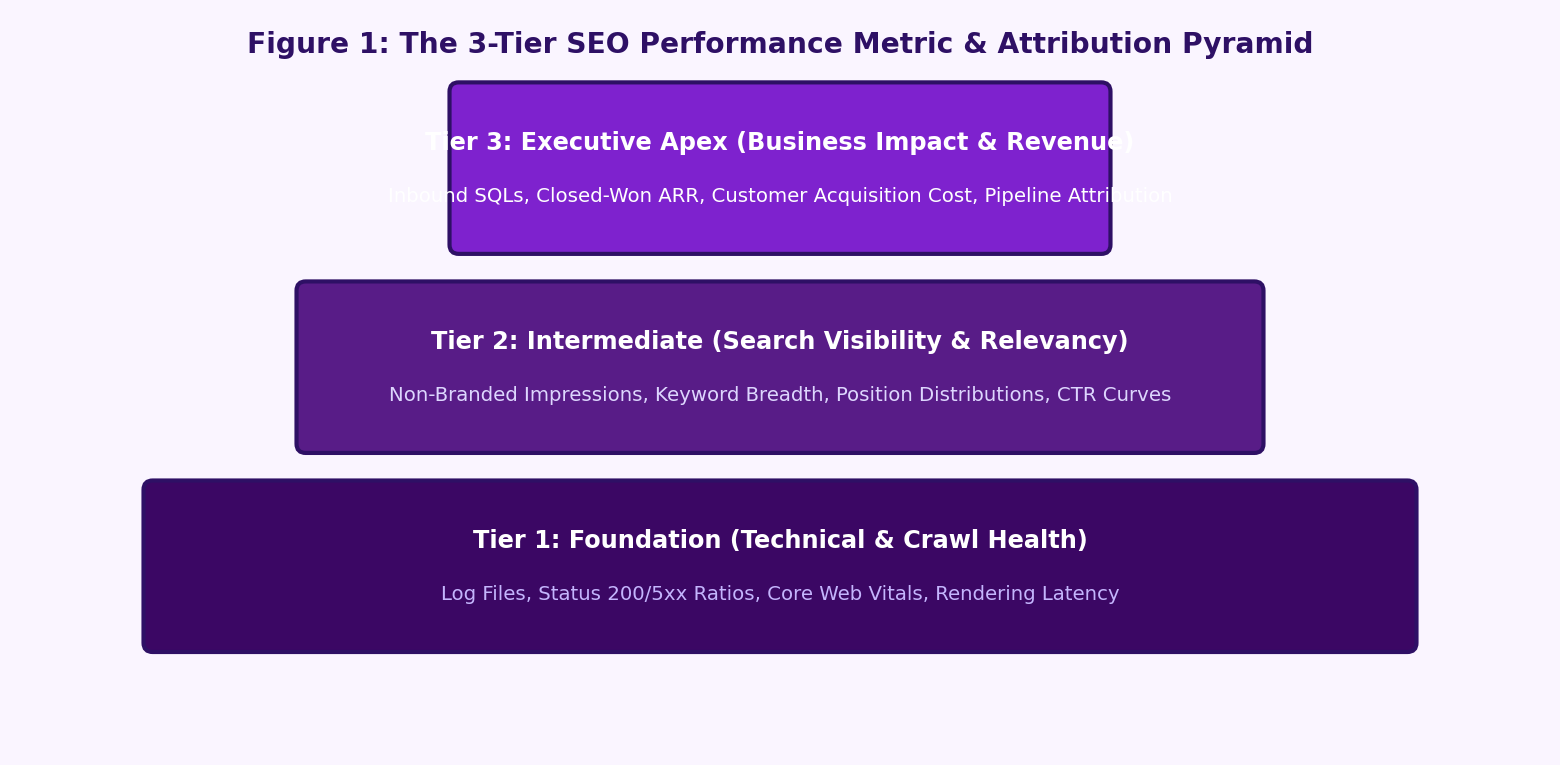
Figure 1: The 3-Tier SEO Performance Metric & Attribution Pyramid Organizations frequently fail to align measurement criteria with organizational maturity. An early-stage software venture scaling organic presence requires leading visibility indicators, such as indexed page velocity and non-branded impression growth. Conversely, established enterprise domains must track commercial efficiency, pipeline contribution, and revenue generated per organic visitor.
Furthermore, operational teams require granular technical signals, while C-suite executives evaluate strategic business impact. Segmenting performance indicators into engineering-level diagnostics and board-level commercial revenue prevents reporting confusion and establishes clear cross-departmental accountability.
2. Why Are Leading SEO KPI Metrics More Valuable Than Lagging Rankings?
Quick Answer: Leading SEO KPI metrics, such as non-branded impression velocity and crawl frequency, predict organic search ranking shifts weeks before organic traffic materializes. Monitoring leading indicators allows marketing engineering teams to validate recent site deployments and algorithmic relevance before lagging metrics, like completed sales deals, reflect strategic success.
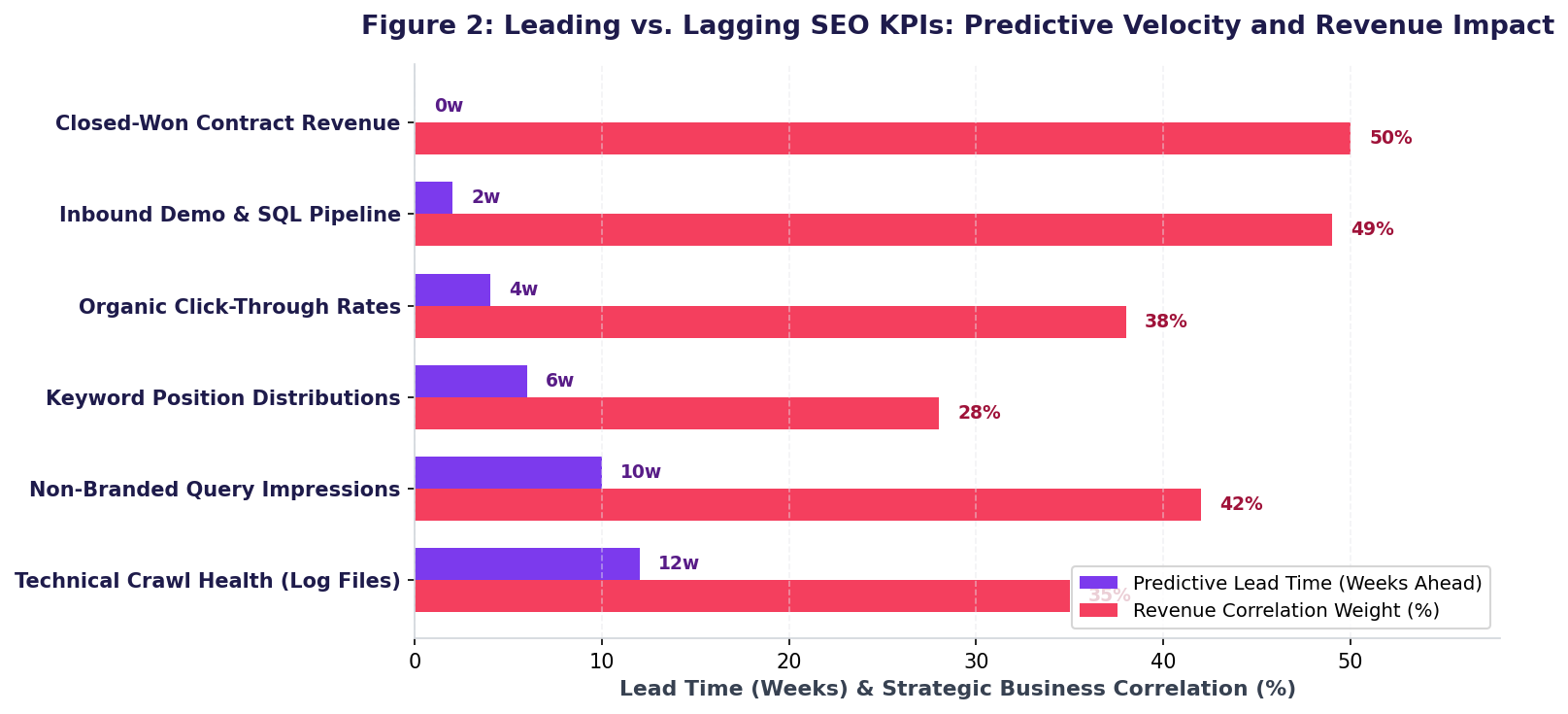
Figure 2: Leading vs. Lagging SEO KPIs: Predictive Velocity and Revenue Impact Search algorithms evaluate web properties incrementally through phased testing. Before Google awards top-three positions, algorithms test page resonance by increasing impression exposure across broad query clusters. Measuring non-branded impressions inside Google Search Console acts as a predictive radar, signaling organic momentum up to ten weeks ahead of conversion spikes.
In contrast, waiting for closed-won revenue or top-ranking positions to evaluate optimization initiatives creates significant strategic lag. If an engineering deployment introduces subtle canonical loops or rendering errors, leading crawl metrics detect the anomaly within 24 hours, preventing months of suppressed organic pipeline.
3. How Do Technical Teams Track Crawl Indexation Efficiency and Bot Behavior?
Quick Answer: Technical teams track crawl efficiency by analyzing server access log files and Google Search Console index coverage reports. Evaluating the ratio of crawled URLs to indexed pages uncovers wasted crawl budget, detects creeping 5xx server errors, and validates that automated search bots prioritize high-converting commercial hubs.
Search engine spiders possess finite processing resources for every domain. By parsing raw web server log entries, technical directors evaluate daily bot request volumes, HTTP response times, and crawling frequency across specific subdirectories. A sudden spike in crawl activity on parameterized filter URLs warns of impending crawl budget depletion.
Furthermore, calculating the index-to-crawl ratio measures architectural health. When a domain generates 200,000 monthly bot requests but only catalogs 5,000 unique URLs, 97% of bot bandwidth is wasted on duplicate parameters or redirect chains. Restricting low-value paths via robots.txt and canonicalization directly accelerates indexation velocity for core landing pages.
4. Which User Engagement Metrics Signal High-Quality Organic Content to Search Engines?
Quick Answer: User engagement metrics that signal content quality include scroll depth, engaged session duration, repeat visitor frequency, and low search result pogo-sticking rates. When organic searchers remain on a page to consume substantive information rather than immediately returning to search results, algorithms recognize verified topical authority.
Modern search engines observe post-click user satisfaction to calibrate ranking positions. When visitors click an organic listing and immediately hit the browser back button—a behavior known as pogo-sticking—it indicates that the page failed to fulfill primary user intent. Maintaining low bounce rates on commercial landing pages protects existing rankings.
Specifically regarding content architecture, tracking average scroll depth and interaction rates inside web analytics reveals where readers lose interest. Structuring pages with answer-first summaries, clear data visualizations, and contextual subheadings keeps prospective buyers actively engaged through to conversion endpoints.
5. How Does Organic Click-Through Rate Curve Analysis Reveal SERP Deficiencies?
Quick Answer: Organic click-through rate curve analysis compares your page’s actual click share against industry benchmarks for specific SERP positions. URLs ranking in top positions that underperform standard click distributions highlight missing rich snippet schema, uncompelling meta descriptions, or competitor AI Overviews pushing organic listings down the digital viewport.
Standard ranking trackers report numerical positions but fail to communicate visual SERP dynamics. A URL ranking in position two typically captures approximately 15% of search clicks. However, if prominent AI Overviews, sponsored ads, and video carousels dominate the top of the search result page, actual click-through rates may drop below 5%.
Furthermore, identifying pages with high impressions but below-average CTR uncovers immediate optimization opportunities. Rewriting title tags to directly answer search intent and implementing structured JSON-LD schema (such as FAQPage, Product, or Review ratings) reclaims click share without requiring position increases.
6. Where Do Marketers Find Meaningful SEO Conversion and Pipeline Metrics?
Quick Answer: Marketers uncover meaningful SEO conversion metrics by integrating web analytics platforms directly with CRM databases like Salesforce or HubSpot. Tracking initial organic discovery touchpoints through opportunity creation, lead stage velocity, and customer lifetime value proves organic search’s direct contribution to organizational revenue generation.
Standard web analytics dashboards focus heavily on micro-conversions, such as PDF downloads or newsletter subscriptions. While informative, executive leadership requires visibility into sales qualified leads (SQLs), pipeline velocity, and customer acquisition costs. Connecting web forms directly to CRM pipelines bridges the gap between organic traffic and closed revenue.
In contrast to standalone analytics, multi-touch attribution models demonstrate organic search’s compounding value. Prospective enterprise buyers typically require four to seven digital touchpoints before submitting an inquiry; attributing value across the entire conversion path justifies continued investment in technical search infrastructure.
7. How Do Core Web Vitals Function as Crucial Technical SEO Tracking Metrics?
Quick Answer: Core Web Vitals function as objective technical metrics measuring user page experience across Largest Contentful Paint, Interaction to Next Paint, and Cumulative Layout Shift. Maintaining green thresholds across at least 75% of real-user visits satisfies Google’s algorithmic page experience requirements and directly reduces bounce rates.
Page performance metrics directly govern both technical crawling efficiency and user conversion behavior. Research indicates that a 1-second delay in mobile loading latency reduces overall site conversion rates by up to 20%. While developers use synthetic testing tools, Google’s ranking systems evaluate real user measurements aggregated in the Chrome UX Report over trailing 28-day windows.
Specifically regarding technical stability, tracking Interaction to Next Paint (INP) ensures that interactive elements like demo forms and product calculators respond immediately. Eliminating long main-thread JavaScript tasks ensures smooth rendering and maintains favorable algorithmic evaluation.
8. When Should an Organization Audit Keyword Cannibalization Metrics?
Quick Answer: An organization should audit keyword cannibalization metrics quarterly or whenever high-priority landing pages experience ranking volatility. Identifying instances where multiple internal URLs compete for identical search queries prevents search algorithms from dividing ranking authority, allowing teams to consolidate competing pages through strategic 301 redirects.
As websites publish hundreds of blog posts, product updates, and case studies, thematic overlap inevitably occurs. Keyword cannibalization manifests when Google oscillates ranking positions between two separate URLs for the same search phrase, causing both pages to underperform in search results.
Furthermore, evaluating query-to-landing-page mapping in Google Search Console uncovers cannibalization patterns. When multiple URLs earn impressions for identical commercial terms, consolidating thin variations into a single authoritative pillar page resolves internal competition and restores top-tier ranking positions.
9. What Is the Contrarian Truth About Relying on Total Organic Session Volume?
Quick Answer: Relying on total organic session volume creates a dangerous illusion of search marketing success. High aggregate traffic numbers frequently reflect low-intent informational visits or branded navigational searches that generate zero sales pipeline; measuring non-branded commercial traffic quality delivers far greater business value than celebrating vanity traffic spikes.
Marketing agencies frequently celebrate exponential traffic gains generated by viral lifestyle articles or top-of-funnel glossary definitions. However, if those visitors never evaluate your product or request a commercial consultation, server hosting expenses increase while corporate revenue remains stagnant.
In contrast, sophisticated search marketing teams prioritize high-intent, low-volume keyword segments. Capturing 200 visits monthly from enterprise technology directors actively researching specialized software generates significantly more annual recurring revenue than attracting 50,000 casual readers seeking elementary definitions.
10. How Should Marketing Leadership Build an Executive SEO Reporting Dashboard?
Quick Answer: Marketing leadership should structure an executive SEO reporting dashboard around commercial outcomes rather than technical jargon. Prioritize pipeline revenue, sales-qualified leads, organic acquisition cost savings, and leading non-branded impressions, presenting complex technical health audits as supporting operational evidence beneath bottom-line financial impact.
Executive board presentations lose strategic impact when filled with hundreds of keyword ranking rows and esoteric server error graphs. Senior leadership requires clear, succinct summaries demonstrating how organic search reduces paid customer acquisition costs and accelerates annual recurring revenue.
Furthermore, an effective dashboard establishes clear correlation between technical engineering investments and commercial returns. Displaying how resolving server latency and crawl traps increased indexed URL capacity by 40% and generated $1.8 million in new enterprise pipeline cements technical SEO as an essential organizational growth pillar.
Comprehensive Framework: Primary SEO Metrics and KPI Hierarchy
| Metric Tier | Key Performance Indicators | Primary Data Source | Diagnostic & Business Action |
|---|---|---|---|
| 1. Technical Health (Foundation) | Crawl error rate, server latency (TTFB), Core Web Vitals (LCP, INP, CLS) | Server Access Logs, Google Search Console, CrUX | Resolves server bottlenecks; protects site from crawl budget waste and ranking penalties. |
| 2. Search Visibility (Leading) | Non-branded impressions, query ranking breadth, CTR curve variance | Google Search Console, Enterprise Rank Trackers | Confirms search engine recognition of topical authority 8-12 weeks before revenue. |
| 3. On-Site Engagement (Behavioral) | Engaged session duration, scroll depth, search bounce rate | Google Analytics 4, Mixpanel, Heatmaps | Identifies content drop-off points; optimizes page layout to increase visitor retention. |
| 4. Commercial Revenue (Executive) | Inbound SQLs, demo requests, closed-won ARR, multi-touch attribution | Salesforce, HubSpot, Enterprise CRM Databases | Verifies organic search return on investment (ROI) and justifies ongoing engineering budget. |
Next Steps: Deploying Your Strategic SEO Scorecard
Establishing an actionable SEO metrics framework provides the operational clarity required to outpace competitors in organic search. Begin by segmenting branded from non-branded query impressions inside Google Search Console, implementing server log monitoring for bot crawl frequencies, and integrating conversion events with your CRM database. Tracking leading technical signals alongside closed-won revenue ensures your digital infrastructure consistently compounds enterprise valuation.
Frequently Asked Questions & Citations
Essential metrics for SEO evaluate technical infrastructure health, organic search visibility, user engagement, and revenue attribution. Rather than tracking isolated keyword positions, modern performance scorecards measure non-branded click-through rates, crawl indexation efficiency, Core Web Vitals pass rates, and pipeline conversion velocity to ensure search optimizations drive verifiable business expansion.
Master metrics SEO with this strategic framework. Discover how leading KPI indicators, crawl health, and CRM pipeline attribution measure true search ROI. Aligning SEO Metrics with clean site architecture and measurable conversion pathways ensures sustainable organic pipeline growth.
Digital Marketing Specialist in Technical SEO, Generative Engine Optimization (GEO), and paid search acquisition.
Related Technical Guides & Frameworks
Organic Traffic Meaning: SEO Definition and Metrics
Learn organic traffic meaning, how it differs from paid, direct, and referral traffic, and how to measure SEO clicks, conversions, and revenue accurately.
Organic Search Visibility: Meaning, Metrics & SEO
Learn what organic search visibility means, how it differs from rankings and traffic, and how to improve SERP presence in modern SEO.
Organic Positions: Meaning, SEO Impact & Tracking
Learn what organic positions mean in SEO, how rankings affect CTR, traffic, and visibility, and how to track them against SERP features and intent.
CTR SEO: What Organic CTR Means and Why It Matters
Learn what organic CTR means in SEO, how to calculate it, why ranking position changes click share, and how to improve clicks from existing impressions.