
Organic Positions: Meaning, SEO Impact & Tracking
Organic positions are the unpaid rankings a page earns in search engine results for a query. They matter because they determine discoverability, influence click-through rate, and shape downstream traffic, conversions, and AI citation likelihood. In modern SEO, organic search positions must be evaluated alongside SERP features, intent alignment, and visibility share.12
Define Organic Positions and Why They Matter in Modern SEO
Organic positions are the placement order of non-paid listings in the organic SERP for a given query, device, location, and time. A page ranking #1 organically appears above other standard unpaid results, but not necessarily above ads, shopping units, local packs, featured snippets, or other search features that can displace visual attention.1 In practice, “organic positions,” “organic search positions,” and “organic SERP rankings” refer to the same core KPI: where a URL appears among eligible unpaid results.
Organic positions vs paid placements vs SERP features
Here is how they break down:
- Organic positions: earned through crawling, indexing, relevance, authority, and ranking systems.
- Paid placements: sponsored ads bought through auction systems and labeled as ads.
- SERP features: interface elements such as featured snippets, image packs, video carousels, People Also Ask, local packs, and AI-generated answer surfaces that may reduce standard blue-link visibility.13
A page can rank highly in the organic SERP while still receiving weak click volume if the query triggers multiple high-attention features above it. That is why ranking reports must be interpreted in relation to actual SERP composition, not as isolated numeric positions.
Why ranking position alone is incomplete without CTR, intent, and visibility context
Ranking position remains a core KPI because it reflects search engine trust and retrieval competitiveness. However, rank alone is incomplete. A #3 result for a high-intent transactional query may outperform a #1 result for an ambiguous informational query if the former captures stronger commercial intent and better snippet engagement. Likewise, average position can look stable while impressions and clicks decline due to SERP layout changes, query shifts, or richer competing features.24
This is why advanced SEO programs connect organic positions to:
- Organic CTR and snippet performance, as explained in CTR SEO
- Intent matching across informational, navigational, commercial, and transactional queries
- Visibility share across keyword clusters and device types
- Business outcomes through Measuring SEO Performance and broader Metrics SEO
For GEO, organic positions also influence whether content is surfaced, cited, or synthesized by AI answer engines that rely on authoritative, high-relevance web documents.3
How Search Engines Determine Organic Search Positions
Organic search positions are only possible after a page becomes eligible through crawling and indexing. Search engines first discover URLs, render and process content, evaluate canonicalization, and decide whether a page should be indexed. Only indexed documents can compete for rankings, and even then, eligibility varies by query, language, geography, and content quality.1
Crawling, indexing, and ranking systems as the foundation of position eligibility
The pipeline runs in three stages:
- Crawling: bots discover and fetch URLs.
- Indexing: systems interpret content, media, structured data, canonicals, and duplication signals.
- Ranking: algorithms retrieve and order indexed documents based on relevance and usefulness for the specific query.1
If a page is blocked, canonicalized elsewhere, soft-duplicated, or judged low-value, it may never enter the ranking set. Organic positions therefore begin with technical SEO hygiene, not just on-page optimization.
Relevance, authority, page experience, and intent matching signals
Search engines evaluate many signals rather than a single ranking factor. Core dimensions include:
- Relevance: semantic alignment between query intent and document content
- Authority and trust signals: link-based reputation, source credibility, and topic depth
- Usefulness: originality, completeness, and people-first content quality
- Page experience: mobile usability, HTTPS, Core Web Vitals, and intrusive interstitial avoidance
- Intent matching: whether the page satisfies informational, navigational, local, or transactional demand patterns15
“Our ranking systems are designed to sort through hundreds of billions of webpages and other content in our Search index to present the most relevant, useful results in a fraction of a second.” — Google Search Central1
For AI citation pipelines, AI answer systems also favor documents with clear entities, strong topical coverage, and high perceived usefulness.
How personalization, location, device, and SERP layout affect observed rankings
Observed rank isn’t absolute. It changes according to:
- Location: country, city, and local-intent modifiers
- Device: mobile and desktop often produce different layouts and result sets
- Language and interface settings
- Search history and personalization
- SERP feature density: ads, local packs, video blocks, and AI overviews can alter effective visibility even when nominal rank remains unchanged23
A keyword may rank #4 on desktop in the US, #7 on mobile in the UK, and be visually pushed below the fold by a local pack. This is why rank tracking must be segmented and why raw position should be paired with impression, click, and landing-page performance data.
CTA — Establish a reliable baseline
Audit your current keyword visibility before optimizing. Connect rank movement with traffic, engagement, and conversion trends using Measuring SEO Performance.
Organic Positions, Average Position, and Visibility: What to Measure
Measurement quality determines whether ranking data becomes actionable or misleading. Teams often conflate exact rank, average position, and visibility share, even though each answers a different question.
The difference between exact ranking, average position, and share of visibility
- Exact rank is the observed position for a keyword under a defined device-location context.
- Average position is the mean ranking across impressions or tracked observations, commonly surfaced in Search Console-style reporting.2
- Search visibility estimates how much SERP exposure a domain or URL captures across a keyword set, often weighted by ranking and search volume.
- Organic CTR measures how often impressions convert into clicks.
Exact rank is useful for tactical diagnosis. Average position is useful for trend analysis. Visibility share is better for portfolio-level monitoring across clusters. CTR explains whether rankings are converting exposure into traffic.
Why top 3, top 10, and page-two thresholds matter operationally
Thresholds matter because click behavior is nonlinear. The difference between positions 11 and 8 is meaningful, but the difference between 3 and 1 is often disproportionately valuable due to steep CTR concentration in upper results.4 Operationally:
- Top 3: strongest traffic capture potential
- Top 10: first-page eligibility and realistic click acquisition
- Positions 11–20: high-opportunity terms for optimization and internal linking
- Beyond 20: lower immediate yield, often requiring stronger authority or content restructuring
How clicks, impressions, and organic CTR change the interpretation of rankings
A page can improve from #9 to #5 and still underperform if impressions are low or snippets fail to attract clicks. Conversely, a page with stable average position may gain traffic if query demand rises or snippet relevance improves. This is why ranking analysis should be integrated with CTR SEO, Google Analytics Organic Search, and broader Metrics SEO.
| Metric | What it measures | Best use case | Where it misleads |
|---|---|---|---|
| Exact rank | Specific observed position for a keyword | Diagnose keyword-level movement and SERP competition | Ignores volatility, personalization, and feature displacement |
| Average position | Mean position across impressions or observations | Trend reporting across pages and queries | Can mask distribution changes and mixed query intent |
| Search visibility | Weighted exposure across a keyword set | Portfolio and cluster-level performance tracking | Depends on tool methodology and keyword universe selection |
| Organic CTR | Click rate from organic impressions | Evaluate snippet performance and real traffic capture | Distorted by branded demand, SERP features, and query intent differences |
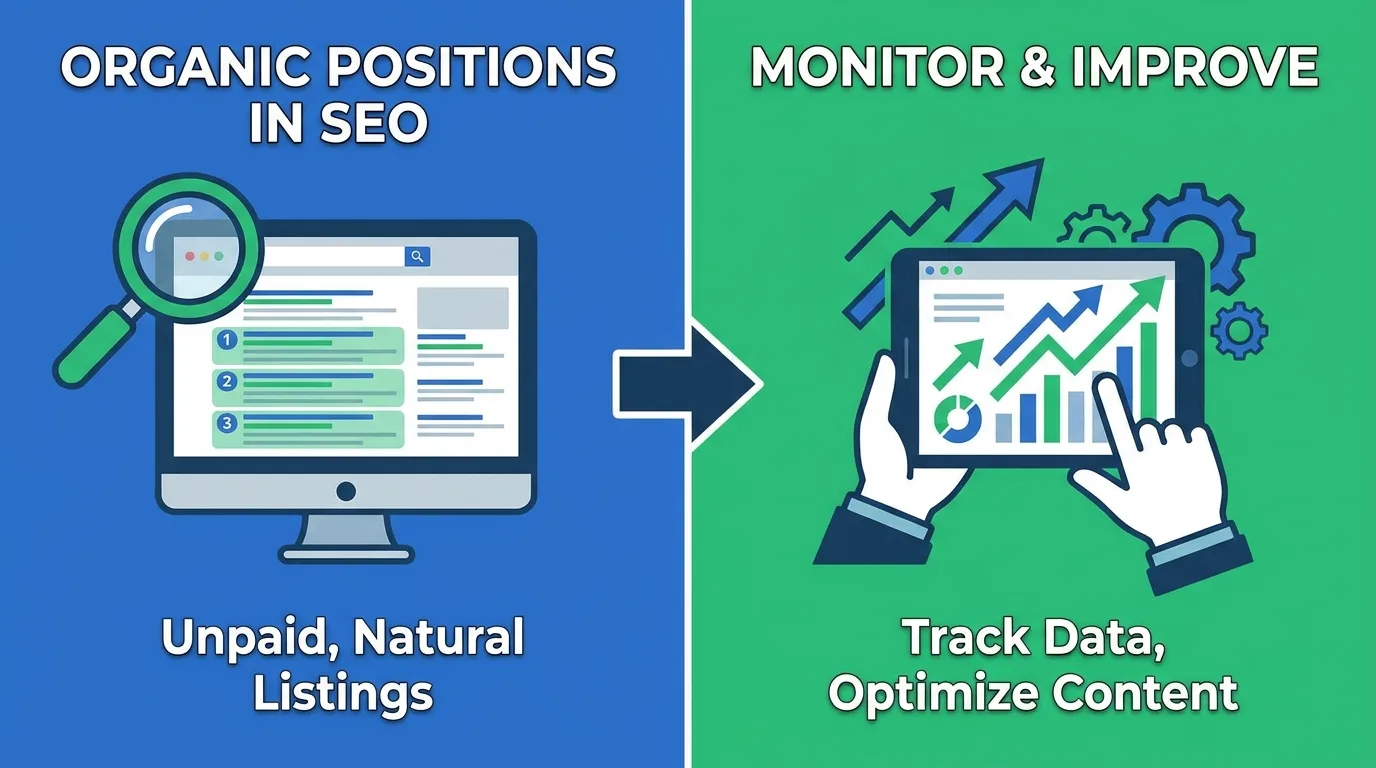
How to Monitor Organic SERP Rankings Accurately
Accurate monitoring requires a layered measurement stack. No single platform provides a complete view because first-party search data, analytics data, and third-party rank observations each answer different questions.
Google Search Console, GA4, and third-party rank trackers: roles and limitations
Use the stack as follows:
- Google Search Console: best source for queries, impressions, clicks, CTR, and average position from Google Search. Limitation: sampled aggregation, limited historical windows unless exported, and no true universal exact-rank monitoring for every context.2
- GA4: best for post-click behavior, conversions, engagement, and revenue from organic sessions. Limitation: doesn’t provide full keyword-level organic query reporting due to privacy and platform constraints.
- Third-party rank trackers: best for controlled keyword monitoring by device, country, ZIP/city, and competitor comparison. Limitation: rankings are simulated snapshots, not full user reality.
The strongest architecture combines all three: Search Console for search demand and visibility, GA4 for business impact, and rank tracking for controlled SERP observation.
Segment tracking by keyword cluster, page type, device, country, and search intent
Do not monitor rankings as a flat keyword list. Segment by:
- Keyword cluster: topic entities and semantic groups
- Landing page type: category, article, product, feature, location page
- Device: mobile vs desktop
- Geography: country, region, city
- Intent: informational, commercial, transactional, navigational
- Brand vs non-brand
- SERP feature presence: local pack, video, snippet, AI answer surface
This segmentation reveals whether movement is systemic or isolated. For example, a sitewide mobile decline in commercial terms suggests technical or UX issues; a drop in one cluster may indicate content freshness or stronger competitors.
Build a monitoring cadence: daily volatility checks vs weekly and monthly reporting
Cadence should match decision type:
- Daily: monitor high-value keywords, major launches, migrations, and anomaly detection
- Weekly: evaluate cluster movement, page winners/losers, CTR shifts, and SERP feature changes
- Monthly: assess strategic trends, visibility share, conversion impact, and content roadmap reprioritization
To reduce noise:
- Track a canonical keyword set rather than every possible variant
- Annotate updates, deployments, and content releases
- Separate volatility from trend by using rolling averages
- Compare ranking movement against impressions, clicks, and conversions before acting
A practical workflow is to flag:
- keywords that dropped more than 3 positions,
- pages that lost top-10 status,
- queries with rising impressions but weak CTR,
- URLs with ranking gains but no conversion lift.
That framework turns organic SERP monitoring into an operational growth system rather than a vanity dashboard.
CTA — Build a measurement stack tied to outcomes
Connect rankings to traffic quality, engagement, and revenue. Use Google Analytics Organic Search to align GA4 with search performance data.
Why Rankings Change: Common Causes of Position Gains and Losses
Organic positions change when Google recalculates relevance, quality, usability, and result presentation for a query. Movement may come from algorithm updates, competitor gains, SERP feature expansion, indexing or rendering failures, intent shifts, or weakening topical authority. Diagnosis requires separating true ranking loss from visibility loss caused by changing SERP layouts.
Algorithm updates, competitor improvements, and SERP feature displacement
Organic search positions aren’t static placements; they are recalculated within a live auction of relevance, authority, freshness, and user-value signals across the indexed web.1 A ranking drop doesn’t always mean a page became “worse.” It may indicate that Google reweighted quality systems, competitors published stronger assets, or the query now triggers more aggressive SERP features such as AI Overviews, featured snippets, video packs, local packs, or People Also Ask modules (Google Search Central, 2025).3
When diagnosing volatility, separate three conditions:
| Condition | What changed | Typical evidence | Primary response |
|---|---|---|---|
| True ranking loss | Average organic position declines for the same query set | Search Console position and clicks both fall2 | Audit content quality, relevance, links, and technical health |
| Visibility displacement | Organic serp listing remains similar, but SERP features absorb clicks | Impressions stable, CTR drops disproportionately24 | Rework snippets, target featured formats, improve entity clarity |
| Competitive replacement | Another domain outranks you with stronger coverage or authority | Manual SERP review shows better pages, fresher assets, stronger link profiles | Expand topical depth, improve evidence, strengthen authority signals |
“Average position is a directional metric, not an absolute truth, because SERP layouts, blended results, and personalization can change user visibility without equivalent changes in underlying relevance.” — Industry measurement guidance synthesized from enterprise SEO research and volatility analyses [Gartner]
This is why CTR SEO must be evaluated alongside rankings: position 3 on a feature-heavy SERP can drive less traffic than position 5 on a cleaner result page.4
Technical SEO issues: indexing, canonicals, internal linking, and rendering
Technical failures often cause abrupt organic position losses because they interrupt crawling, indexing, consolidation, or content interpretation.1 High-impact causes include incorrect canonical tags, noindex directives, robots.txt blocking, JavaScript rendering gaps, orphaned pages, weak internal link distribution, and accidental URL changes without proper redirects.
Common technical signals include:
- Indexed pages dropping after deployment
- Canonical selection shifting to the wrong URL
- Important content absent from rendered HTML
- Crawl budget diverted into faceted or duplicate URLs
- Internal links removed from high-authority hub pages
Use Search Console coverage and performance data, crawl logs, rendered HTML inspection, and canonical cluster validation to confirm whether the loss is query-specific or architecture-wide.2 This is where Google Analytics Organic Search and Search Console should be correlated rather than reviewed in isolation.
Content decay, intent mismatch, and authority gaps
Many ranking declines are content problems disguised as algorithm problems. Pages lose organic positions when they become outdated, fail to satisfy evolved search intent, or remain too shallow relative to competing documents. Informational queries often shift toward fresher, more comparative, or more directly answerable formats over time.
Root causes usually fall into three buckets:
- Content decay: statistics, screenshots, workflows, or references are outdated.
- Intent mismatch: the page targets one interpretation of the query while the SERP now favors another.
- Authority gap: the page lacks expert evidence, citations, original data, or off-page trust signals.5
A reliable diagnosis framework is to compare affected URLs against current top-ranking pages for entity coverage, answer structure, source quality, freshness, and SERP feature fit. Then benchmark the losses against broader Measuring SEO Performance and Metrics SEO indicators to determine whether the problem is isolated, systemic, or market-driven.
How to Improve Organic Positions Systematically
Strengthen search intent alignment and topical completeness
Improving organic positions starts with intent precision. Map each target query to its dominant SERP pattern: definition, comparison, process, tool, local result, commercial investigation, or transactional outcome. If the top results answer “what,” “why,” and “how” in one document, a narrow page will underperform even if it contains the primary keyword.
Build topical completeness through entity coverage, not keyword stuffing. For a page targeting organic positions, include adjacent entities such as Google Search Console, impressions, CTR, average position, canonicalization, crawl efficiency, SERP features, AI Overviews, schema markup, and internal linking. This improves semantic alignment for both traditional ranking systems and answer extraction pipelines.13
Use a repeatable content upgrade model:
- Re-evaluate the current SERP for intent and feature composition.
- Expand the page to cover missing subtopics and comparison points.
- Add concise definitions, structured steps, examples, and evidence-backed claims.
- Refresh stale statistics, screenshots, and references.
- Improve scannability with hierarchy that mirrors query refinement paths.
Improve on-page SEO: titles, headings, entities, schema, and internal links
On-page improvements compound when they tighten relevance and increase click efficiency. Rewrite title tags to match dominant query framing while preserving specificity and differentiation. Headings should reflect user tasks, not generic section labels. Front-load definitions and direct answers so both users and retrieval systems can extract value quickly.
Entity-rich on-page optimization should include:
- Clear primary topic declaration in the introduction
- Consistent terminology across title, H1, H2s, and body copy
- Comparative tables where users evaluate alternatives
- Schema markup where applicable, especially Article, FAQ, Breadcrumb, and Organization
- Internal links from contextually relevant pages using descriptive anchors
Internal linking is often the fastest ranking lever because it redistributes authority and clarifies topical relationships. Link from adjacent high-value documents such as CTR SEO, Google Analytics Organic Search, Measuring SEO Performance, and Metrics SEO to strengthen semantic clustering and crawl discovery.
Raise technical quality: Core Web Vitals, crawl efficiency, and index control
Technical quality sustains ranking gains by ensuring search systems can crawl, render, evaluate, and consolidate the right URL efficiently.1 Prioritize:
- Index control: validate canonicals, noindex usage, hreflang, redirects, and duplicate clusters.
- Crawl efficiency: reduce parameter waste, broken links, redirect chains, and orphaned content.
- Rendering reliability: ensure critical content exists in rendered HTML, not only delayed JavaScript states.
- Performance: improve LCP, INP, and CLS because speed and stability affect usability and crawl processing at scale.5
A practical prioritization model is impact × scope × reversibility. A broken canonical on 5,000 URLs outranks a title tag tweak on 50 pages. Technical SEO should therefore be triaged by indexation risk first, then crawl efficiency, then performance refinement.
Build authority with digital PR, citations, and link-worthy assets
Authority remains a decisive differentiator for competitive queries. Pages improve organic serp visibility when they are supported by trusted mentions, relevant backlinks, branded search demand, and evidence-rich assets that others cite naturally. Digital PR should focus on publishing original research, benchmark datasets, technical studies, calculators, templates, and visual explainers that earn editorial references.
The strongest authority programs combine:
| Authority lever | Mechanism | Ranking benefit |
|---|---|---|
| Editorial backlinks | Third-party citations from relevant publications | Improves trust and comparative authority |
| Original data assets | Proprietary benchmarks, surveys, or studies | Attracts links and supports E-E-A-T-style credibility |
| Expert-reviewed content | Named authors, sourced claims, revision history | Strengthens perceived reliability |
| Brand mentions | Unlinked and linked references across the web | Reinforces entity recognition and trust |
The objective isn’t isolated link acquisition but cumulative authority formation across topic clusters. Sustainable gains in organic positions come from repeated improvements in relevance, technical accessibility, and trust rather than one-off ranking hacks.5
SERP Ranking Improvement Workflow for GEO and AI Overviews
Entity-rich content design for retrieval, summarization, and answer extraction
Generative Engine Optimization requires content that can be retrieved, parsed, segmented, and cited reliably by AI-assisted search systems. That means each section should express a clear claim, define entities explicitly, and connect concepts through unambiguous language. Pages that bury definitions or scatter evidence across vague prose are harder for retrieval and summarization systems to use.
For organic search positions, structure content so models can extract:
- A direct definition of the metric
- Causes of gains and losses
- Diagnostic frameworks
- Improvement workflows
- Supporting evidence from authoritative sources
This increases eligibility for AI Overviews, synthesized answers, and citation-driven retrieval layers (Google Search Central, 2025).3
Use structured comparisons, definitions, and evidence-backed claims
GEO favors high-clarity information architecture. Use short executive answers, comparison tables, stepwise procedures, and source-backed assertions. Distinguish related concepts precisely: ranking position vs visibility, impressions vs clicks, average position vs actual SERP exposure, and traditional blue-link rankings vs blended result competition.24
Evidence-backed claims should cite Google documentation, standards bodies, and credible research sources rather than unsupported SEO folklore. Strong source planning also improves downstream trust for human readers.
Plan citations and references: Google Search Central, IEEE, arXiv, Gartner, and W3C
A citation-aware workflow strengthens both SEO and GEO. Build each article around verifiable claims with references from:
- Google Search Central for crawling, indexing, ranking, and search feature behavior13
- Google Search Console Help for metrics definitions and reporting logic2
- W3C for web standards affecting rendering and structured data implementation
- IEEE and arXiv for information retrieval, ranking systems, and summarization research
- Gartner for enterprise measurement interpretation and search volatility framing
The operational model is simple: define entities clearly, answer directly, support claims with authoritative references, and format information so both search engines and generative systems can extract it with minimal ambiguity. That is how modern content improves organic positions while also becoming more citation-ready for AI-mediated discovery.
Build a Practical Reporting Framework for Organic Search Positions
Executive answer: A practical reporting framework converts organic positions into decisions by separating leading indicators, lagging indicators, and business outcomes; mapping them to role-specific dashboards; and defining thresholds for refresh, consolidation, or expansion. This structure reduces noise, improves prioritization, and ties ranking movement to traffic, conversions, and revenue impact.12
Track leading indicators, lagging indicators, and business outcomes
Organic positions become operationally useful only when connected to a measurement hierarchy. Leading indicators signal future movement: impressions, average position by query cluster, share of voice across target terms, crawl/indexation health, internal link depth, and click-through rate by rank band.13 Lagging indicators validate whether visibility translated into demand capture: clicks, landing-page sessions, engaged sessions, assisted conversions, and non-brand organic traffic from Google Analytics Organic Search. Business outcomes complete the chain: qualified leads, pipeline value, ecommerce revenue, and customer acquisition efficiency.
Use intent-grouped keyword sets rather than isolated terms. Segment by informational, commercial, transactional, and navigational intent, then aggregate median rank, traffic delta, and conversion rate at the cluster level. This avoids vanity reporting and aligns organic search positions with actual demand capture. Pair ranking data with CTR SEO because rank alone doesn’t explain click loss when SERP features compress traditional blue-link visibility.4
Create dashboards for executives, SEO teams, and content owners
Different stakeholders need different abstractions:
| Audience | Primary View | Core Metrics | Decision Output |
|---|---|---|---|
| Executives | Portfolio-level trend | Organic traffic, non-brand visibility, conversions, revenue, share of voice | Budget allocation, growth forecasting |
| SEO team | Diagnostic performance | Organic positions, indexation, CTR, cannibalization, SERP feature presence, page quality signals | Technical fixes, content prioritization |
| Content owners | URL and cluster performance | Ranking delta, query coverage, decay rate, engagement, assisted conversions | Refresh, expand, merge, reframe content |
A strong dashboard architecture should connect Search Console query data, analytics outcomes, and page-level metadata into one reporting layer. This is the foundation of disciplined Measuring SEO Performance and KPI governance through Metrics SEO.
Set thresholds for action: when to refresh, consolidate, or expand content
Define explicit triggers to prevent subjective decision-making. Example rules:
- Refresh when a URL loses 3 or more average positions across a priority cluster for 21 to 28 days, while impressions remain stable or increase.
- Consolidate when two or more URLs rank for overlapping intent and both underperform in CTR or conversions, indicating cannibalization.1
- Expand when a page holds positions 4-10 for high-intent queries with rising impressions, suggesting incremental gains could produce disproportionate traffic growth.
Thresholds should be weighted by business value, not rank movement alone. A one-position gain on a high-conversion commercial term can matter more than a five-position gain on a low-intent informational query.
Mistakes to Avoid When Tracking and Interpreting Organic Positions
Overreacting to short-term volatility
Daily fluctuations in organic search positions are normal. Rankings vary due to personalization, device type, localization, data center differences, SERP experimentation, and query reformulation.15 Treat single-day changes as noise unless corroborated by sustained movement across a meaningful sample window. Use 7-day and 28-day comparisons, median rank by cluster, and confidence thresholds before changing content or technical architecture.
Tracking too many keywords without intent grouping
A large keyword list without taxonomy creates false precision. Tracking hundreds or thousands of disconnected terms often obscures whether visibility is improving for the topics that generate qualified demand. Group keywords by entity, intent, funnel stage, and landing-page destination. Then evaluate cluster-level organic positions, CTR, and conversion contribution. This produces a more reliable operating model than monitoring isolated terms with no commercial context.
Ignoring SERP features, localization, and cannibalization
Organic SERP analysis is incomplete if it excludes pixel displacement from featured snippets, AI Overviews, local packs, image modules, video carousels, and People Also Ask elements.14 A nominal position 2 may function like a lower-visibility result if multiple SERP features occupy the viewport. Likewise, rankings differ by geography and device, so location-normalized reporting is essential for multi-market programs.
Cannibalization is another frequent blind spot. If multiple URLs compete for the same intent, search engines may rotate the ranking page, suppressing stability and weakening relevance signals. Diagnose cannibalization by mapping queries to landing pages, inspecting CTR divergence, and reviewing internal linking and canonical intent.
Conclusion: Turn Organic Position Data Into Sustainable SEO Growth
Organic positions aren’t a vanity metric; they are an early visibility signal that must be interpreted through intent, SERP context, and business outcomes. The sustainable model is cyclical: measure rankings and SERP conditions, diagnose the cause of movement, optimize the page or cluster, then validate impact through clicks, conversions, and revenue.12
The highest-performing teams operationalize this cycle with role-based dashboards, entity-level keyword grouping, and action thresholds that distinguish between refresh, consolidation, and expansion. They also avoid common interpretation errors: reacting to daily volatility, over-indexing on raw rank counts, and ignoring localization, SERP feature encroachment, or cannibalization.
Evidence-backed SEO execution depends on traceable metrics, authoritative references, and repeatable workflows. That is how monitoring organic positions becomes a durable growth system rather than a reporting ritual.
Turn ranking data into a repeatable growth system with KPI dashboards, page refresh workflows, and ROI tracking via Metrics SEO.
References & Authoritative Sources
- Google Search Central. SEO Starter Guide. Google, accessed 2026.
- Google Search Central. Search ranking systems guide. Google, accessed 2026.
- Google Search Console Help. Performance report. Google, accessed 2026.
- Google Analytics Help. GA4 acquisition and conversion reporting documentation. Google, accessed 2026.
- W3C. Web Performance Working Group specifications and web architecture guidance. World Wide Web Consortium. https://www.w3.org/
- IEEE. Standards and publications relevant to web data quality, analytics, and information retrieval systems. Institute of Electrical and Electronics Engineers. https://www.ieee.org/
- Manning, C. D., Raghavan, P., and Schütze, H. Introduction to Information Retrieval. Cambridge University Press.
- arXiv. Research literature on learning-to-rank, retrieval evaluation, and search result presentation effects. https://arxiv.org/
Footnotes
-
Google Search Central. “How Search Works.” Google documentation describing crawling, indexing, and ranking systems. ↩ ↩2 ↩3 ↩4 ↩5 ↩6 ↩7 ↩8 ↩9 ↩10 ↩11 ↩12 ↩13 ↩14 ↩15 ↩16 ↩17 ↩18
-
Google Search Console Help. Performance report documentation covering clicks, impressions, CTR, and average position. ↩ ↩2 ↩3 ↩4 ↩5 ↩6 ↩7 ↩8 ↩9 ↩10 ↩11 ↩12
-
Google Search Central, 2025; Google documentation and search feature references describing evolving SERP layouts and AI-enhanced result presentations. ↩ ↩2 ↩3 ↩4 ↩5 ↩6 ↩7 ↩8
-
Advanced Web Ranking CTR studies and industry SERP click-through benchmarks; CTR varies significantly by position and SERP feature composition. ↩ ↩2 ↩3 ↩4 ↩5 ↩6 ↩7
-
Google Search Central guidance on helpful, reliable, people-first content and page experience signals. ↩ ↩2 ↩3 ↩4 ↩5
Frequently Asked Questions & Citations
Organic positions are the ranking order of unpaid listings in a search engine results page for a specific query. They vary by device, location, language, and time, and they exclude sponsored ads while still being affected by SERP features such as featured snippets, local packs, and video carousels.
Organic search positions strongly influence how often users see and click a result, which affects traffic volume and downstream conversions. Higher rankings generally earn more impressions and clicks, but conversion impact depends on intent match, landing page relevance, and how much SERP real estate is taken by ads or other features.
SERP features do not always change a page's numeric organic rank, but they can reduce its visual prominence and click potential. A page ranking first organically may still appear below ads, shopping results, AI answers, or a featured snippet, which lowers effective visibility and can suppress CTR.
Track rankings at the keyword and URL level while segmenting by device, geography, and search intent. Pair position data with impressions, CTR, clicks, conversion rate, and SERP feature presence in tools such as Google Search Console and rank tracking platforms to avoid misleading conclusions from average position alone.
Organic positions are earned through indexing, relevance, authority, and ranking systems, while paid placements are purchased through ad auctions and labeled as sponsored results. Both can appear on the same results page, but they are measured separately because they rely on different visibility mechanics and optimization workflows.
Improve rankings by aligning content with search intent, strengthening internal linking, resolving crawl and indexing issues, and increasing topical authority with high-quality supporting content. Ongoing SERP monitoring, snippet optimization, and regular performance reviews help identify ranking losses caused by competitors, query shifts, or layout changes.
Digital Marketing Specialist in Technical SEO, Generative Engine Optimization (GEO), and paid search acquisition.
Related Technical Guides & Frameworks
CTR SEO: What Organic CTR Means and Why It Matters
Learn what organic CTR means in SEO, how to calculate it, why ranking position changes click share, and how to improve clicks from existing impressions.
Organic Traffic Meaning: SEO Definition and Metrics
Learn organic traffic meaning, how it differs from paid, direct, and referral traffic, and how to measure SEO clicks, conversions, and revenue accurately.
Organic Search Visibility: Meaning, Metrics & SEO
Learn what organic search visibility means, how it differs from rankings and traffic, and how to improve SERP presence in modern SEO.
Organic CTR in SEO: Meaning, Formula, and Impact
Learn what organic CTR in SEO means, how to calculate it, and how rankings, snippets, and intent affect clicks and traffic growth.