
Organic vs Paid Search: Key Differences Explained
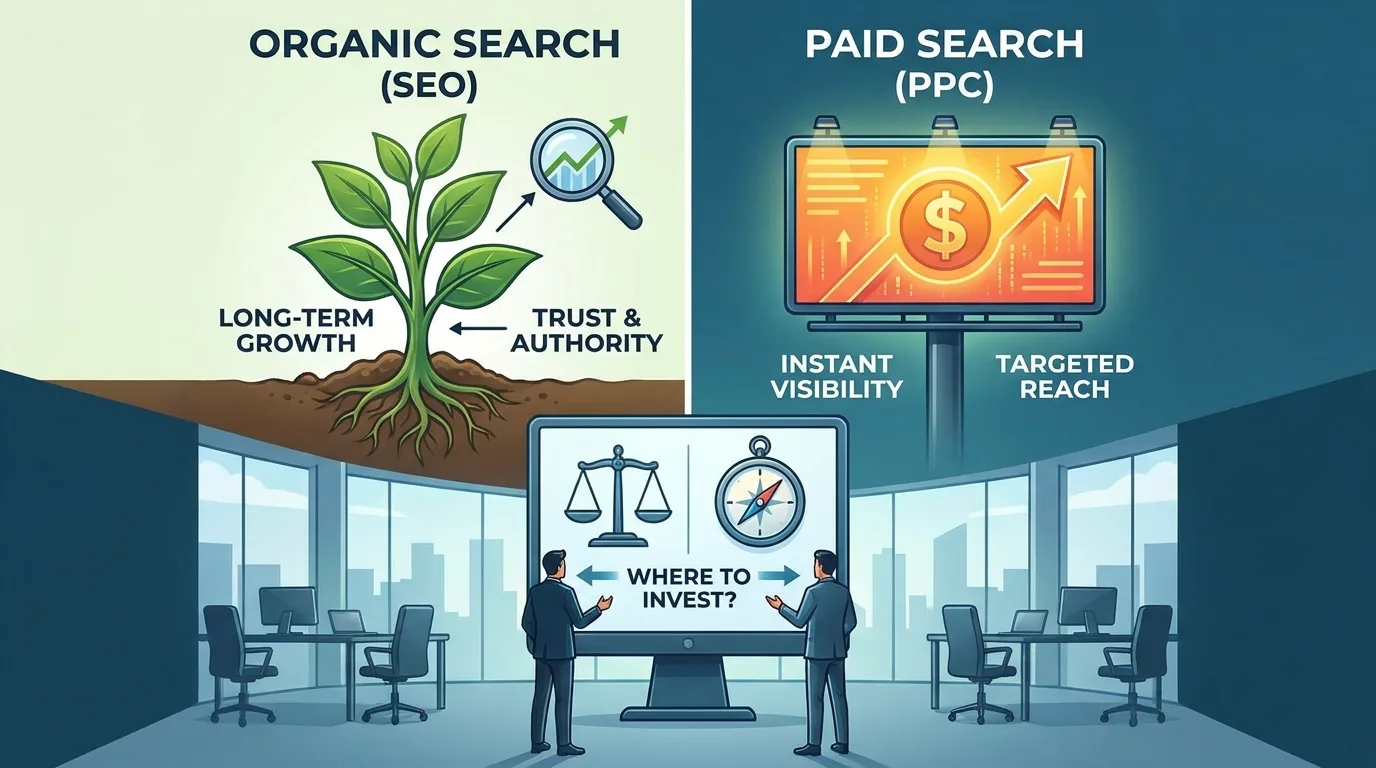
Organic search is unpaid visibility earned through crawlability, indexing, relevance, authority, and content quality, while paid search is sponsored visibility won through ad auction bids, targeting, Quality Score, and budget. The right mix depends on time horizon, CAC tolerance, margin structure, and how aggressively a business must capture existing search demand.12
Executive Answer: Organic vs Paid Search in One View
Why This Comparison Matters for GEO and AI Overviews
For generative search, the organic vs paid search decision is no longer a simple SEO vs PPC budget split. It is a visibility architecture decision across classic SERPs, AI Overviews, answer engines, and commercial query pathways. Organic search and paid search operate under different retrieval and delivery systems: organic rankings are earned through indexing, relevance, information gain, authority, and technical accessibility, while paid placements are purchased through auction dynamics, bid strategy, audience targeting, and landing page quality.12
This comparison matters because AI-generated search experiences tend to synthesize authoritative organic sources, while commercial interfaces often preserve monetized ad inventory for high-intent queries. That changes how brands should evaluate paid vs natural search: SEO builds retrievable knowledge assets and durable discoverability, whereas PPC captures demand immediately but only while spend remains active. For most businesses, the correct decision isn’t organic or paid search in isolation, but how organic and paid search are sequenced against revenue goals, payback period, and competitive SERP pressure.
What Organic Search and Paid Search Actually Mean
Organic Search: Unpaid Rankings, Indexing, Relevance, and Authority
Organic search refers to unpaid search visibility in which pages appear because search engines can crawl, render, index, and rank them for relevant queries. Organic rankings are influenced by content usefulness, query intent alignment, internal linking, canonicalization, page experience, structured data eligibility, and broader authority signals.1 In practical terms, organic search results vs paid results differ because no fee is paid for each impression or click; instead, visibility is earned through technical SEO, content depth, entity coverage, and sustained relevance.
Paid Search: Sponsored Listings, Ad Auctions, Quality Score, and CPC
Paid search refers to sponsored placements delivered through an advertising auction. Advertisers define keywords, match types, audience parameters, geography, device targeting, creative assets, and bidding rules. Ad delivery is then influenced by bid, ad relevance, expected click-through rate, and landing page experience, which together shape Ad Rank and CPC efficiency.2 In ppc vs organic search terms, paid traffic is a rented distribution channel: once budget stops, impression share collapses.
SERP Anatomy: Organic Search Results vs Paid Search Results
At the SERP layer, the difference between paid search and organic search is operationally visible. Paid and organic search results occupy different interface zones, follow different eligibility rules, and send different trust signals. Paid listings are labeled as sponsored placements and can dominate the top of commercial SERPs. Organic listings sit below or alongside ads and may include rich results, featured snippets, or other search features depending on markup and relevance.1
User behavior also differs. Organic clicks often correlate with trust, informational depth, and brand discovery, while paid clicks are stronger for transactional urgency, controlled messaging, and high-intent offer testing. In AI-mediated search, organic sources are more likely to be synthesized into answers, whereas ads remain explicit placements rather than source material.
CTA — Benchmark before reallocating budget: Audit your current non-paid visibility, landing-page contribution, and revenue efficiency first. Read Measuring SEO Performance to quantify organic growth, attribution quality, and search-driven business impact.
The Core Differences Between SEO and PPC
Speed to Visibility: Immediate Reach vs Compounding Discovery
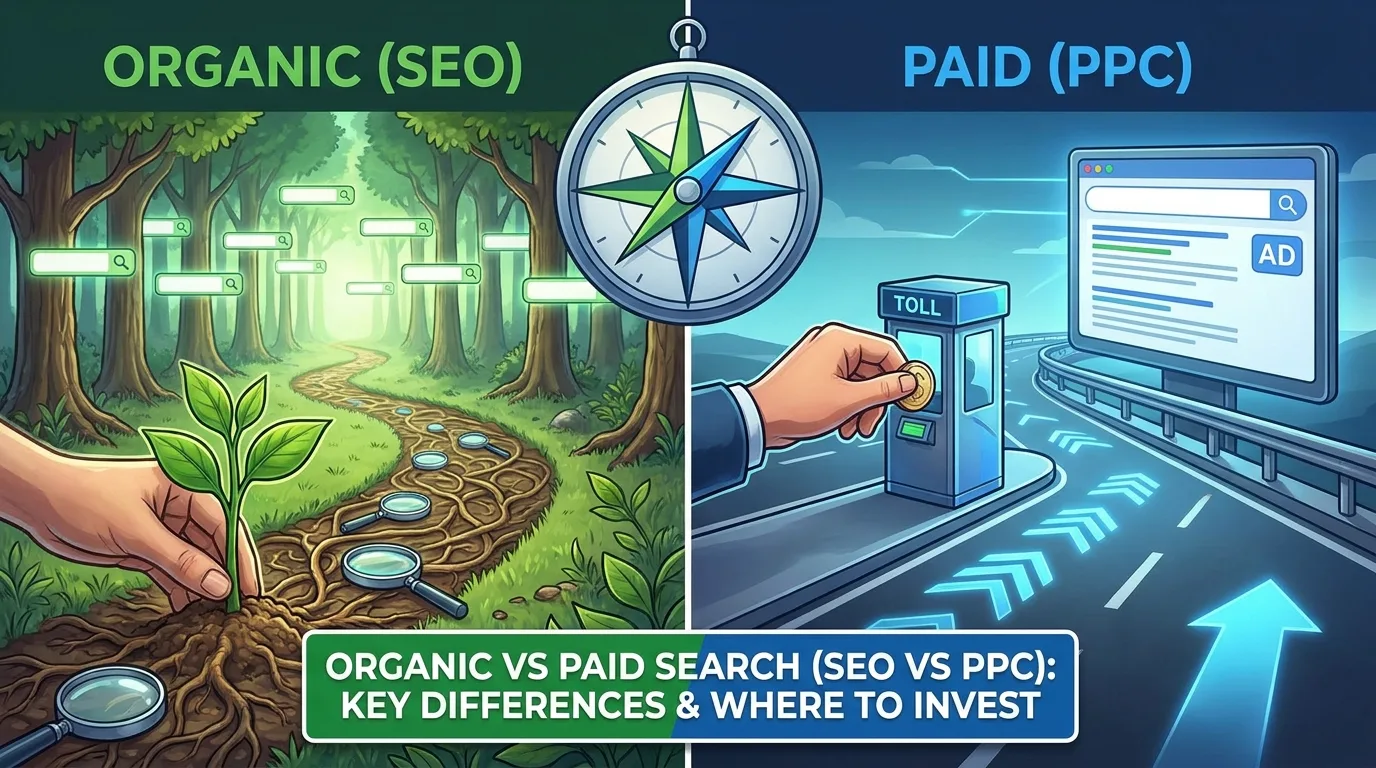
The central distinction in organic search vs paid search is time-to-impact. PPC can generate impressions and clicks within hours of campaign launch, assuming budget, targeting, and policy approval are in place. SEO typically requires weeks or months to improve crawl frequency, indexing depth, ranking positions, and query coverage, especially in competitive verticals.12 That makes paid search effective for immediate demand capture, while organic search is superior for compounding discovery over time.
Cost Structure: CPC Spend vs Content, Technical, and Authority Investment
Paid traffic uses a variable cost model. Each click has a direct acquisition cost tied to CPC, conversion rate, and auction pressure. Organic traffic uses an asset-building cost model: content production, technical remediation, information architecture, internal linking, digital PR, and measurement infrastructure. Organic seo vs paid seo is therefore not free vs paid; it is rented traffic vs owned discoverability. SEO front-loads investment and can lower blended CAC over time, while PPC offers cleaner short-term spend control but rising marginal costs in saturated auctions.2
| Dimension | Organic Search (SEO) | Paid Search (PPC) |
|---|---|---|
| Visibility timeline | Slow initial ramp; improves through indexing and ranking growth | Immediate once campaigns are approved and funded |
| Cost model | Upfront and ongoing investment in content, technical SEO, authority, and measurement | Pay per click or impression; direct media spend plus management costs |
| Traffic durability | Can persist after publication and optimization | Stops when budget pauses |
| Click behavior | Strong for trust, research, and informational intent | Strong for transactional and high-commercial-intent queries |
| Targeting precision | Query-led, content-led, and limited by search engine ranking systems | Fine-grained control by keyword, audience, device, geography, schedule |
| Testing speed | Slower; dependent on crawl, reprocessing, and ranking changes | Fast; creative, bid, and landing-page tests can run immediately |
| Scalability | Compounds through topic authority and content breadth | Scales with budget, auction availability, and efficiency thresholds |
| Predictability | Less deterministic; affected by algorithm changes and competition | More controllable; constrained by CPC inflation and impression share |
| Trust perception | Often higher due to editorial ranking status | Lower trust for some users due to sponsored labeling |
| Best use cases | Long-term demand capture, authority building, lower blended CAC | Launches, promotions, branded defense, rapid lead generation |
Control, Testing, and Predictability Across Both Channels
PPC offers superior short-cycle control. Advertisers can test headlines, offers, audiences, and landing pages rapidly, then route spend toward high-converting segments. SEO is less controllable because search engines decide when to crawl, index, rewrite titles, and reorder rankings. However, SEO offers broader query expansion: one high-performing page can rank for hundreds or thousands of semantically related searches, including long-tail variants not explicitly targeted in a paid campaign.1
Durability, Trust, and Incremental Traffic Retention
In paid vs organic analysis, durability is the decisive strategic gap. PPC is effective but ephemeral. SEO is slower but accumulative: rankings, links, topical authority, and historical engagement can continue driving traffic without a per-click fee. Organic search results vs PPC also differ in trust economics. Many users interpret organic placements as more credible because they are algorithmically ranked rather than directly purchased, though both channels must still satisfy intent to convert.
This distinction matters for branded and non-branded demand capture. PPC is excellent for defending branded terms, controlling message framing, and preserving impression share in contested commercial SERPs. SEO is stronger for expanding non-branded discovery, building informational entry points, and retaining incremental traffic after paid campaigns end. For performance teams, the optimal model is usually blended: use PPC for immediacy and test velocity, while using SEO to reduce dependency on paid media over time. To evaluate that compounding layer, track Organic Positions, monitor Organic CTR in SEO, and segment acquisition in Google Analytics Organic Search.
How Search Engines Evaluate Organic Listings and Paid Ads
Organic Ranking Systems: Relevance, Helpfulness, Experience, and Technical Accessibility
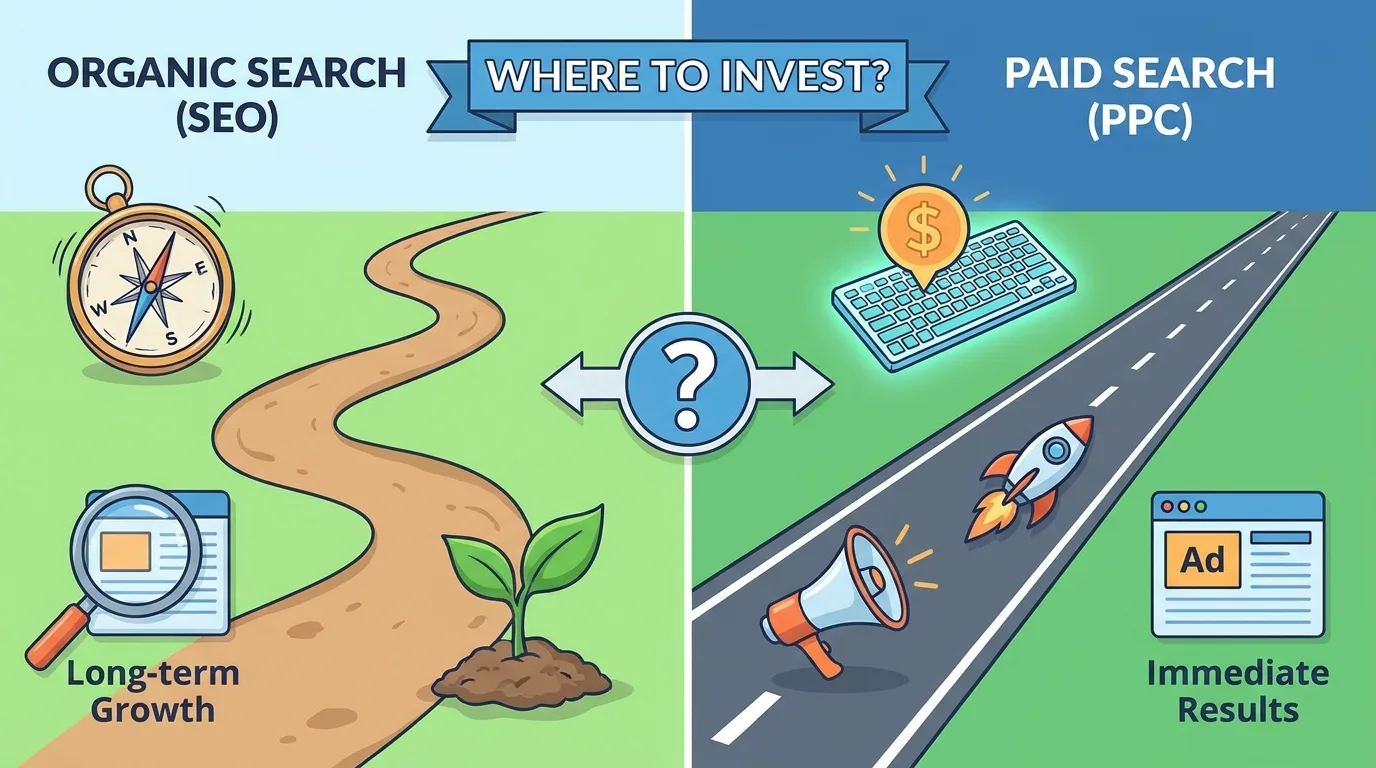
Organic evaluation begins with technical eligibility. If a page can’t be crawled, rendered, canonically consolidated, and indexed, it can’t rank. After eligibility, ranking systems assess relevance to the query, content helpfulness, information quality, page experience signals, internal linking context, and broader site-level trust patterns.1 Structured data doesn’t guarantee rankings, but it can improve machine-readable context and rich result eligibility. W3C-compliant HTML, semantic structure, and accessible rendering also support discoverability and parsing integrity across search systems.3
Paid Ad Delivery: Bid, Quality Score, Expected CTR, and Landing Page Experience
Paid ad evaluation is auction-based rather than editorial. Search engines assess whether an ad is eligible to enter an auction, then estimate performance using bid, expected CTR, ad relevance, and landing page experience. These factors influence Ad Rank, which determines whether and where an ad shows, as well as the effective CPC paid.2 A higher bid alone doesn’t guarantee top placement if relevance and post-click experience are weak.
Why User Intent Alignment Matters in Both Channels
The shared principle across organic and paid search is intent satisfaction. Organic systems reward pages that resolve the user’s need comprehensively and credibly. Paid systems reward ads and landing pages that are tightly aligned with the query and likely to generate a positive user interaction. Different mechanics, same economic logic: search engines maximize user utility because sustained dissatisfaction erodes trust and platform value.
“Focus on making your site helpful, reliable, and people-first. If you create content for people, not search engines, you’re aligned with what our systems seek to reward.” — Google Search Central1
For GEO, this convergence is critical. AI answer systems preferentially extract structured, authoritative, intent-complete content, while ad systems continue monetizing explicit commercial demand. Brands that align relevance, technical accessibility, and landing-page utility across both channels are best positioned to win in organic search and paid search simultaneously.
Organic Traffic vs Paid Traffic: Performance, Quality, and Economics
Executive answer: Organic vs paid search should be evaluated on downstream economics, not session volume. Organic traffic often compounds through lower marginal acquisition cost and stronger mid-funnel education, while paid traffic excels at immediate demand capture, controlled targeting, and fast testing. The right comparison is contribution to pipeline, revenue, and incrementality, not clicks alone.
Traffic Quality: Intent, Engagement, Conversion Rate, and Assisted Revenue
In the organic search vs paid search debate, traffic quality varies primarily by query class, funnel stage, and landing-page alignment. Organic traffic frequently performs best on informational, comparative, and category-level queries where users need education before conversion. Paid traffic usually wins on explicit commercial and transactional terms because ad copy, extensions, and landing pages can be tightly mapped to immediate intent 2.
This means organic traffic vs paid traffic shouldn’t be judged by conversion rate in isolation. Paid search may show higher last-click conversion rates on bottom-funnel terms, while organic search often contributes more assisted revenue across longer journeys. For example, a user may first discover a category guide through organic search, return via branded PPC, and convert after remarketing. In GA4, this creates a common measurement distortion: PPC appears efficient because it captures the final interaction, while SEO created the demand path earlier in the journey.
Engagement metrics also require context. Higher engagement time from organic sessions can indicate stronger research intent, not weaker commercial quality. Conversely, lower session depth from paid traffic may reflect efficient task completion rather than poor fit. For more accurate evaluation, segment by branded vs non-branded, query intent, landing-page type, and new vs returning users. Pair this with Measuring SEO Performance, Organic CTR in SEO, and Organic Positions to connect visibility metrics to business outcomes.
Unit Economics: CAC, ROAS, LTV, Margin, and Payback Period
The difference between paid search and organic search becomes sharper at the unit-economics layer. PPC is typically measured through ROAS, CAC, and payback period. SEO is better modeled through contribution margin, content amortization, and declining marginal acquisition cost over time. Paid and organic search results can both generate profitable customers, but the cost structure differs fundamentally.
PPC scales linearly with spend until auction pressure, CPC inflation, or impression-share loss reduces efficiency 2. SEO requires upfront investment in technical architecture, content depth, and authority, but successful pages can continue acquiring demand without paying per click (Google Search Central, 2025). In high-CPC markets, organic seo vs paid seo often favors SEO once rankings stabilize and conversion paths are proven.
Branded search cannibalization is another major issue. If paid ads absorb clicks that would have arrived through organic search results vs paid placements anyway, reported PPC efficiency may be overstated. Incrementality testing, geo holdouts, and branded campaign controls are essential to determine whether paid spend creates net-new demand or merely captures existing intent.
Attribution Pitfalls in GA4 and Multi-Touch Journeys
GA4’s event-based model improves path analysis, but default reporting can still over-credit last non-direct interactions if teams don’t actively compare attribution models and channel groupings. Organic search and paid search should be reviewed in parallel across first user, session, and conversion dimensions. Brand search, cross-device journeys, consent loss, and offline sales feedback loops can all distort channel value.
Use a reporting framework that separates:
- branded vs non-branded search
- informational vs commercial vs transactional queries
- landing pages by funnel role
- first-touch, assisted, and last-touch revenue
- new customer CAC vs blended CAC
- incrementality vs attributed conversions
Audit contribution to pipeline, not just clicks. Map how organic and paid sessions influence assisted conversions, branded demand, and revenue quality with Google Analytics Organic Search: GA4 Keyword Tracking.
When SEO Is the Better Investment
Long Buying Cycles, High Information Intent, and Category Education
SEO is the stronger investment when demand formation depends on education, comparison, and trust accumulation. In ppc vs organic search analysis, SEO usually outperforms for long buying cycles where users ask multiple questions before selecting a vendor. B2B software, healthcare education, financial explainers, and technical product comparisons are strong examples because the path to conversion is research-heavy and query breadth is large.
Organic search and paid search don’t serve the same role here. Paid ads can intercept high-intent demand, but they are inefficient for covering every informational variation, objection, and subtopic at scale. SEO captures recurring informational demand through structured content hubs, comparison pages, glossaries, and expert-led explainers that align with how search systems and AI answer engines extract authoritative passages 13.
Compounding Returns Through Content Depth and Topical Authority
Where seo organic vs paid favors SEO most clearly is in evergreen markets with stable search demand and high CPCs. A well-ranked page can generate traffic, links, citations, and entity reinforcement for months or years, reducing blended CAC over time. This compounding effect is especially valuable when budgets are constrained or when paid acquisition costs are volatile.
For GEO, SEO also creates citation eligibility. Pages with semantic structure, intent-complete answers, supporting entities, and strong internal linking are more likely to be surfaced in AI-generated summaries and retrieval systems (Google Search Central, 2025). That makes organic search results vs ppc more than a click-acquisition decision; it becomes an authority and knowledge-surface strategy.
Defensibility, Brand Trust, and Lower Marginal Acquisition Costs Over Time
Owned search assets are strategically durable. Rankings can fluctuate, but a technically sound site with topical authority, strong internal links, and trusted content creates defensibility that ad spend alone can’t replicate. Organic visibility also carries trust advantages because many users distinguish organic search results vs paid placements and associate editorial ranking with relevance.
When PPC Is the Better Investment
Urgent Demand Capture, Product Launches, and Geographic Targeting
PPC is the better investment when speed, control, and immediate visibility matter more than long-term compounding. In paid vs organic decision-making, paid search dominates when a business needs leads now: product launches, seasonal promotions, local service expansion, event-driven demand, or inventory liquidation.
Paid search also outperforms when geographic precision is essential. Local service businesses, multi-location brands, and region-specific campaigns can target by location, schedule, device, and audience segment with far more control than SEO alone 2. This makes ppc vs organic especially favorable where service availability, pricing, or urgency varies by market.
High-Intent Commercial Queries and Fast Testing Loops
For transactional keywords, paid and organic search results behave differently. PPC can place an offer directly at the top of the SERP, with message control through headlines, sitelinks, callouts, and landing-page matching. That is especially effective for “buy,” “book,” “quote,” “demo,” and near-me query classes.
PPC also provides faster testing loops. Teams can validate keyword intent, offer framing, and landing-page conversion paths in days rather than months. This is one of the strongest advantages in the organic vs paid search comparison: paid media generates immediate behavioral data that can later inform SEO content strategy.
Budget-Backed Scale, Audience Segmentation, and Offer Validation
Paid search scales with budget and operational discipline. It enables audience exclusions, remarketing paths, competitor conquesting, and segmented landing experiences that organic search can’t fully replicate. However, this advantage has limits: CPC inflation, auction competition, ad fatigue, and impression-share constraints can erode efficiency quickly 2. Traffic also stops when spend stops, making paid search highly effective but structurally dependent on ongoing budget.
Why the Best Strategy Is Often Organic and Paid Search Together
Full-Funnel Search Coverage Across Informational, Commercial, and Transactional Intent
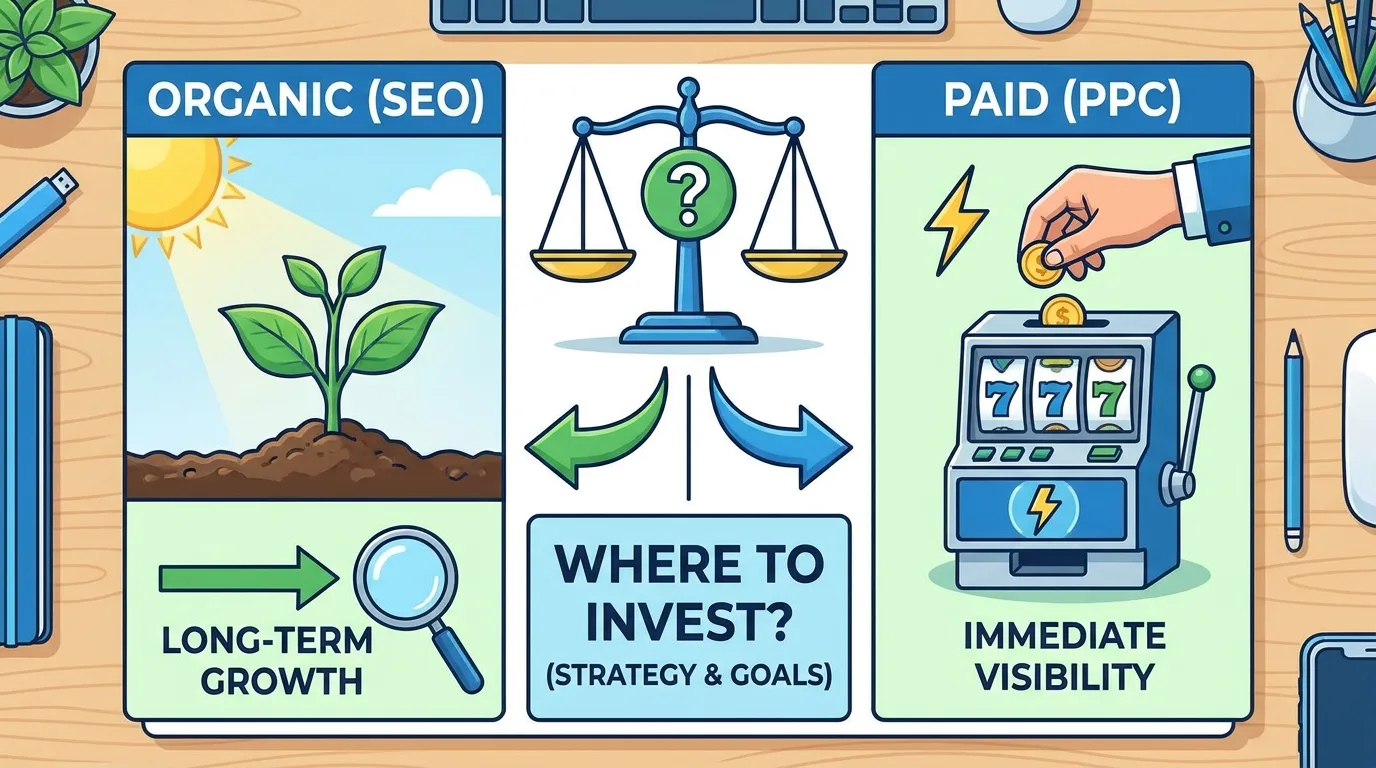
The highest-performing search programs rarely choose paid vs natural search as a binary. They integrate both. Organic and paid search together provide full-funnel SERP coverage: SEO captures informational and comparative demand, while PPC captures urgent commercial intent and protects branded visibility. This reduces dependence on any single ranking system or auction environment.
Using PPC Query Data to Inform SEO Content and SERP Targeting
PPC is an efficient keyword validation engine. Search term reports, ad CTR, conversion rate by query, and landing-page performance reveal which topics deserve long-form SEO investment. If paid campaigns show strong conversion efficiency on a comparison modifier, pricing theme, or use-case phrase, that signal can guide editorial prioritization for organic search content.
Using SEO Insights to Lower Paid Acquisition Costs and Improve Quality
SEO insights also improve paid efficiency. High-performing organic landing pages can be adapted for paid use, reducing bounce risk and improving relevance. Strong information architecture, semantic clarity, and page experience support better landing-page utility, which influences ad performance and quality signals in paid systems 23. Organic CTR and ranking data can also identify where paid support is necessary to defend high-value SERPs and where organic strength allows budget reallocation.
“The best search programs stop arguing about channel ownership and start measuring intent coverage, incrementality, and blended CAC. SEO builds durable demand capture; PPC buys speed and precision. Together, they outperform siloed optimization almost every time.” — Avinash Kaushik, digital marketing and analytics leader
Operationally, integrated teams should share:
- paid search term reports to identify emerging SEO topics
- organic ranking and CTR data to prioritize paid defense
- landing-page conversion data across both channels
- branded vs non-branded performance splits
- assisted-conversion and path-length reporting in GA4
- margin and LTV data by query cluster, not just by channel
This is the practical answer to organic search vs paid search: use PPC for speed, testing, and demand capture; use SEO for authority, scale, and cost efficiency; use both to improve resilience against algorithm volatility, CPC inflation, and attribution bias.
Executive Answer
Organic vs paid search isn’t a binary choice. SEO compounds authority, non-branded visibility, and marginally efficient demand capture over time, while PPC delivers immediate reach, controllable targeting, and faster testing. The optimal mix depends on site maturity, sales urgency, budget tolerance, query economics, and measurement discipline across funnel stages.12
Decision Framework: Where to Invest by Business Model, Budget, and Timeline
Startup, SMB, Enterprise, and Marketplace Scenarios
The difference between paid search and organic search is most visible when mapped to business constraints rather than channel ideology. New domains with limited authority typically struggle to win competitive organic search results at speed, making PPC the practical launch channel for immediate visibility, message testing, and early conversion data.12 By contrast, mature brands with existing demand should defend branded SERPs with paid and organic search together, especially where competitors bid on brand terms or SERP features compress organic CTR.
| Business scenario | Primary investment bias | Time to impact | Core resource requirement | Governance constraint |
|---|---|---|---|---|
| New startup, low authority site | PPC-first, SEO foundation | PPC: days; SEO: 3-9 months | Paid media operator, technical SEO setup, conversion tracking | Cash efficiency, limited content velocity |
| SMB needing immediate leads | Hybrid with local SEO + high-intent PPC | PPC: days; SEO: 2-6 months | Landing pages, local optimization, call tracking | Small team bandwidth |
| Enterprise brand protecting demand | Integrated SEO + PPC | PPC: immediate; SEO: ongoing compounding | Cross-functional SEO, media, analytics, legal | Slow approvals, fragmented ownership |
| Marketplace or publisher | SEO-first with selective PPC | SEO: 4-12 months; PPC: tactical | Scalable content systems, taxonomy, internal linking, feed quality | Indexation control, template governance |
For publishers monetizing informational traffic, organic search vs paid search usually favors SEO because CPC arbitrage is fragile while organic scale improves margin durability. For local services, paid vs organic shouldn’t be framed as either-or; map packs, local landing pages, and call-driven PPC often outperform single-channel execution.
Choosing by Funnel Stage, Sales Cycle, and Revenue Urgency
PPC vs organic search should be selected by intent class. Bottom-funnel commercial queries with clear conversion paths often justify paid acquisition if CPA remains below contribution margin. Upper-funnel informational queries usually favor SEO because repeated paid exposure against low-intent traffic degrades efficiency. Long sales cycles require blended reporting: PPC creates immediate pipeline coverage, while SEO builds trust, category education, and assisted conversions over time.1
If revenue urgency is high, paid search absorbs more budget. If category education and non-brand demand creation matter, organic and paid search should be sequenced: PPC for rapid demand capture and SEO for durable query ownership.
A Simple Allocation Model for SEO, PPC, and Hybrid Search Programs
Use a practical allocation model based on maturity, urgency, and economics:
- 70/20/10 PPC/SEO/experimentation: new site, urgent revenue, no ranking base.
- 40/40/20 PPC/SEO/CRO-content: SMB with some traction, mixed funnel demand.
- 30/50/20 PPC/SEO/technical-content expansion: established brand seeking lower blended CAC.
- 20/60/20 PPC/SEO/analytics-governance: publisher or marketplace scaling organic traffic vs paid traffic efficiency.
Executives comparing ppc vs organic should require three inputs before allocation: expected time-to-impact, marginal acquisition cost, and operational capacity to sustain landing page, content, and measurement quality.
Measurement Framework: KPIs for Organic Search and Paid Search
SEO KPIs: Rankings, Organic CTR, Non-Branded Clicks, Conversions, and Share of Voice
SEO measurement must extend beyond rankings. The required KPI stack includes impressions, clicks, indexed pages, average position, page-level visibility, non-branded clicks, assisted conversions, and revenue contribution. Organic search results vs paid should be normalized by query intent and brand status; otherwise branded navigational demand will distort performance comparisons.
Priority SEO metrics:
- Impressions and clicks by landing page and query class
- Organic positions for priority keyword clusters and entity sets
- Organic CTR by rank band, device, and SERP feature presence
- Indexed vs submitted pages to detect crawl and rendering inefficiency
- Non-brand sessions and conversions to measure true market expansion
- Assisted revenue and conversion lag to capture upper-funnel influence
Use Google Analytics Organic Search, Measuring SEO Performance, Organic CTR in SEO, and Organic Positions to build a defensible reporting layer.
PPC KPIs: CPC, CPA, ROAS, Impression Share, and Conversion Value
For paid search, the baseline KPI set is spend, clicks, CPC, conversion rate, CPA, ROAS, impression share, lost impression share due to budget or rank, and conversion value by match type, audience, and device.2 Advanced evaluation should include marginal CPA, incrementality, and landing page experience because ad auction outcomes depend on bid, relevance, and expected user experience.2
Unified Search Reporting for Executive Decision-Making
A fair organic search and paid search dashboard should segment:
- Brand vs non-brand
- Informational vs commercial vs transactional intent
- New vs returning users
- Short vs long conversion lag
- Assisted vs last-click contribution
This prevents false conclusions such as “PPC is expensive” or “SEO is free.” Executive reporting should compare channels on normalized revenue contribution, blended CAC, and share of high-intent SERP visibility rather than raw clicks alone.
Common Mistakes in SEO vs PPC Budget Allocation
Over-Reliance on Last-Click Attribution
Last-click models systematically understate SEO’s role in discovery and consideration while overstating branded PPC efficiency. Organic and paid search often interact across multiple sessions, devices, and query refinements, making assisted conversion analysis essential.
Treating SEO as Free or PPC as Universally Expensive
Organic seo vs paid seo is often misframed by cost optics. SEO requires engineering, content operations, information architecture, structured data, QA, and measurement investment.13 PPC can be highly efficient on branded defense, local emergency intent, or tightly matched high-conversion keywords. The correct comparison isn’t channel cost in isolation, but marginal profit after fulfillment and retention.
Ignoring SERP Features, AI Overviews, and Query Intent Shifts
Paid vs natural search outcomes change as SERPs evolve. AI Overviews, featured snippets, local packs, shopping units, and ad-heavy layouts can suppress traditional organic CTR even when rankings remain stable. Weak landing page alignment also reduces Quality Score and inflates CPC in paid search.2 Budget decisions must therefore reflect SERP design, zero-click behavior, and intent volatility rather than static rank reports.
References, Source Plan, and Final Recommendation
- SEO mechanics, indexing, and people-first guidance from Google Search Central1
- Ad auction, Ad Rank, Quality Score, and landing page factors from Google Ads Help2
- Semantic HTML and machine-readable document structure from W3C3
- Measurement, attribution, and search evaluation frameworks from IEEE, arXiv, and analyst research where applicable
Recommended Investment Paths by Scenario
The most reliable recommendation model is straightforward:
- Invest primarily in SEO when the goal is durable non-brand demand capture, content-led discovery, and lower long-run acquisition cost.
- Invest primarily in PPC when speed, launch visibility, geographic targeting, or immediate lead generation is the priority.
- Invest in both when the business has enough maturity, budget, and analytics discipline to coordinate organic search results vs PPC across the full funnel.
For most organizations, ppc vs organic is best resolved as sequencing, not opposition: PPC validates demand and accelerates revenue; SEO compounds authority and reduces dependency on rented traffic over time.
Closing Summary and Next Step
Organic vs paid search should be governed by business model, conversion lag, SERP economics, and operational capability. SEO wins on durability and trust. PPC wins on speed and control. Integrated search wins when leadership measures both against normalized revenue contribution instead of channel silos.
Build a search investment plan grounded in rankings, CTR, and revenue contribution. Start with Organic Positions: Meaning, SEO Impact & Tracking.
References & Authoritative Sources
Footnotes
-
Google Search Central. SEO Starter Guide and people-first content guidance, accessed 2025. ↩ ↩2 ↩3 ↩4 ↩5 ↩6 ↩7 ↩8 ↩9 ↩10 ↩11 ↩12 ↩13 ↩14
-
Google Ads Help. Ad auction, Ad Rank, Quality Score, and landing page experience documentation, accessed 2025. ↩ ↩2 ↩3 ↩4 ↩5 ↩6 ↩7 ↩8 ↩9 ↩10 ↩11 ↩12 ↩13 ↩14 ↩15 ↩16 ↩17
-
W3C. HTML and web standards guidance for semantic, accessible, machine-readable web documents, accessed 2025. ↩ ↩2 ↩3 ↩4 ↩5
Frequently Asked Questions & Citations
Organic search is unpaid visibility earned when search engines crawl, index, and rank pages based on relevance, authority, and technical accessibility. Paid search is sponsored visibility won through ad auctions using bids, keyword targeting, expected click-through rate, ad relevance, and landing page experience.
PPC is the better choice when a business needs immediate traffic, fast testing, or rapid coverage for high-intent commercial queries. It is especially useful for new sites with little authority, seasonal campaigns, product launches, and markets where organic rankings will take months to build.
In many cases, yes, because strong organic content can keep generating impressions, clicks, and assisted conversions long after publication without paying per click. Paid search usually delivers faster results, but its marginal traffic stops as soon as spend pauses, which can make blended CAC and payback less favorable over time.
AI Overviews tend to synthesize information from authoritative, well-structured organic sources, so SEO now supports both classic rankings and answer-engine retrieval. Paid search still remains critical on high-commercial-intent queries because monetized placements often persist above or alongside AI-generated results.
Teams should compare non-brand and brand click share, conversion rate, revenue per session, blended CAC, payback period, impression share, assisted conversions, and lifetime value by channel. For paid search, monitor CPC, Quality Score, and search lost IS due to budget or rank; for organic, track indexed pages, rankings, click-through rate, and share of voice.
Use PPC to capture immediate demand, validate keyword intent, and identify high-converting landing page themes, then use those insights to prioritize SEO content and information architecture. At the same time, protect branded queries with paid coverage when competitors bid aggressively, and let organic rankings reduce dependency on paid spend where sustainable positions are achieved.
Digital Marketing Specialist in Technical SEO, Generative Engine Optimization (GEO), and paid search acquisition.
Related Technical Guides & Frameworks
Organic Traffic Meaning: SEO Definition and Metrics
Learn organic traffic meaning, how it differs from paid, direct, and referral traffic, and how to measure SEO clicks, conversions, and revenue accurately.
Organic SEO Marketing: Long-Term Success Metrics
Learn what defines long-term organic SEO marketing success: qualified traffic growth, durable rankings, stronger engagement, clean indexation, and conversions.
Organic Search Visibility: Meaning, Metrics & SEO
Learn what organic search visibility means, how it differs from rankings and traffic, and how to improve SERP presence in modern SEO.
Organic Positions: Meaning, SEO Impact & Tracking
Learn what organic positions mean in SEO, how rankings affect CTR, traffic, and visibility, and how to track them against SERP features and intent.