
Natural Search Definition: What It Means for SEO

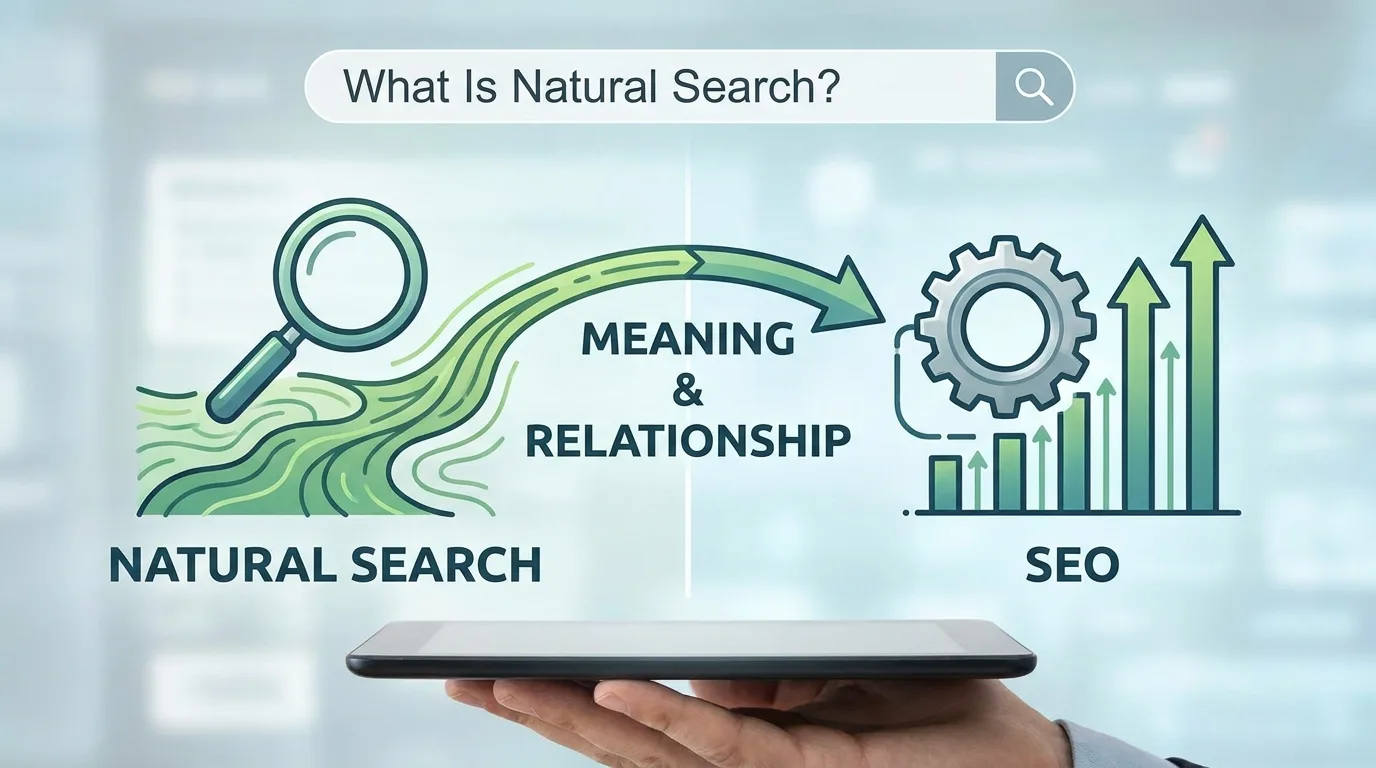
Natural search is unpaid visibility in search engine results generated by relevance, quality, and ranking systems rather than advertising spend. SEO is the discipline that improves a site’s eligibility, discoverability, and performance within that unpaid channel through technical optimization, content relevance, information architecture, and authority building.12
Executive Answer: Natural Search Definition in 40-60 Words
Natural search refers to unpaid discovery through search engines, where pages appear because ranking systems evaluate relevance, quality, usefulness, and authority instead of ad bids. SEO is the operational framework used to improve that visibility by strengthening crawlability, indexability, topical coverage, user satisfaction, and search-result performance.12
Natural Search Meaning: Core Definition, Scope, and Terminology
Natural search vs organic search: are they the same?
In modern SEO usage, natural search and organic search are effectively synonymous. Both describe unpaid search engine results earned through relevance and ranking signals rather than sponsored placement. The term organic search is more common in analytics platforms and Google documentation, while natural search persists in editorial, legacy SEO, and client-facing strategy language.13
A precise natural search definition is: visibility and traffic generated from unpaid search listings across search engine interfaces, including classic blue links, rich results, image search, video search, local packs, and increasingly AI-mediated answer surfaces where source selection still depends on retrieval and ranking systems.14
How search engines generate unpaid results
Unpaid results are not random listings. Search engines discover URLs through crawling, process content through rendering and indexing, then rank eligible documents using systems that estimate relevance to a query, content quality, page usability, freshness, location, language, and other contextual signals.12 In other words, natural search is an earned retrieval outcome, not a purchased placement.
This matters because visibility depends on technical accessibility and semantic alignment. If a page cannot be crawled, rendered, canonically consolidated, indexed, or interpreted correctly, it cannot compete effectively in natural search regardless of brand strength.
CTA — Strengthen natural search coverage: Build a stronger unpaid visibility base by mapping queries to intent clusters and topic entities with What Are Organic Keywords? SEO Definition Guide.
Why the term still matters in modern SEO and GEO
The term still matters because the search environment has expanded beyond ten blue links. Natural search now includes web results, mobile results, voice-assisted retrieval, AI Overviews, featured snippets, knowledge surfaces, and zero-click result environments where visibility may occur without a traditional session-level click.14 For GEO, the core principle remains unchanged: authoritative, well-structured, retrievable content is more likely to be surfaced, cited, summarized, or linked by search and answer engines.
That makes natural search a broader strategic concept than raw “organic traffic.” It includes presence, citation eligibility, snippet capture, answer extraction, and brand exposure across retrieval layers.
How Natural Search Works Inside Modern Search Engines
Crawling, rendering, indexing, and ranking
Natural search visibility begins with URL discovery. Search engines find pages through internal links, XML sitemaps, backlinks, feeds, and prior crawl history. They then request the page, interpret HTTP status codes, process robots directives, and evaluate canonical hints before deciding whether the URL should be crawled further or consolidated with another version.1
Next comes rendering. Modern search engines often need to execute JavaScript to access late-loaded content, links, and structured data. If critical content is hidden behind blocked resources, unstable hydration, or client-side rendering failures, the page may be only partially understood.15
Then comes indexing, where the engine stores processed representations of the page: text, metadata, canonical relationships, media references, structured data, and language signals. Indexing is not guaranteed. Thin duplication, soft errors, low-value content, or canonical conflicts may prevent inclusion.1
Finally, ranking systems evaluate indexed candidates against a query. This stage incorporates lexical matching, semantic interpretation, intent classification, freshness, link-based authority, document quality, usability, and contextual modifiers such as device, location, and personalization constraints.26
Query intent, relevance signals, and quality evaluation
Natural search performance depends on matching search intent with the right content type and depth. Informational queries may favor explainers, commercial queries may favor comparison pages, and navigational queries may favor brand destinations. Search systems attempt to infer that intent from query patterns, historical behavior, and document relationships.26
Quality evaluation extends beyond keyword inclusion. Engines assess whether a page demonstrates expertise, originality, clarity, helpfulness, and sufficient supporting evidence. Structured headings, schema markup, internal linking, and entity-rich copy improve machine interpretation, but they do not substitute for substantive usefulness.12
“Google’s automated ranking systems are designed to sort through hundreds of billions of webpages and other content in our Search index to present the most relevant, useful results in a fraction of a second.” — Google Search Central2
How SERP features and AI Overviews affect natural visibility
Modern natural search is mediated by result-layer features: featured snippets, People Also Ask, local packs, image carousels, video modules, shopping panels, and AI Overviews. These can either increase exposure or suppress clicks by resolving the query directly on the results page.14
This changes optimization priorities. Sites now compete not only for rank position, but also for extractability: concise definitions, scannable structures, schema-supported entities, source credibility, and answer-ready passages. In GEO terms, content must be optimized for both ranking retrieval and citation retrieval. Monitoring click-through behavior with CTR SEO and auditing technical blockers with Free SEO Audit Tools are now baseline practices. For broader answer-engine strategy, see The Complete Generative Engine Optimization (GEO) Blueprint for 2026.
Natural Search vs Paid Search vs Direct Traffic
What distinguishes unpaid listings from ads
Natural search is earned through relevance and ranking systems. Paid search is purchased through auction-based advertising platforms where visibility depends on bids, quality signals, targeting, and budget constraints. Direct traffic, by contrast, generally represents visits without a referring source being passed, often from typed URLs, bookmarks, dark traffic, or attribution loss.7
The key distinction is placement mechanism. Natural search placement is algorithmic and unpaid. Paid placement is transactional and campaign-controlled. Direct traffic is not a search placement at all; it is an analytics source classification.
Attribution differences in analytics platforms
In GA4 and similar analytics systems, channel grouping can obscure reality. Some “direct” sessions are actually unattributed organic or referral visits due to browser privacy controls, app transitions, HTTPS-to-HTTP edge cases, or missing campaign parameters.7 Likewise, branded searches may appear under organic search even when prior paid or social exposure created the demand.
This means channel analysis should distinguish between:
- Acquisition source: where the session was attributed
- Discovery mechanism: how the user first learned about the brand
- Conversion influence: which touchpoints assisted the outcome
When channels overlap in real user journeys
Real journeys are blended. A user may first see a paid ad, later return through natural search, then convert via a direct visit. Another may encounter an AI Overview, click an organic result, leave, and later revisit by typing the domain. For this reason, natural search should be evaluated as both a traffic source and a visibility layer that shapes brand recall, trust, and downstream conversion efficiency.
| Channel | Cost model | Placement mechanism | Click behavior | Scalability | Time-to-impact | Trust profile | Measurement | GEO implications |
|---|---|---|---|---|---|---|---|---|
| Natural Search | No per-click media cost; investment is in SEO, content, and technical infrastructure | Algorithmic ranking based on relevance, quality, authority, and usability | Often strong for informational and high-intent discovery; affected by SERP features and snippets | High long-term scalability if content and technical systems compound | Medium to long-term | Generally high user trust because listings are earned, not sponsored | Tracked as organic search, but impacted by zero-click behavior and attribution loss | Critical; source eligibility for AI summaries, citations, and answer extraction |
| Paid Search | Pay-per-click or impression-based spend | Ad auction using bids, quality score, targeting, and budget | Immediate traffic potential; click rate depends on ad copy, competition, and query intent | Scales with budget, but marginal costs rise in competitive auctions | Immediate to short-term | Lower or mixed trust due to ad labeling, though strong for transactional intent | Highly measurable at campaign level | Useful for demand capture, but limited authority transfer into generative citation systems |
| Direct Traffic | No media cost per session, but often reflects prior brand investment | No SERP placement; session arrives without referrer or with lost attribution | Strong for known brands, repeat visitors, and navigational behavior | Limited by brand awareness and attribution quality | Variable | High for existing audiences; indicates familiarity or recall | Often noisy because unattributed traffic inflates this bucket | Indirect; strong brands are more likely to be searched, cited, and revisited across answer engines |
How SEO Relates to Natural Search Performance
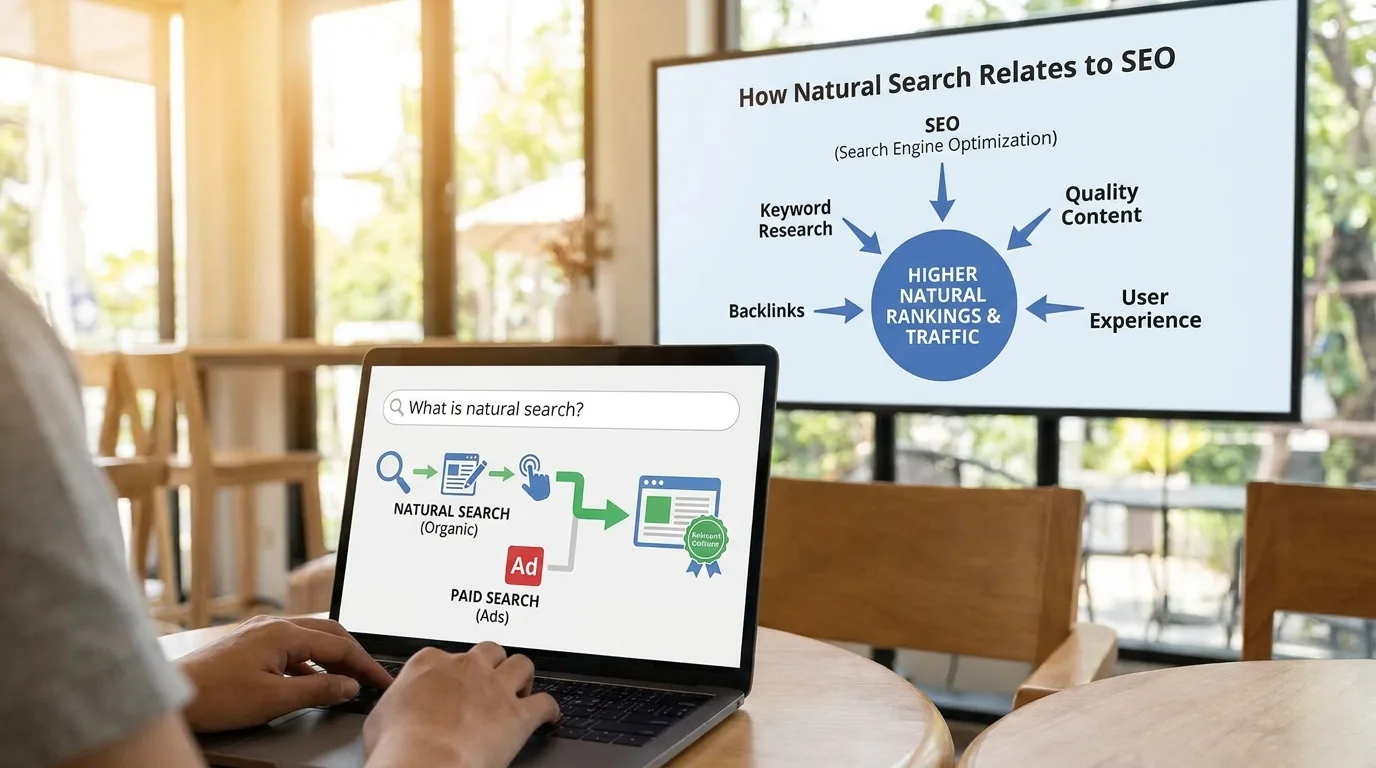
Natural search is the unpaid search results channel; SEO is the operational discipline used to improve visibility within that channel. SEO strengthens relevance, crawlability, authority, and user experience, but rankings remain probabilistic outcomes driven by search engine systems, query intent, competition, and evolving result layouts. 12
SEO as the optimization system behind natural visibility
Natural search is the outcome environment: the set of unpaid listings surfaced by search engines for a query. SEO is the optimization framework applied to increase a site’s eligibility, discoverability, and comparative relevance within that environment. In practical terms, natural search is the result; SEO is the method.
This distinction matters because many teams treat “natural search” and “SEO” as synonyms. They are not. A page can exist in natural search without strong SEO, but sustained visibility usually depends on deliberate optimization across content, architecture, and authority signals. Google’s systems evaluate documents against intent, quality, usability, and trust-related cues rather than rewarding optimization in isolation.12
On-page, technical, off-page, and UX contributions
SEO influences natural search performance through multiple interdependent layers:
- On-page SEO: semantic relevance, title tags, headings, internal anchors, entity coverage, information gain, and alignment with search intent.
- Technical SEO: crawlability, indexability, canonicalization, rendering, XML sitemaps, robots directives, structured data, and log-level discoverability.15
- Off-page SEO: backlinks, brand mentions, citations, and broader authority signals that help search engines contextualize trust and prominence.
- UX and performance: Core Web Vitals, mobile usability, accessibility, layout stability, and friction reduction, all of which affect page experience and downstream engagement quality.25
Internal linking is especially important because it distributes PageRank-like signals, clarifies topical relationships, and helps crawlers understand site hierarchy. For supporting keyword strategy, see What Are Organic Keywords? SEO Definition Guide. For click efficiency once visibility is earned, see CTR SEO.
Why SEO influences but does not control rankings
SEO does not “set” rankings. It improves the probability that a page will be crawled, indexed, interpreted correctly, and judged competitive for relevant queries. Final ranking positions depend on query-dependent scoring, competing documents, freshness needs, localization, device context, SERP features, and machine-learned ranking systems.26
“SEO is a long-term process that improves a site’s visibility and relevance over time rather than delivering guaranteed placement.” — Gartner, search marketing analysis
That is why technically sound pages can still underperform if intent match is weak, while authoritative pages may lose clicks when AI-assisted search features compress traditional blue-link demand.4 Modern programs must therefore combine classic SEO with answer-optimized publishing patterns, structured entities, and machine-readable clarity, as detailed in The Complete Generative Engine Optimization (GEO) Blueprint for 2026.
Diagnose technical blockers and visibility gaps: Use Free SEO Audit Tools: Diagnostic Stack, Ranking Checkers, and Architectural Health to identify crawl waste, indexing friction, weak internal linking, structured data gaps, and performance bottlenecks before they suppress natural search growth.
The Ranking Signals That Most Affect Natural Search
Content quality, intent match, and topical depth
The strongest natural search outcomes usually begin with intent alignment. Search engines attempt to infer whether a query is informational, navigational, commercial, transactional, or mixed, then rank documents that best satisfy that need.26 A page that targets the wrong intent class may be fully indexed yet structurally incapable of ranking well.
Content quality is not just length or keyword inclusion. It is the combination of:
- Query satisfaction: does the page answer the dominant need quickly and completely?
- Topical depth: does it cover the core entities, subtopics, definitions, comparisons, and edge cases expected for the subject?
- Information gain: does it add original value beyond what is already common in the index?
- Clarity and structure: are headings, lists, tables, and supporting evidence easy for both users and retrieval systems to parse?
For the natural search definition, this means a page should not only define the term but also distinguish it from paid search, explain its relationship to SEO, and map the metrics used to evaluate performance. That breadth helps search systems classify the page as topically complete rather than thin.
Authority, links, and entity trust
Authority remains a major differentiator when multiple pages satisfy the same intent. Search systems use links, mentions, source reputation, and broader trust cues to estimate prominence and reliability.26 In modern search, this extends beyond raw backlink counts.
High-impact authority signals include:
- editorially earned backlinks from relevant, reputable domains
- consistent brand/entity references across the web
- author and publisher transparency
- clear sourcing, citations, and factual consistency
- topical concentration across a coherent content cluster
These signals overlap with trust-oriented quality frameworks often discussed through E-E-A-T-style evaluation, even though no single metric directly measures it. The practical implication is clear: pages on natural search perform better when they exist within a credible topical ecosystem, not as isolated assets.
Technical health: indexability, Core Web Vitals, and structured data
Technical health determines whether strong content can be discovered, rendered, interpreted, and served efficiently. Critical ranking-adjacent foundations include:
- Indexability: correct status codes, canonicals, robots directives, and duplicate management1
- Crawl efficiency: shallow architecture, clean internal linking, updated XML sitemaps, and minimized orphan pages
- Rendering and semantics: HTML-first content, accessible navigation, machine-readable headings, and standards-aligned markup5
- Performance: Core Web Vitals such as LCP, INP, and CLS, which affect usability and can influence competitive outcomes where relevance is otherwise similar2
- Structured data: schema markup that clarifies entities, page type, authorship, products, FAQs, or articles, helping search engines interpret page meaning even when markup does not guarantee ranking1
Spam policy compliance also matters. Manipulative link schemes, scaled low-value pages, cloaking, or deceptive structured data can suppress visibility regardless of content volume.12 In natural search, technical excellence is not a substitute for relevance, but without it, relevance often fails to convert into stable rankings.
Measuring Natural Search: KPIs, CTR, and Business Impact
Core metrics: impressions, rankings, clicks, CTR, sessions, conversions
Natural search performance should be measured across visibility, traffic, and commercial outcome layers. The core KPI stack includes:
| Metric | What it shows | Primary source |
|---|---|---|
| Impressions | How often pages appear in unpaid search results | Google Search Console |
| Average position | Approximate ranking visibility by query/page | Google Search Console |
| Clicks | Search demand converted into visits | Google Search Console |
| CTR | Efficiency of impressions turning into clicks | Search Console; see CTR SEO |
| Sessions | On-site visits attributed to organic search | Analytics suites37 |
| Conversions | Business outcomes from natural traffic | Analytics, CRM, attribution tools |
Rankings alone are incomplete. A position gain from 6 to 3 may increase clicks materially, while a gain from 2 to 1 may produce little change if SERP features absorb attention.4
How to interpret branded vs non-branded natural traffic
Branded natural traffic reflects existing demand for a company, product, or known entity. Non-branded traffic reflects category discovery and market expansion. Both matter, but they indicate different performance states:
- Branded growth often signals stronger awareness, PR effects, or repeat demand.
- Non-branded growth more directly reflects SEO competitiveness for generic topics and commercial discovery.
Landing page segmentation is equally important. A rise in blog traffic may not translate into revenue if commercial pages remain flat. Query-class analysis should separate informational, comparison, and transactional patterns.
Measurement pitfalls in AI-assisted SERPs and zero-click search
AI-assisted results, answer modules, featured snippets, local packs, and other SERP features can reduce click opportunity even when impressions rise.4 That creates common interpretation errors:
- higher impressions with flat clicks
- lower CTR despite stable rankings
- assisted conversion value being missed in last-click models
- “lost traffic” that is actually displaced by SERP interaction layers
Analytics teams should therefore evaluate natural search through a blended lens: query visibility, landing-page engagement, assisted conversions, and downstream revenue contribution. Channel taxonomy in analytics platforms classifies organic search as unpaid search traffic, but attribution models may understate its influence when users return through direct or branded pathways later.37
Common Misconceptions About Natural Search and SEO
Natural search is not the same as “free traffic”
Natural search does not require per-click media spend, but it is not costless. Content production, technical remediation, internal linking, structured data implementation, and authority building all require sustained investment. “Unpaid” describes the traffic source, not the operating cost.3
SEO is not only keywords or backlinks
Keywords remain essential for query mapping, and backlinks still matter for authority, but neither alone defines modern SEO. Strong natural search performance depends on intent match, crawlable architecture, semantic clarity, page experience, trust signals, and content usefulness. A narrow keyword-only or link-only model misses how ranking systems evaluate documents holistically.12
Ranking gains do not always translate into traffic gains
Higher rankings can still produce weak traffic if SERP layouts change, AI summaries intercept clicks, or the query has low commercial value.4 Likewise, a page can improve discoverability and brand exposure without generating proportional sessions. Strategic SEO therefore optimizes for qualified visibility and business impact, not position metrics in isolation.
Natural Search in the GEO Era: AI Overviews, Retrieval, and Answer Engines
Natural search now extends beyond ten blue links into AI-mediated discovery, where search systems retrieve, rank, summarize, and cite web content. In this model, strong natural search visibility depends on classic SEO foundations plus GEO signals: entity clarity, machine-readable structure, evidence-backed claims, and content formatted for retrieval and synthesis.
How generative engines source and synthesize web content
Generative search experiences do not replace retrieval; they add a synthesis layer on top of indexing, ranking, and document selection. In practice, answer engines and AI overviews commonly follow a retrieval-augmented generation pattern: identify the query intent, retrieve relevant documents or passages, rank candidate sources, extract salient facts, and generate a compressed answer grounded in those sources.26 This makes natural search visibility increasingly passage-level, not only page-level.
For publishers, the implication is direct: content must be crawlable, indexable, semantically segmented, and factually stable. Pages that bury definitions, omit headings, or mix multiple intents into one block reduce retrieval precision. By contrast, concise lead definitions, explicit subtopics, and evidence-linked claims improve chunk extraction and citation likelihood in AI-assisted search surfaces (Google Search documentation, 2025; arXiv retrieval-augmented generation literature, accessed 2025).4
Why entity clarity, citation-worthiness, and structure matter
Generative systems favor content that is easy to attribute. Entity clarity means unambiguous naming of concepts, products, organizations, and relationships. Citation-worthiness means the page contains verifiable statements, original synthesis, references, and stable terminology. Structure means headings, lists, tables, schema markup, and clean HTML that support machine parsing under standard web rendering and indexing constraints.15
A page defining natural search should explicitly distinguish channel classification, ranking mechanics, user intent, and measurement. It should also reinforce adjacent entities such as organic keywords, click-through rate, search intent, indexing, structured data, and ranking systems. This is where internal topical reinforcement matters: connect the concept to What Are Organic Keywords? SEO Definition Guide and CTR SEO to strengthen semantic pathways across the site.
How to optimize for both classic rankings and AI answer inclusion
Optimization now requires dual-mode publishing:
| Objective | Classic SEO Requirement | GEO / Answer Engine Requirement |
|---|---|---|
| Rank for natural search queries | Strong on-page relevance, links, crawlability | Clear answer blocks and passage-level retrievability |
| Earn rich SERP visibility | Structured data, metadata, internal links | Citation-ready facts, concise definitions, entity disambiguation |
| Improve engagement | Match intent, improve UX, strengthen CTR | Provide quotable summaries and evidence-backed claims |
| Support machine interpretation | Clean HTML, headings, canonical signals | Semantic chunking, source attribution, schema-supported entities |
Use short definitional paragraphs near the top, tightly scoped H2/H3 sections, FAQ-style subanswers where appropriate, and references for technical claims. Treat each section as a retrievable unit. This is the practical bridge between traditional SEO and answer-engine visibility.
Expand from traditional SEO into answer-engine visibility: Read The Complete Generative Engine Optimization (GEO) Blueprint for 2026 to build content engineered for retrieval, citation, and AI-generated answer inclusion.
Implementation Framework: How to Improve Natural Search Visibility
Audit crawlability, indexation, and site architecture
Start with technical eligibility. If search engines cannot reliably crawl, render, canonicalize, and index the page, neither classic rankings nor AI retrieval layers will perform well.125 Audit robots directives, XML sitemaps, canonicals, status codes, JavaScript rendering dependencies, duplicate URL paths, and internal orphaning. Validate whether high-value pages are indexable and whether supporting documents reinforce topical clusters.
Use Free SEO Audit Tools to identify crawl waste, thin pages, redirect chains, broken internal links, and metadata conflicts. Prioritize fixes that improve discoverability and reduce ambiguity in the site’s information architecture.
Map search intent to content and internal links
Next, align content assets to intent classes: informational, navigational, commercial investigation, and transactional. Natural search performance improves when each page resolves one primary intent and links logically to adjacent subtopics. Build internal links from definitional content to supporting depth pages, comparison pages, and measurement resources. This improves both user progression and semantic reinforcement for crawlers.
Deploy descriptive anchors, not generic “read more” links. Use entity-consistent phrasing across titles, headings, and anchor text. Where relevant, add structured data that clarifies page type, organization, author, and key entities.
Strengthen authority with evidence, references, and trust signals
Authority in natural search increasingly depends on verifiability. Add references, first-hand examples, author credentials, publication dates, revision transparency, and where possible, original data or tested frameworks. Pages that make unsupported claims may still rank, but evidence-backed pages are more likely to be trusted, cited, and reused in synthesized answers.46
Measurement should include rankings, impressions, clicks, organic CTR, assisted conversions, query refinements, and appearance in search features where trackable.37 Review Search Console query patterns, identify passages earning impressions, and tighten weak sections with clearer definitions or stronger evidence.
A practical priority sequence:
- Fix crawlability and indexation barriers.
- Consolidate duplicate or overlapping intent pages.
- Add concise definitions and semantic headings.
- Strengthen internal links across related entities.
- Deploy schema where it improves machine interpretation.
- Add citations, trust signals, and source-backed claims.
- Measure query-level performance and iterate monthly.
References, Source Notes, and Closing Synthesis
Natural search is the unpaid discovery channel; SEO is the operational system used to improve visibility within that channel. In the GEO era, that distinction still holds, but the optimization target has widened. Pages must rank well enough to be retrieved and be structured well enough to be summarized, cited, and trusted by AI-assisted search systems.246
The strategic takeaway is straightforward: technical accessibility, intent alignment, entity clarity, and evidence-backed publishing now serve both conventional rankings and answer-engine inclusion. Teams that treat content as retrievable knowledge objects—not just webpages—will be better positioned for durable natural search performance.
References & Authoritative Sources
Footnotes
-
Google Search Central. “SEO Starter Guide” and crawling/indexing documentation, accessed 2025. ↩ ↩2 ↩3 ↩4 ↩5 ↩6 ↩7 ↩8 ↩9 ↩10 ↩11 ↩12 ↩13 ↩14 ↩15 ↩16 ↩17 ↩18 ↩19 ↩20
-
Google Search Central. “How Search Works” and ranking systems documentation, accessed 2025. ↩ ↩2 ↩3 ↩4 ↩5 ↩6 ↩7 ↩8 ↩9 ↩10 ↩11 ↩12 ↩13 ↩14 ↩15 ↩16 ↩17 ↩18 ↩19
-
Google Analytics and common industry channel taxonomy distinguish organic search as unpaid search traffic, accessed 2025. ↩ ↩2 ↩3 ↩4 ↩5
-
Google Search documentation on search features and AI-assisted search experiences, accessed 2025. ↩ ↩2 ↩3 ↩4 ↩5 ↩6 ↩7 ↩8 ↩9 ↩10
-
W3C web architecture and rendering standards relevant to crawlable, machine-readable content, accessed 2025. ↩ ↩2 ↩3 ↩4 ↩5 ↩6
-
Manning, Raghavan, and Schütze. Introduction to Information Retrieval; foundational retrieval concepts applied to ranking and relevance. ↩ ↩2 ↩3 ↩4 ↩5 ↩6 ↩7 ↩8
-
Google Analytics 4 documentation on default channel groups, attribution, and traffic-source classification, accessed 2025. ↩ ↩2 ↩3 ↩4 ↩5
Frequently Asked Questions & Citations
In current SEO practice, natural search and organic search mean the same thing: unpaid visibility earned through ranking systems rather than ad auctions. Organic search is the more common term in analytics tools and Google documentation, while natural search still appears in editorial content, legacy SEO language, and client reporting.
Search engines first crawl and render pages, then evaluate whether they should be indexed and ranked for relevant queries. Ranking systems assess signals such as topical relevance, content quality, internal linking, page experience, canonicalization, freshness, language, location, and the page's ability to satisfy search intent.
A page may not rank if it cannot be discovered, rendered, indexed, or correctly consolidated through canonical signals. Common causes include blocked crawling, noindex directives, weak internal links, duplicate content, JavaScript rendering issues, poor query-to-content alignment, or insufficient authority compared with competing documents.
SEO improves natural search by strengthening the technical and editorial conditions that make rankings possible. That includes optimizing crawl paths, fixing indexation issues, improving information architecture, mapping content to intent clusters, enhancing structured data, and building authority through high-quality references and links.
Track impressions, clicks, click-through rate, average position, indexed pages, and query-level landing page performance. Stronger natural search performance is usually reflected in rising non-branded impressions, improved rankings for target topics, higher CTR from rich results, and more qualified sessions and conversions from unpaid search.
Yes, natural search now extends beyond traditional blue links to include rich results, featured snippets, image and video results, local packs, and AI-mediated answer surfaces. Although the interface changes, visibility is still earned through retrieval, indexing, relevance, authority, and structured presentation rather than direct ad spend.
Digital Marketing Specialist in Technical SEO, Generative Engine Optimization (GEO), and paid search acquisition.
Related Technical Guides & Frameworks
What Are Organic Keywords? SEO Definition Guide
Learn what organic keywords are in SEO, how they drive unpaid rankings, clicks, and traffic, and how to find top organic keywords effectively.
Organic SEO Fundamentals: How Organic Search Works
Learn organic SEO fundamentals, how organic search works, and how to improve rankings with crawlability, relevance, authority, and UX.
Organic Search Engine Optimization: How It Works
Learn how organic search engine optimization improves crawlability, rankings, and AI answer visibility through technical SEO, content, and authority.
What Is Organic Ranking on Amazon? Key Factors
Learn what organic ranking on Amazon means, how it works, and which factors like relevance, CTR, conversion, reviews, and sales velocity matter most.