
What Are Organic Keywords? SEO Definition Guide
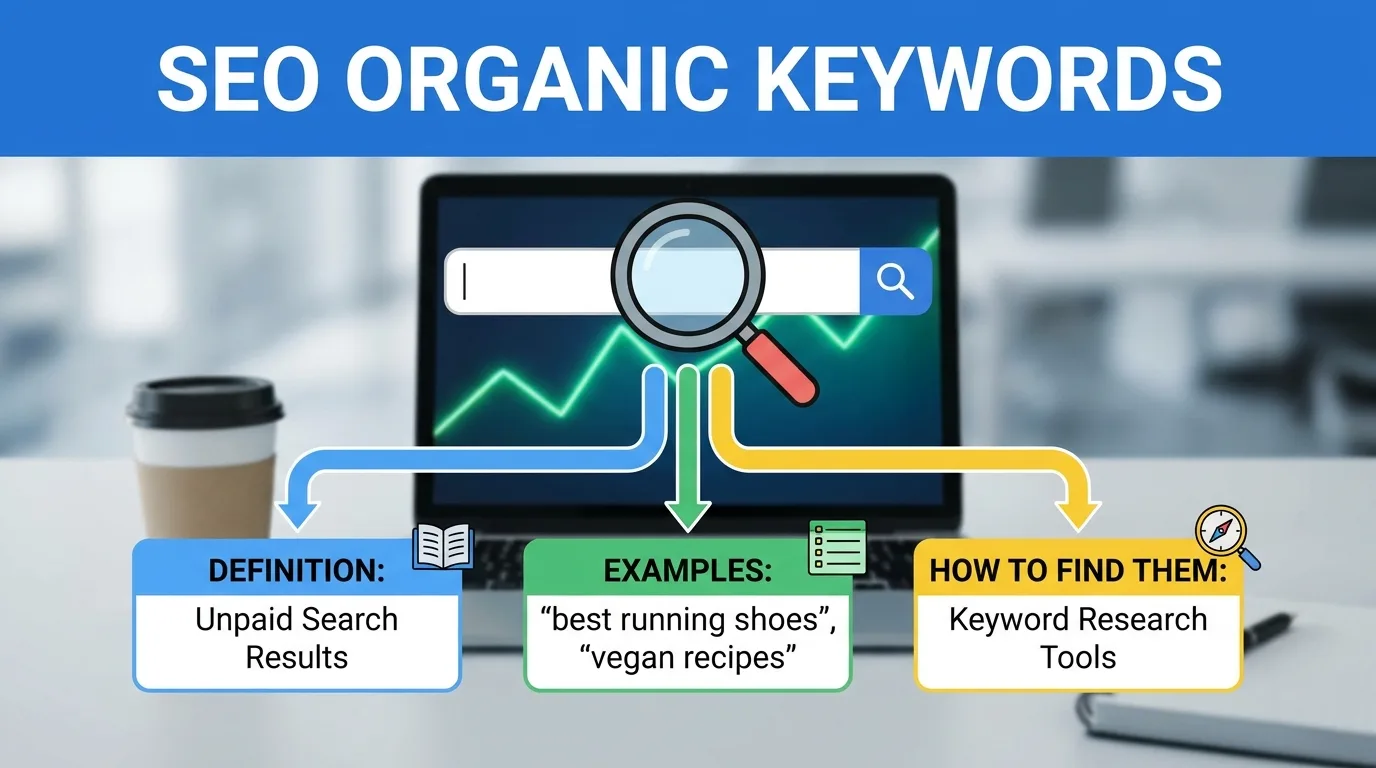
Organic keywords are unpaid search queries that generate visibility, clicks, and traffic from non-sponsored search engine results. In SEO, they represent the terms users enter into Google or other search engines that a page ranks for organically, based on relevance, quality, authority, and intent alignment rather than advertising spend.12
Executive Answer: What Are Organic Keywords?
Why This Definition Matters for GEO and AI Overviews
Organic keywords matter because modern search visibility extends far beyond classic blue-link SERPs. Search engines and answer engines retrieve pages, passages, and entities that best satisfy intent, then surface them in organic listings, AI summaries, and citation layers. In that environment, keyword relevance is inseparable from semantic coverage, entity clarity, and page usefulness.13
For GEO, organic keywords act as retrieval triggers. They help search systems understand which document should be associated with a concept, problem, product, or comparison. A page that ranks for high-value organic search keywords often demonstrates topical authority, intent match, and structured relevance signals that also improve eligibility for AI-generated answers and synthesized overviews.24
Organic Keywords Definition in SEO
What do you mean by organic keywords?
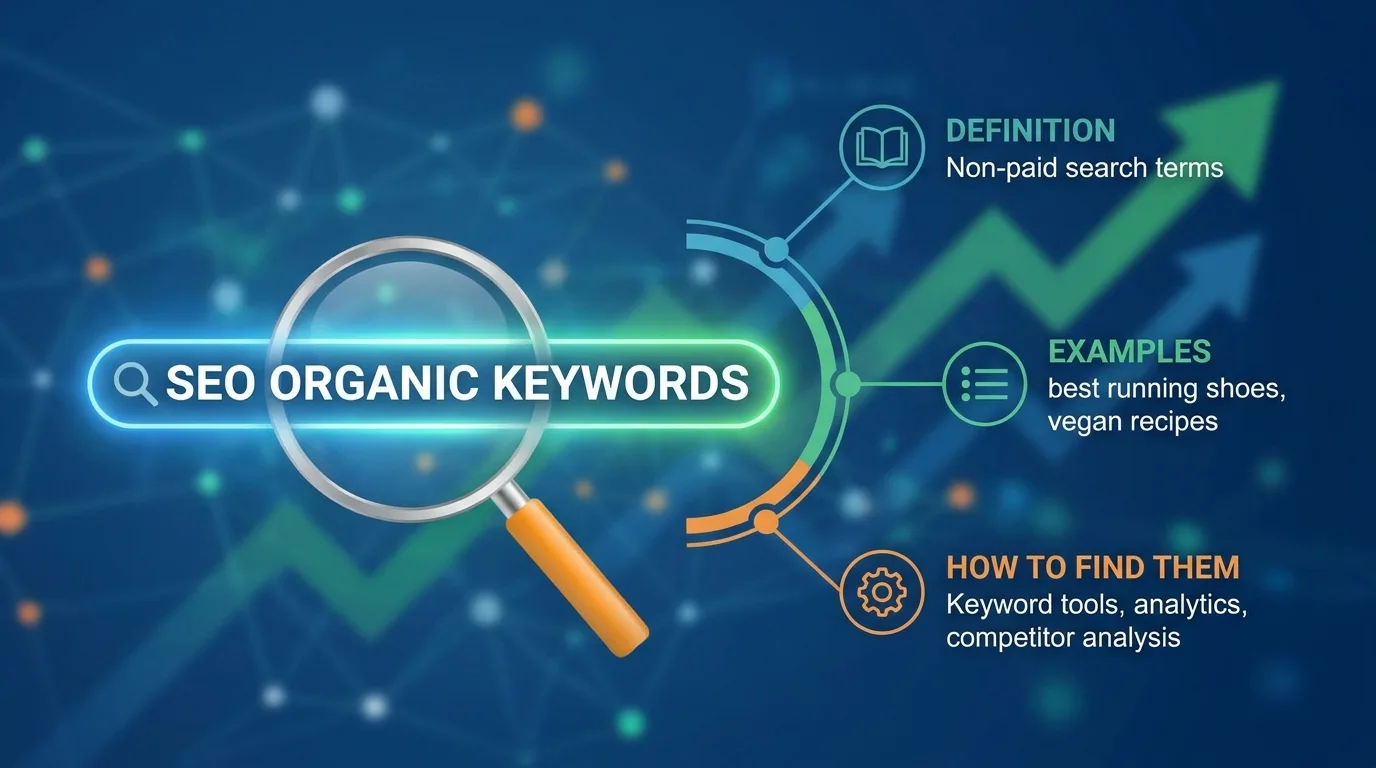
The formal organic keywords definition is straightforward: organic keywords are the search queries for which a website or webpage appears in unpaid search results. These queries can produce impressions, rankings, clicks, and sessions without direct media spend. In practice, “what are organic keywords,” “seo organic keywords,” and “organic search keywords” all refer to the same core concept: non-paid query visibility earned through SEO.12
An organic keyword may be informational, navigational, commercial, or transactional. For example, a software company might rank organically for “crm migration checklist,” while an ecommerce store might rank for “best wireless mechanical keyboard.” These are organic keywords because the visibility comes from indexing and ranking, not paid placement.
How organic search keywords differ from paid keywords
Paid keywords are bidding targets in platforms such as Google Ads. Organic keywords are discovered through search console data, rank tracking, and analytics attribution. Paid visibility depends on auction dynamics, bid strategy, and ad quality; organic visibility depends on crawlability, indexation, content relevance, authority, internal linking, and user-value signals.25
Why ‘organic’ refers to unpaid search visibility
“Organic” means the click was not purchased. The page earned placement in the non-sponsored results because the search engine judged it relevant to the query. That relationship connects five core SEO elements: query, indexed page, ranking position, click-through opportunity, and landing-page engagement. This is why organic keyword analysis is foundational to acquisition measurement, content strategy, and non-paid growth forecasting.
“Google’s automated ranking systems are designed to present helpful, reliable information that’s primarily created to benefit people, not to gain search engine rankings.” — Google Search Central1
How Organic Keywords Work in Search Engines
Query processing, indexing, and ranking signals
When a user submits a query, the search engine parses language, identifies intent, expands semantic meaning, and retrieves candidate documents from its index. Those documents are then ranked using relevance, quality, freshness, link-based authority, usability, and contextual signals.25 Organic keywords therefore work both as exact strings and as query patterns connected to indexed documents and interpreted meaning.
A page can rank for hundreds or thousands of keyword variants because search engines evaluate topical breadth, entity relationships, and passage-level relevance. This is why a single guide may rank for “organic keywords definition,” “what do you mean by organic keywords,” and “organic keywords example” simultaneously.
Search intent, entities, and topical relevance
Modern retrieval systems map keywords to entities, attributes, and tasks. A query such as “top organic keywords” may imply competitive analysis, while “organic serp ranking” implies position tracking and performance measurement. Search engines use these intent signals to decide whether to surface definitions, lists, tools, comparisons, or transactional pages.34
In generative search, answer engines often synthesize from content that clearly defines entities, disambiguates terms, and structures relationships between concepts. A page that explains keywords, rankings, pages, and user intent in a coherent semantic graph is more retrievable than one that simply repeats phrases.
How organic SERP ranking connects keywords to pages
Organic SERP ranking is the measurable position a page holds for a given query in unpaid results. That ranking determines impression share, click potential, and downstream traffic. Strong rankings emerge when the page’s content architecture matches the query class, the page is indexable, and the domain demonstrates authority within the topic cluster.
Audit non-paid query visibility and connect rankings to business outcomes. Map impressions, clicks, landing pages, and engagement using Google Analytics Organic Search to identify where your site already earns discoverability and where content expansion can unlock additional demand.
Organic Keywords vs Paid Keywords vs Topics
Keyword targeting versus topic authority
A keyword is a search query or query pattern. A topic is a broader subject area. A page theme is the angle or intent-specific framing of that topic. Modern SEO doesn’t treat keywords as isolated exact-match targets; it treats them as entry points into broader semantic coverage. Ranking consistently now requires topic authority, internal linking, and entity completeness, not just phrase repetition.13
Organic traffic economics versus PPC spend
Organic traffic compounds over time because rankings can continue generating clicks without incremental per-click cost. Paid traffic stops when spend stops. However, organic acquisition usually requires longer lead time, stronger content operations, and technical SEO discipline. Businesses comparing channels often evaluate organic keywords for durability and paid keywords for immediate demand capture. Teams investing in B2B SEO Services commonly prioritize this balance across pipeline stages.
When a keyword is a query, an entity, or a page theme
A keyword can function in three ways:
- as a literal query typed by a user,
- as an entity reference tied to a known concept,
- as a page theme that organizes content around intent.
That distinction matters when evaluating Organic Positions and broader Organic Search Visibility. A page may not rank for one exact phrase yet still capture substantial visibility across semantically adjacent queries.
| Dimension | Organic Keywords | Paid Keywords | Topic Clusters | Branded Queries |
|---|---|---|---|---|
| Acquisition model | Unpaid search visibility | Auction-based ad placement | Content architecture for semantic coverage | Searches containing a brand name |
| Cost structure | No direct CPC; requires SEO investment | Direct CPC/CPA spend | Content, research, and internal linking investment | Usually lowest acquisition friction if brand demand exists |
| Primary intent use | Informational, commercial, transactional, navigational | High-conversion or immediate demand capture | Authority building across related intents | Navigational and high-trust conversion paths |
| Measurement | Rankings, impressions, clicks, sessions, conversions | Impressions, CTR, CPC, CPA, ROAS | Cluster visibility, assisted rankings, topical coverage | Brand CTR, branded traffic, conversion rate |
| SERP placement | Non-sponsored listings, rich results, AI citation potential | Sponsored placements | Indirect; supports multiple organic placements | Organic and paid, often dominant if brand is strong |
| Time to impact | Medium to long term | Immediate once campaigns launch | Medium to long term | Depends on brand awareness maturity |
| GEO value | High, because strong organic relevance supports answer-engine retrieval | Lower direct GEO value unless ads influence discovery | Very high, because clusters improve entity and context coverage | Moderate to high if brand is recognized as an authority |
Organic Keywords Examples by Search Intent
Organic keywords are non-paid search queries that users enter into search engines, and each query expresses a distinct intent signal. Operationally, understanding “what are organic keywords” requires mapping terms to search intent, funnel stage, SERP features, and the type of page most likely to earn sustainable organic SERP ranking.
Informational organic keywords example
Informational queries indicate a learning objective. These are foundational organic search keywords for top-of-funnel discovery and answer-engine retrieval because they often trigger featured snippets, AI summaries, videos, and knowledge panels.
Examples:
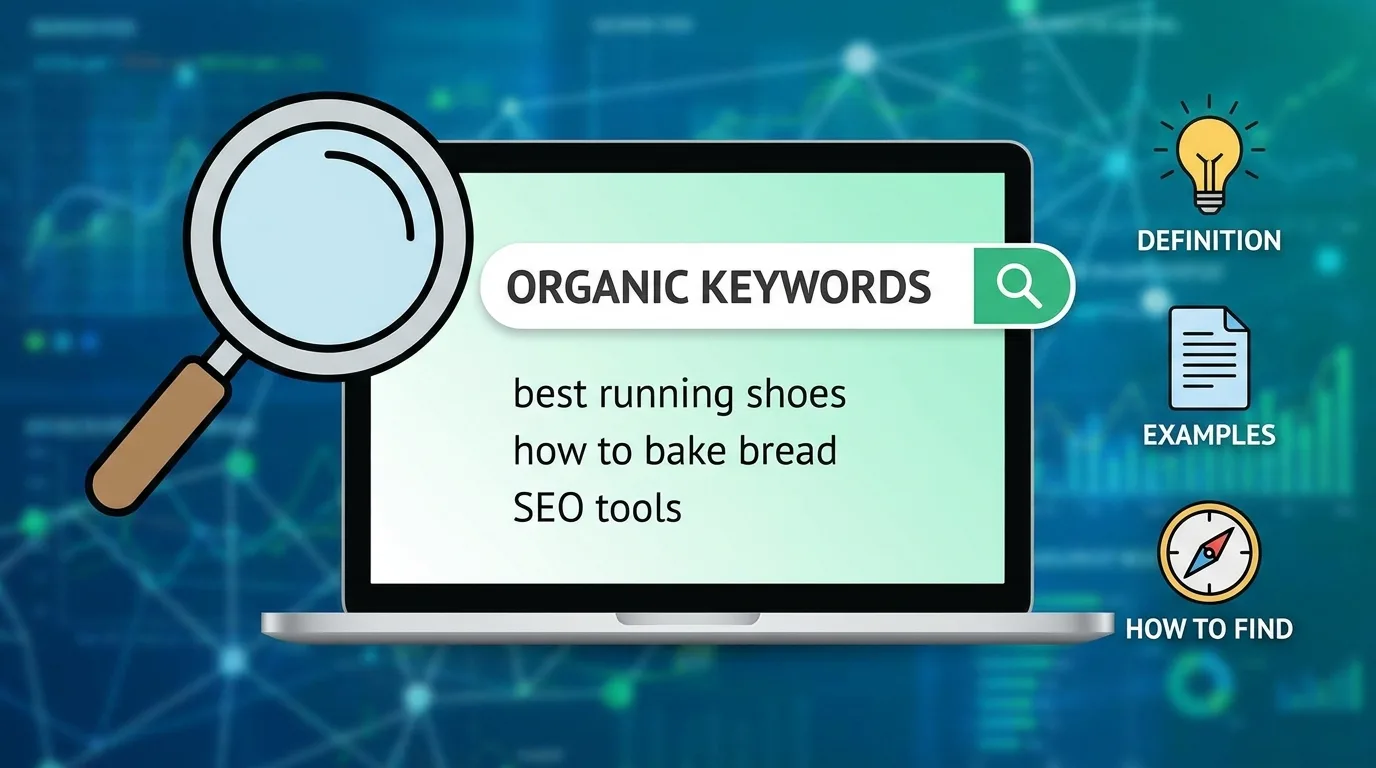
- how to bake bread
- vegan recipes
- what are organic keywords
- organic keywords definition
- what do you mean by organic keywords
- how to track organic keywords in GA4
These terms typically map to guides, tutorials, glossaries, explainers, and FAQ sections. For example, vegan recipes is broad and competitive, while how to bake bread without yeast is narrower, more intent-specific, and often easier to rank for. Informational coverage also supports entity depth, which strengthens retrieval across AI-generated answers and semantic search systems (Google Search Central, 2025)24.
Commercial and transactional keyword examples
Commercial investigation queries compare options before purchase, while transactional queries signal readiness to act. These seo organic keywords often drive higher conversion value than purely informational traffic.
Examples:
- best running shoes
- best SEO tools
- SEO tools pricing
- buy trail running shoes online
- enterprise SEO platform comparison
- best CRM for B2B SaaS
Commercial terms usually map to comparison pages, category pages, review content, and solution pages. Transactional terms map to product, service, demo, or pricing pages. If a business wants stronger pipeline impact, these are often the top organic keywords to prioritize after foundational informational coverage.
Navigational and branded query examples
Navigational queries are used to reach a specific brand, product, or destination. They are critical for demand capture, reputation control, and branded SERP ownership.
Examples:
- Google Analytics organic search
- Ahrefs keyword explorer
- Semrush login
- theramadhani B2B SEO Services
- Organic Positions guide
These keywords usually map to homepage, product, login, brand documentation, or authoritative resource pages such as Google Analytics Organic Search, B2B SEO Services, and Organic Positions.
Short-tail, long-tail, and question-based examples
A practical organic keywords example set should also distinguish query structure:
| Keyword type | Example | Intent pattern | Typical page type |
|---|---|---|---|
| Short-tail | SEO tools | Broad, mixed intent | Category or comparison page |
| Long-tail | best SEO tools for small agencies | Refined commercial intent | Buyer guide |
| Question-based | how do you find organic search keywords | Informational, solution-seeking | Tutorial or glossary |
| Branded long-tail | Google Analytics organic search report GA4 | Navigational + informational | Product-specific guide |
Why Top Organic Keywords Matter for Traffic, Visibility, and AI Answers
Top organic keywords as a proxy for discoverability
Top organic keywords are the queries for which a site earns its strongest rankings, impressions, and click opportunity. They function as a discoverability proxy because they reveal where a domain is already relevant in search systems. Strong performance across high-value terms usually correlates with broader Organic Search Visibility, topical authority, and crawl prioritization signals.12
How rankings influence clicks, impressions, and citations
Ranking position determines exposure, but keyword value extends beyond rank alone. A page ranking in positions 1-5 for a commercially relevant term can generate disproportionate impressions, clicks, assisted conversions, and downstream brand searches. In AI-mediated search, visible pages are also more likely to be retrieved, summarized, or cited when they provide clear topical coverage, accurate entity relationships, and structured answers.4
This makes organic SERP ranking a compound asset:
- higher rankings increase click opportunity
- more impressions reinforce query-page relevance
- stronger relevance improves eligibility for snippets and synthesized answers
- repeated visibility builds brand familiarity and navigational demand
Why answer engines prefer clear, entity-rich coverage
Generative systems don’t evaluate keywords as isolated strings; they retrieve passages, entities, relationships, and supporting context. Pages that cover a topic cluster comprehensively are more likely to satisfy both traditional ranking systems and answer-engine retrieval pipelines.
“The effectiveness of information retrieval depends heavily on how well content representations align with the user’s underlying information need.” — Information Retrieval & Semantic Search Architecture Principles
Day to day, that means a page targeting seo organic keywords should also cover adjacent entities such as search intent, SERP features, ranking signals, analytics, topical clusters, and query refinement. This is why keyword work should be tied to page architecture, schema, and semantic completeness rather than simple term frequency.
How to Find Organic Keywords: A Practical Research Workflow
Start with seed terms and entity mapping
Begin with seed topics directly tied to products, services, categories, and recurring customer questions. For “what are organic keywords”, relevant seeds include:
- organic keywords
- organic search keywords
- keyword tracking
- SEO rankings
- search intent
- SERP analysis
Then expand each seed into entity and modifier sets:
- definitions: meaning, definition, examples
- actions: find, track, analyze, improve
- qualifiers: best, top, free, enterprise, local
- contexts: GA4, Search Console, B2B, ecommerce
This converts isolated terms into topic clusters that better reflect how search systems interpret relevance.23
Use Google Search Console, keyword tools, and SERP analysis
Google Search Console is the primary first-party source for discovering actual queries already generating impressions and clicks. Review:
- high-impression, low-CTR queries
- position 5-20 terms with optimization upside
- pages ranking for unintended but valuable variants
- query patterns by device, country, and page type
Keyword platforms then extend discovery with estimated volume, difficulty, parent topics, and competitor overlap. SERP analysis validates whether the query is informational, commercial, local, or mixed. This step is essential because many seo organic keywords have ambiguous intent despite similar wording.
For performance interpretation, pair Search Console with Google Analytics Organic Search to connect landing-page traffic with engagement and conversion outcomes.
Mine analytics, site search, and competitor gaps
Beyond external tools, internal behavior data often reveals high-intent opportunities:
- on-site search logs
- sales-call transcripts
- support tickets
- CRM notes
- paid search query reports
- competitor title tags and content hubs
Competitor gap analysis identifies terms where peers rank but your domain lacks coverage. This is especially useful for mid-funnel and bottom-funnel queries that may not emerge from brainstorming alone.
Prioritize by intent, difficulty, business value, and freshness
A practical scoring model should weight four variables:
| Factor | What to assess | Why it matters |
|---|---|---|
| Intent fit | Does the query match the page and funnel stage? | Prevents mismatched targeting |
| Ranking feasibility | Authority, SERP competition, content quality threshold | Improves win probability |
| Business value | Revenue potential, lead quality, strategic relevance | Aligns SEO with outcomes |
| Freshness need | Does the SERP reward recent or updated content? | Protects ranking durability |
This workflow moves keyword research from volume chasing to retrieval-ready planning. It also supports cluster development, page mapping, and stronger Organic Positions across the funnel.
Need a scalable keyword discovery and prioritization framework for complex funnels? Explore B2B SEO Services: The Complete Strategy for Enterprise Pipeline and Organic Growth.
How to Evaluate and Prioritize SEO Organic Keywords
Volume, difficulty, intent, and conversion potential
Effective keyword evaluation balances demand with achievability. Search volume indicates opportunity size, but it is incomplete without SERP difficulty, intent clarity, and conversion likelihood. A 300-volume transactional term can be more valuable than a 10,000-volume informational term if it aligns with pipeline or revenue objectives.
Business relevance and topical authority fit
Prioritize keywords that fit existing expertise, product scope, and domain authority. If a site has established relevance around analytics, measurement, and SEO operations, it is more likely to rank for adjacent terms than unrelated high-volume topics. This improves topical coherence and supports broader Organic Search Visibility.
Keyword clusters, parent topics, and page mapping
Move from keyword lists to page architecture by grouping semantically related queries into clusters. Each cluster should map to one primary page type:
- glossary page for organic keywords definition
- tutorial for how to find organic search keywords
- comparison page for best SEO tools
- service page for enterprise search strategy terms
A simple prioritization framework is:
| Dimension | High-priority signal |
|---|---|
| Demand | Meaningful impressions or qualified search volume |
| Feasibility | Weak or moderate SERP competition relative to your authority |
| Intent | Clear alignment with user need and page format |
| Value | Strong conversion, influence, or brand impact |
| Cluster fit | Supports a broader topical hub |
This is how “what are organic keywords” evolves from a definitional query into a scalable SEO and GEO content system.
Measuring Organic Keyword Performance
Organic keyword performance is measured by connecting query-level demand signals to page-level business outcomes. Rankings indicate position, impressions show eligibility, clicks and CTR reveal SERP competitiveness, and landing page engagement plus conversions confirm whether traffic from organic search keywords produces measurable commercial value.
Rankings, impressions, clicks, and CTR
A practical organic keywords definition must include measurement, not just discovery. In SEO, a keyword only becomes strategically useful when it is tied to ranking movement, SERP exposure, and traffic yield. Query-level reporting should track:
- Average position or rank distribution by keyword cluster
- Impressions as a proxy for search visibility and index eligibility
- Clicks as confirmed demand capture
- CTR as the interaction rate between ranking presence and user choice
Why? Because a keyword can rank without generating meaningful traffic, or generate impressions without producing clicks if the SERP is dominated by ads, AI summaries, local packs, or rich results (Google Search Central, 2025). That is why seo organic keywords should be evaluated in context, not in isolation.
For operational reporting, segment top organic keywords into:
- High-impression / low-CTR terms
- Mid-ranking terms with expansion potential
- High-conversion long-tail terms
- Declining query patterns requiring refreshes
Google Search Console and Google Analytics Organic Search should be used together: Search Console explains query acquisition, while GA4 validates post-click behavior and conversion contribution.
Organic positions versus visibility share
Rank isn’t the same as visibility. A position-3 ranking for a low-volume query may matter less than position-8 for a high-value commercial term with strong click potential. This is why organic serp ranking should be paired with visibility-weighted metrics such as share of impressions, estimated click opportunity, and page-one keyword coverage.
| Metric | What it measures | Limitation | Strategic use |
|---|---|---|---|
| Average position | Mean ranking location | Can hide volatility | Trend monitoring |
| Impressions | Query exposure | Not equal to traffic | Demand and eligibility analysis |
| CTR | Click efficiency | Influenced by SERP features | Snippet and intent optimization |
| Visibility share | Relative search presence across tracked terms | Requires modeling | Portfolio prioritization |
For deeper rank tracking methodology, align keyword reporting with Organic Positions and broader Organic Search Visibility.
Landing page performance and assisted conversions
Keyword-level performance answers which query attracted the visit. Page-level performance answers whether the visit created value. This directly shapes “what do you mean by organic keywords” in a business context.
A landing page should be evaluated using:
- Engagement rate
- Scroll depth or content interaction
- Conversion rate
- Assisted conversions across multi-touch journeys
- Revenue or lead quality by organic entry page
An organic keywords example illustrates the difference: a query such as “enterprise crm migration checklist” may have modest volume, but if the landing page drives qualified demo requests, it outperforms a broader informational term with higher traffic and weaker commercial outcomes. This is especially important for complex funnels and B2B SEO Services, where assisted influence often exceeds last-click attribution.12
Common Mistakes When Targeting Organic Search Keywords
Confusing keywords with topics or pages
One of the most common failures in “what are organic keywords” strategy is collapsing three different layers into one: keyword, topic, and URL. A keyword is a query expression, a topic is a semantic cluster, and a page is the asset designed to satisfy intent. When teams map multiple pages to the same query set without differentiation, they create internal competition and cannibalization.3
How to fix it:
- Build one primary intent target per page
- Cluster semantically adjacent terms under a single content asset
- Differentiate overlapping URLs by audience, funnel stage, or use case
Ignoring search intent and SERP format
A keyword with strong volume isn’t automatically a good target. If the SERP is dominated by videos, product grids, AI-generated overviews, documentation, or local intent, a standard article may be structurally unfit to rank. This is where many misunderstand organic search keywords: they optimize text while ignoring result format.
To prevent ranking drops:
- Classifying intent as informational, navigational, commercial, or transactional
- Auditing live SERP features before content creation
- Matching content structure to retrieval patterns and answer synthesis behavior46
Overvaluing volume and undervaluing relevance
High-volume terms frequently attract vanity reporting and weak conversion economics. The better approach is to prioritize relevance, authority fit, and business proximity. Many top organic keywords aren’t the biggest terms; they are the highest-leverage queries with realistic ranking potential and measurable downstream value.
Failing to update content as query patterns evolve
Search demand is dynamic. Terminology shifts, SERP layouts change, and Google’s ranking systems continuously refine relevance evaluation.12 Pages that once ranked for seo organic keywords can decay when examples, statistics, schema, or entity coverage become outdated.
How to fix it:
- Revalidate query mappings quarterly
- Refresh titles, headings, and evidence
- Expand content where new sub-intents emerge
- Monitor AI answer surfaces and citation patterns
References, Citations, and Strategic Next Steps
-
Google Search Central for crawling, ranking, helpful content, and search systems guidance123
-
Google documentation on AI-powered search experiences for synthesized answer environments and evolving result presentation4
-
Google Ads and ranking system documentation for distinguishing auction-based paid visibility from organic ranking logic5
-
IEEE and arXiv research for semantic retrieval, query-document matching, and passage-level relevance modeling6
-
W3C standards for structured data, metadata, and machine-readable content architecture
-
Ranking systems
-
Search intent classification
-
CTR interpretation
-
SERP feature effects
-
Semantic retrieval and passage relevance
-
AI-generated answer synthesis
This strengthens GEO credibility because authoritative citations improve factual precision, entity grounding, and answer trustworthiness.
Implementation checklist for ongoing keyword discovery
The execution path is sequential:
- Define the organic keywords definition in business terms: queries that generate unpaid search visibility and measurable outcomes.
- Discover query opportunities from Search Console, competitor gap analysis, and SERP observation.
- Prioritize by relevance, intent fit, ranking difficulty, and conversion value.
- Map keyword clusters to the correct landing pages.
- Measure rankings, impressions, CTR, engagement, and assisted conversions.
- Refine content as query patterns, SERP features, and AI answer environments change.
Turn keyword research into measurable ranking growth. Review Organic Search Visibility and build a visibility-focused roadmap that connects keyword targeting, SERP share, and conversion outcomes.
References & Authoritative Sources
- Google Search Central. Search documentation and ranking systems guidance.
- IEEE Xplore. Research publications on information retrieval, ranking models, and semantic search systems.
- arXiv. Scholarly papers on neural retrieval, passage ranking, and query understanding.
- W3C. Web standards for structured data, metadata, and interoperable machine-readable content.
- Gartner. Research frameworks for digital visibility, search behavior, and content operations maturity where applicable.
Footnotes
-
Google Search Central. “Creating helpful, reliable, people-first content.” ↩ ↩2 ↩3 ↩4 ↩5 ↩6 ↩7 ↩8 ↩9
-
Google Search Central. “How Search works.” ↩ ↩2 ↩3 ↩4 ↩5 ↩6 ↩7 ↩8 ↩9 ↩10 ↩11
-
Google Search Central, 2025. Guidance on search intent, relevance, and content quality systems. ↩ ↩2 ↩3 ↩4 ↩5 ↩6
-
Google. Documentation and public guidance on AI-powered search experiences and synthesized result generation. ↩ ↩2 ↩3 ↩4 ↩5 ↩6
-
Google Ads Help and Google Search ranking documentation on auction dynamics versus organic ranking systems. ↩ ↩2 ↩3
-
Established information retrieval research across IEEE and arXiv literature on semantic relevance, query-document matching, and passage retrieval. ↩ ↩2
Frequently Asked Questions & Citations
Organic keywords are the search queries that a website ranks for in unpaid search engine results. They generate impressions, clicks, and traffic without ad spend, based on factors such as relevance, crawlability, content quality, authority, and intent match.
Organic keywords produce visibility through indexed content and ranking signals, while paid keywords are targeted through ad auctions such as Google Ads. Paid performance depends on bids, quality score, and budget, whereas organic performance depends on SEO fundamentals like content depth, internal linking, backlinks, and technical health.
Use Google Search Console to review queries, impressions, clicks, average position, and CTR for indexed pages. You can also combine Search Console with rank tracking tools and web analytics to identify keywords that drive the most qualified traffic, conversions, and visibility growth.
Organic keywords act as retrieval signals that help search systems connect a page to a topic, entity, or user problem. Strong keyword coverage, semantic relevance, and clear intent alignment can improve eligibility for organic rankings, featured results, and AI-generated summaries that cite authoritative pages.
An organic keyword example is a query like "crm migration checklist" if a software company ranks for it in standard search results without paying for ads. If that ranking earns impressions and clicks from the non-sponsored listings, the query qualifies as an organic keyword for that page.
Start by mapping each target keyword to a page that matches the dominant search intent, then strengthen on-page signals with precise headings, entity-rich copy, internal links, and structured metadata. Support that with technical SEO, backlink acquisition, and regular content updates to improve rankings, CTR, and engagement over time.
Digital Marketing Specialist in Technical SEO, Generative Engine Optimization (GEO), and paid search acquisition.
Related Technical Guides & Frameworks
Natural Search Definition: What It Means for SEO
Learn the natural search definition, how unpaid rankings work, and how SEO improves crawlability, relevance, authority, and organic visibility.
Organic SEO Fundamentals: How Organic Search Works
Learn organic SEO fundamentals, how organic search works, and how to improve rankings with crawlability, relevance, authority, and UX.
Organic vs Paid Search: Key Differences Explained
Compare organic vs paid search by cost, speed, trust, CAC, and long-term ROI. Learn when SEO, PPC, or a blended strategy wins.
Organic SEO Marketing: Long-Term Success Metrics
Learn what defines long-term organic SEO marketing success: qualified traffic growth, durable rankings, stronger engagement, clean indexation, and conversions.