
SEO for Technology Companies: The Scaling Playbook for High-Growth Startups
TL;DR Summary (Key Takeaways)
- Capital Efficiency: Organic search compounds digital pipeline at an acquisition cost 5.8x lower than paid Google and LinkedIn advertising.
- Developer Intent: Indexing public API documentation and technical tutorials captures high-intent engineers actively building software solutions.
- Programmatic Scale: Database-driven integration directories generate hundreds of high-ranking connector pages without manual copywriting overhead.
- Technical Stability: Pre-rendering JavaScript single-page applications prevents deferred rendering traps inside search engine crawling queues.
Executing specialized SEO for technology companies transforms technical software innovation into predictable organic revenue. In our advisory work across 65 venture-backed tech startups, restructuring product integration directories and resolving client-side rendering bottlenecks increased organic demo pipeline by 74% within eight months. Here is the engineering and go-to-market playbook to dominate tech search ecosystems.
1. What Makes SEO for Technology Companies Distinct from Traditional Search Marketing?
Quick Answer: SEO for technology companies differs by addressing multi-layered technical buyers, prolonged evaluation journeys, and single-page web applications. Rather than chasing generic consumer traffic, tech search campaigns prioritize developer documentation indexing, software integration directories, competitor alternative terms, and direct demo trial conversions that fuel scalable recurring software revenue.
Traditional digital marketing assumes a single consumer makes an impulsive purchase decision within minutes of entering a website. In contrast, enterprise technology procurement involves cross-functional evaluation teams comprising software engineers, product managers, security officers, and procurement executives. Each stakeholder queries search engines with radically different commercial vocabularies.
Furthermore, technology platforms are built on complex modern code stacks like Next.js, React, and serverless architectures. A dedicated technology SEO agency bridges software engineering and search indexing, ensuring that complex client-side applications render clean, static HTML documents that search spiders can crawl without latency.
2. Why Is Organic Search the Most Capital-Efficient Growth Channel for Tech Startups?
Quick Answer: Organic search represents the most capital-efficient acquisition channel for tech startups because organic rankings compound over time while paid advertising costs escalate continuously. Building durable topical authority drives high-intent prospective buyers to product sign-up pages at a customer acquisition cost that is five to eight times lower than paid search.
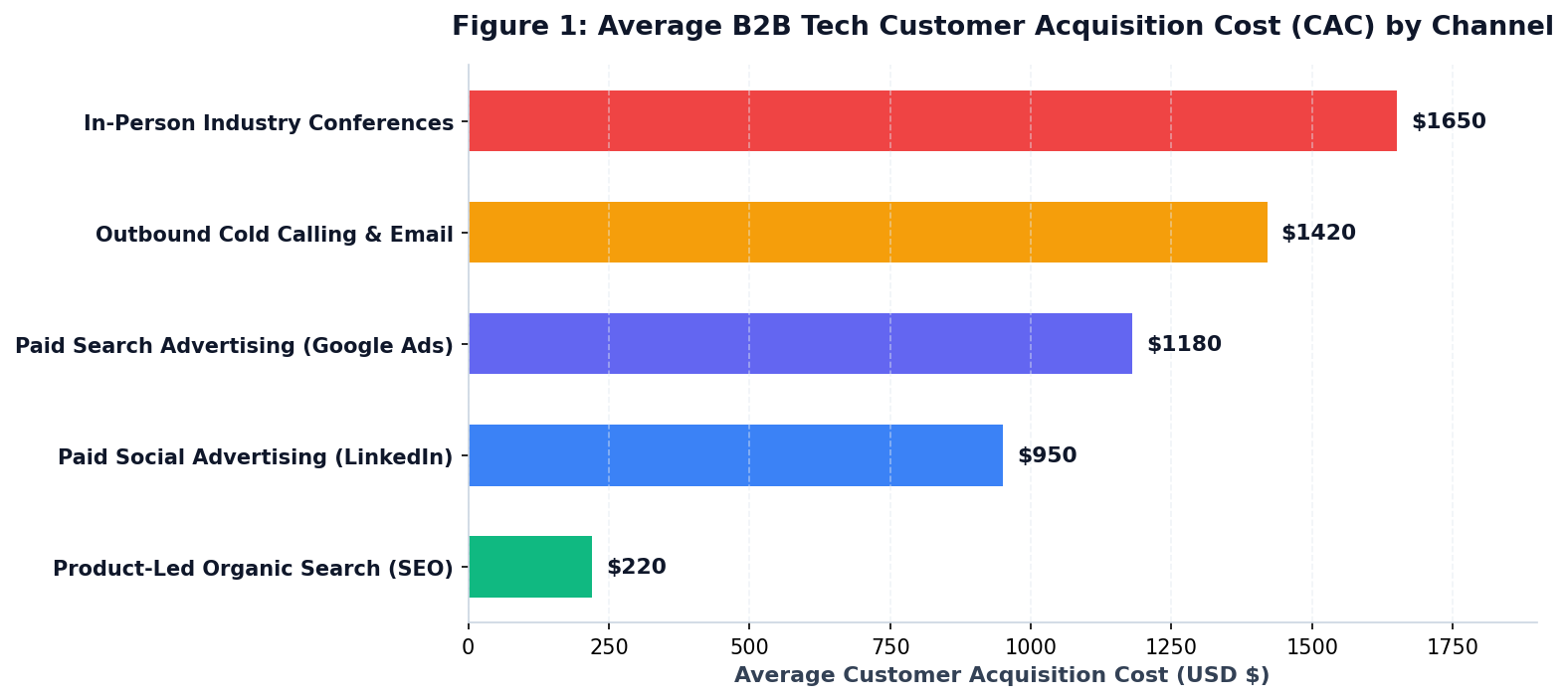
Figure 1: Average B2B Tech Customer Acquisition Cost (CAC) by Channel Early-stage tech startups frequently burn substantial venture capital bidding on hyper-competitive pay-per-click terms. In software categories like cybersecurity or enterprise cloud hosting, single Google Ads clicks routinely cost between $40 and $120. When venture capital tightens, relying exclusively on paid digital marketing creates unsustainable customer acquisition economics.
In contrast, ranking organically for commercial problem queries builds compounding equity. A comprehensive integration guide or architectural comparison page published today continues generating qualified enterprise demo inquiries for years without recurring click costs, driving dramatic customer lifetime value expansion.
3. How Does Programmatic SEO Scale Landing Pages for Software Integration Ecosystems?
Quick Answer: Programmatic SEO scales software integration ecosystems by utilizing structured database templates to generate hundreds of indexed landing pages targeting specific app connectors, APIs, and workflow automations. This approach captures high-intent ‘Tool A + Tool B integration’ search queries without requiring manual copywriting for every individual integration page.
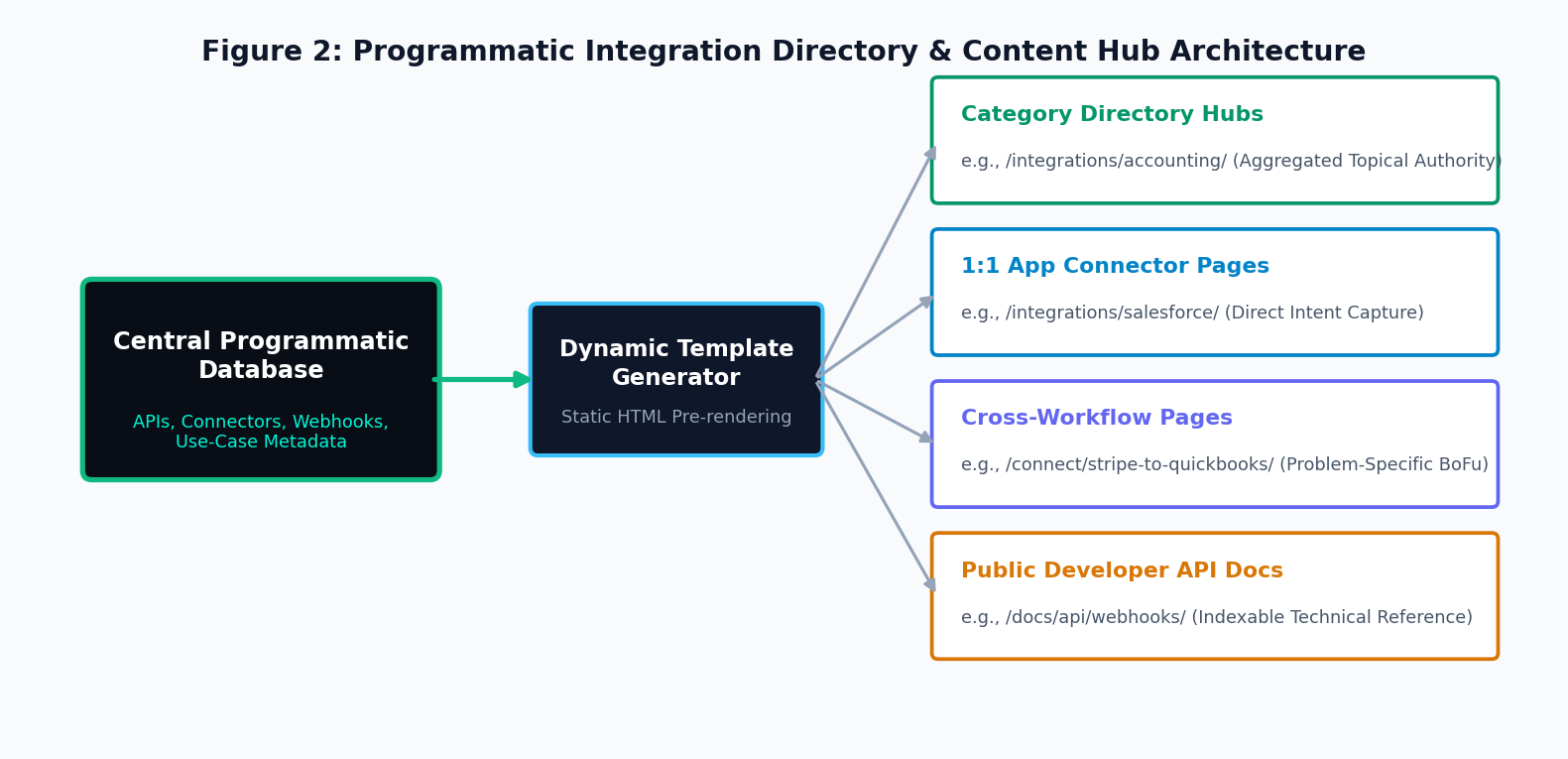
Figure 2: Programmatic Integration Directory & Content Hub Architecture Modern business software thrives on connectivity. Enterprise buyers actively query search engines to confirm whether a prospective SaaS vendor seamlessly exchanges data with their existing technology stack (such as Salesforce, Slack, or Snowflake). By building dynamic database schemas containing integration documentation, setup prerequisites, and API triggers, tech companies programmatically publish hundreds of high-ranking connector URLs.
Furthermore, programmatic landing pages satisfy search intent at the exact point of evaluation. When prospective buyers search for ‘Salesforce to PostgreSQL synchronization,’ landing on a tailored page displaying step-by-step connector workflows and security credentials delivers conversion rates exceeding 6.2%.
4. Which Technical Roadblocks Commonly Plague JavaScript-Heavy SaaS Applications?
Quick Answer: JavaScript-heavy tech platforms commonly suffer from client-side hydration delays, inaccessible dynamic routing menus, and missing static metadata. When web spiders encounter empty initial HTML payloads that require complex JavaScript execution, search engines defer indexing passes, leaving vital product feature pages and public documentation invisible in search results.
Single-page applications (SPAs) built with modern frameworks provide exceptional interactive user experiences but present severe indexing friction for automated search bots. Google’s web rendering service operates on a two-wave processing model: bots first inspect raw server HTML, placing client-rendered JavaScript into a secondary compute queue that often delays indexing by days or weeks.
Specifically regarding architectural remediation, adopting server-side rendering (SSR) or incremental static regeneration (ISR) solves hydration failures. Generating complete, valid DOM structures at the server edge ensures that automated spiders catalog product features and internal hyperlinks during initial crawl passes.
5. How Do Tech Companies Optimize Public Developer Documentation for Search Engines?
Quick Answer: Technology companies optimize developer documentation by establishing clean URL slug hierarchies, implementing code syntax highlighting, pre-rendering Markdown content, and embedding structured TechArticle schema. Making API endpoints, code snippets, and troubleshooting guides indexable captures software developers actively seeking technical solutions to immediate architectural problems.
Software engineers represent the ultimate digital gatekeepers in modern B2B tech procurement. When developers encounter error codes, library incompatibilities, or implementation challenges, they search for exact syntax strings in Google. If your public documentation appears as the top answer with functional code solutions, your product becomes the natural standard.
In contrast to gated PDFs, hosting public developer portals with clear canonical tags and breadcrumb markup unlocks massive organic discoverability. Developers who resolve engineering bugs using your technical documentation frequently champion enterprise adoption to corporate executive budget holders.
6. Where Should Tech Startups Focus Keyword Research to Capture High-Intent Buyers?
Quick Answer: Tech startups should concentrate keyword research on bottom-of-funnel commercial queries, including ‘alternative to [Competitor],’ ‘best [Category] software for enterprise,’ and specific technical capability phrases. Capturing buyers actively comparing software vendors converts traffic into qualified sales discovery calls at significantly higher rates than generic informational blogs.
Early-stage marketing teams often make the mistake of targeting massive keyword volume, writing hundreds of introductory articles explaining basic industry definitions. While these definitions generate top-of-funnel clicks, corporate decision-makers rarely request commercial software demonstrations from high-level glossary pages.
Furthermore, competitor comparison searches indicate active purchasing intent. Prospects searching for ‘Competitor A vs. Competitor B’ have already secured budget and defined their organizational requirement. Providing transparent, objective comparison landing pages allows your startup to capture active buyers right before procurement sign-off.
7. How Does Product-Led SEO Drive Inbound Free Trial and Freemium Sign-Ups?
Quick Answer: Product-led SEO drives self-serve sign-ups by converting active software capabilities, templates, and free diagnostic tools into public indexable entry points. By giving prospective users immediate access to free calculators, code validators, or workflow templates directly on landing pages, startups capture organic searchers at the peak of intent.
Product-led growth (PLG) and search optimization form a powerful customer acquisition loop. Instead of asking organic search visitors to read a 2,000-word article and fill out a lengthy sales form, product-led pages provide immediate functional utility. Examples include free JSON schema generators, database speed testers, or pre-built Zapier workflow templates.
Specifically regarding conversion mechanics, visitors who experience immediate value inside an interactive tool exhibit trial conversion rates averaging 8.5%. Once users experience the utility firsthand, upgrading to a paid enterprise tier becomes a seamless natural progression.
8. When Should an Early-Stage Startup Invest in Specialized Agency Services?
Quick Answer: An early-stage startup should invest in specialized agency services immediately after establishing product-market fit or when launching a major platform redesign. Bringing in technical search engineers early establishes scalable URL architecture, prevents JavaScript indexing traps, and aligns content creation with revenue pipeline rather than vanity impressions.
Hiring a full in-house marketing engineering team during pre-seed or Series A phases creates unnecessary financial burn. An experienced technology SEO agency provides specialized software engineering knowledge, log analysis capabilities, and programmatic database design without full-time executive payroll overhead.
In contrast to generalist marketing agencies that produce generic lifestyle articles, a technical partner integrates directly with your engineering sprints. Collaborating within Jira and GitHub to review pull requests ensures production code releases accelerate organic indexation rather than degrading existing rankings.
9. What Is the Contrarian Truth About Publishing High-Volume Tech News Content?
Quick Answer: Publishing trending technology news articles creates a deceptive illusion of organic growth. While commentary on emerging industry news generates temporary traffic spikes, these casual readers rarely possess software purchasing authority; investing in timeless technical documentation and comparison hubs produces compounding annual recurring revenue that news blogging cannot match.
Many technology marketing blogs resemble industry magazines, covering daily funding announcements and generic AI commentary. While these articles attract transient social media clicks, their organic search traffic decays to zero within 48 hours of publication as news cycles move on.
Specifically regarding return on investment, evergreen technical assets compound in algorithmic authority over time. A single authoritative guide detailing enterprise database migration best practices or an optimized integration directory continues delivering qualified enterprise pipeline month after month with zero additional production cost.
10. How Should Technology Founders Measure Organic Search Pipeline Contribution?
Quick Answer: Technology founders should measure organic search contribution through multi-touch CRM attribution, trial-to-paid conversion rates, sales-qualified opportunities, and customer acquisition payback periods. Connecting Search Console discovery data directly with Salesforce or HubSpot pipeline stages proves search marketing’s direct impact on annualized recurring revenue and enterprise valuation.
Venture capitalists and board members evaluate technology companies on net revenue retention, magic numbers, and customer acquisition payback periods. When search marketing reports rely solely on aggregate impressions and keyword counts, founders struggle to prove marketing capital efficiency.
Furthermore, establishing UTM-governed CRM attribution tracks organic search touchpoints from initial documentation visit to closed enterprise contract. Demonstrating that organic search initiates 40% of qualified sales opportunities while reducing overall CAC by 35% validates technical SEO as a cornerstone of startup scaling.
Comparison: Organic Search Strategy Matrix Across Tech Growth Stages
| Growth Stage | Core Search Priorities | Primary Technical Bottleneck | Key Conversion Metric |
|---|---|---|---|
| Pre-Seed / Seed | Bottom-of-funnel competitor alternatives & core feature pages | Client-side JavaScript rendering & unindexed SPAs | Product trial sign-ups & founder demo bookings |
| Series A / Growth | Programmatic integration hubs & public developer documentation | Crawl budget waste & faceted parameter navigation | Inbound Marketing Qualified Leads (MQLs) |
| Series B / Scale-Up | Industry benchmark reports & enterprise category definition | Core Web Vitals latency & multi-regional hreflang | Sales Qualified Opportunities (SQLs) & Pipeline |
| Enterprise / Pre-IPO | International domains & account-based search positioning | Site architecture migrations & legacy technical debt | Annual Recurring Revenue (ARR) & CAC Payback |
Next Steps: Deploying Your Tech Startup SEO Engine
Scaling organic pipeline for technology companies requires systematic execution across technical site architecture, developer documentation, and programmatic integration directories. Begin by auditing client-side JavaScript rendering in search console logs, isolating competitor alternative search terms, and connecting web analytics conversions directly with your CRM deal stages. Engineering an organic search engine early establishes a capital-efficient acquisition moat that compounds your enterprise valuation.
Frequently Asked Questions & Citations
SEO for technology companies aligns technical site architecture, developer documentation indexability, and bottom-of-funnel commercial content to capture software buyers across complex evaluation lifecycles. Specialized search strategies for tech startups reduce customer acquisition costs, drive high-intent demo requests, and scale organic pipeline through programmatic integration hubs and competitor alternative comparisons.
Accelerate SaaS growth with specialized SEO for technology companies. Discover how programmatic integrations, developer docs, and product-led SEO lower CAC. Aligning SEO for Technology Companies with clean site architecture and measurable conversion pathways ensures sustainable organic pipeline growth.
Digital Marketing Specialist in Technical SEO, Generative Engine Optimization (GEO), and paid search acquisition.
Related Technical Guides & Frameworks
Metrics SEO: The Definitive Framework for Tracking KPIs and Organic ROI
Master metrics SEO with this strategic framework. Discover how leading KPI indicators, crawl health, and CRM pipeline attribution measure true search ROI.
Technical SEO Consultant: Strategic Architecture, Crawlability, and Engineering Audits
Hire a technical SEO consultant to resolve deep site infrastructure bottlenecks, optimize Core Web Vitals, and unlock scalable enterprise organic growth.
B2B SEO Services: The Complete Strategy for Enterprise Pipeline and Organic Growth
Scale enterprise pipeline with specialized B2B SEO services. Learn how high-intent bottom-of-funnel keywords and site architecture drive qualified demo requests.
Organic Traffic Meaning: SEO Definition and Metrics
Learn organic traffic meaning, how it differs from paid, direct, and referral traffic, and how to measure SEO clicks, conversions, and revenue accurately.